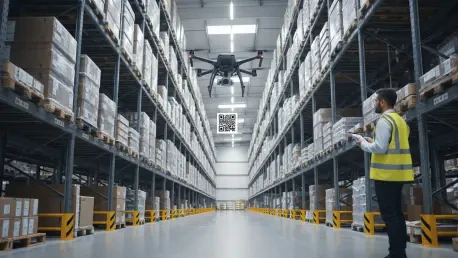

As a leading expert in Insurtech and AI-driven risk assessment, Simon Glairy has a unique vantage point on the innovations shaping our physical world. With companies like Gather AI securing major funding rounds, the conversation around “embodied AI”—intelligent systems that interact directly with their environment—has never been more relevant. We sat down with Simon to discuss the significance of their recent $40 million raise and what their “curious” approach to robotics means for the future of warehouse logistics. Our conversation explores how their foundational work in aerial autonomy translates to the warehouse floor, the strategic advantages of using classical Bayesian techniques in an era of LLMs, and the broader forecast for AI in the supply chain.
Gather AI recently secured a significant $40 million Series B from Smith Point Capital, a firm led by a prominent figure like Keith Block. From your perspective, what makes their value proposition so compelling that it would resonate almost instantly with seasoned investors, and how do you see this capital infusion shaping their immediate future in a competitive market?
It’s incredibly telling that it took Keith Block and his team only five minutes to grasp what they were doing. That kind of immediate understanding from a top-tier investor speaks volumes. The core appeal is the shift from passive data collection to active, “curious” intelligence. They aren’t just scanning barcodes; they’re creating a system that proactively seeks out anomalies—damage, misplaced items, potential safety issues. For an investor, that’s a clear path to tangible ROI by preventing costly errors before they happen. This $74 million in total funding will likely be used to scale their 60-person team, deepen integrations with major clients like GEODIS, and solidify their position as leaders in what we call “embodied AI.”
The concept of a ‘curious’ AI that actively seeks out issues like damages or misplaced stock is fascinating. How would you characterize this approach compared to more conventional inventory scanning systems, and what kind of impact could this proactive problem-solving have for major clients like Kwik Trip or GEODIS?
The difference is fundamental; it’s the distinction between a checklist and an investigation. Standard systems are told what to look for and where. Gather AI’s system, born from PhD work on making robots curious, is designed to explore. It looks beyond the barcode to check for expiration dates, lot codes, and even physical damage to a case of goods. Imagine a massive cold storage facility, an environment unfriendly to human workers. Instead of waiting for a person to discover a pallet of spoiled goods, the drone’s AI notices a subtle leak or crushed box on its own, flags it, and prevents a potential write-off or, worse, a contaminated shipment. For a company like Kwik Trip, this means higher inventory accuracy and a much more resilient supply chain.
The founders of Gather AI have a unique background, transitioning from developing autonomous helicopters at Carnegie Mellon to warehouse logistics. In your view, how might the complex challenges of aerial autonomy—like navigation and safety—have provided a unique foundation for their ’embodied AI’ platform in a warehouse environment?
That transition from autonomous helicopters to warehouse drones is the company’s secret sauce. Teaching a helicopter to fly and land safely, especially in a place like the FBI training grounds, is an exercise in high-stakes spatial awareness and decision-making under uncertainty. You have to account for wind, obstacles, and precise landings without direct control. That core challenge of navigating a complex 3D space safely is directly transferable to a cluttered, dynamic warehouse. The principles of perception, pathfinding, and safe interaction with the physical world are identical. It’s no surprise that their platform is now winning awards for Vision AI; that expertise was forged in a much more demanding environment.
In an era dominated by LLMs, Gather AI’s reliance on classical Bayesian techniques seems almost contrarian. What are the practical advantages of this approach, especially in a physical environment where mistakes have real-world consequences?
It’s a brilliant and pragmatic choice. While LLMs are powerful, they are prone to “hallucinations,” or generating plausible but incorrect information. In a warehouse, a hallucination isn’t a funny chatbot response; it’s a million-dollar pallet being logged in the wrong location. Bayesian techniques, which are rooted in probability, allow the system to learn and make decisions based on prior knowledge and incoming data. It can express uncertainty, which is critical. An LLM-based vision system might misread a damaged label and confidently declare it “Product X,” while a Bayesian system would assess the probability and might flag it for human review. This method of getting “curious” to gather more information before making a high-confidence decision is far safer and more reliable for real-world robotics.
Gather AI’s strategy of using off-the-shelf hardware like drones and cameras appears to be a very scalable model. Based on your knowledge of Insurtech and risk management, how does this approach simplify deployment and lower the barrier to entry for warehouses, ultimately impacting operational risk and efficiency?
This is a game-changer for scalability and risk mitigation. By building their intelligence into software that works with commercially available drones and cameras, they’ve avoided the massive capital expenditure and maintenance nightmare of proprietary hardware. A new facility doesn’t need a custom-built fleet of robots; they can use devices they might already own or can acquire easily. This drastically shortens the deployment timeline and lowers the financial barrier for adoption. From a risk perspective, it means the system is more resilient. If a drone breaks, you can replace it with another off-the-shelf model without waiting for a specialized technician, minimizing operational downtime and ensuring the inventory intelligence remains continuous.
What is your forecast for embodied AI in logistics and supply chain management over the next five years?
Over the next five years, embodied AI will move from a niche advantage to a foundational pillar of modern logistics. We’re going to see it expand beyond simple inventory counting into predictive maintenance, safety monitoring, and workflow optimization. These systems won’t just find problems; they’ll anticipate them. Imagine a system that not only spots a misplaced pallet but also analyzes forklift traffic patterns to identify a high-risk intersection and suggest a safer route. The technology, as demonstrated by companies like Gather AI, is mature enough to move beyond data collection and become a true, interactive partner in running a safer, more efficient, and more intelligent warehouse. It’s the critical link between digital information and physical reality.