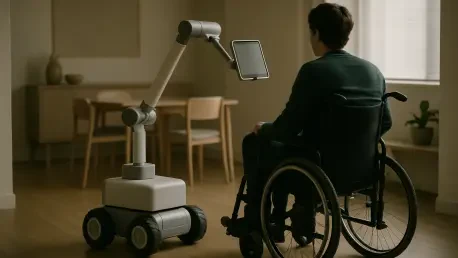

The long-standing vision of sleek, bipedal humanoid assistants gliding through modern kitchens has consistently clashed with the harsh, unforgiving realities of household physics and mechanical fragility. This research investigates a deliberate departure from the “maximalist” trends prevalent in high-tech corridors, focusing instead on a function-first philosophy for domestic robotics. By prioritizing utility over human mimicry, the study explores how hardware simplicity can overcome the “data dearth” that currently stymies artificial intelligence in residential settings. The central focus is the development of a telescoping, wheeled platform designed to navigate the complexities of a living room without the catastrophic failures common in more ambitious, bipedal designs.
The core challenge identified in this research involves balancing the industry’s high-tech ambitions with the basic requirements of real-world domestic utility. Modern robotics often struggles with the unpredictability of human environments, where a single misplaced step or an overly forceful grip can lead to significant property damage. This study suggests that the path to integration lies in reducing mechanical complexity. By replacing multi-jointed limbs with a simplified telescoping arm and utilizing an omnidirectional wheeled base, the research addresses the primary mechanical and safety hurdles that have historically kept robots confined to laboratory settings.
Furthermore, the work highlights the critical shortage of real-world training data from domestic interiors, a bottleneck that prevents AI models from learning how to interact safely with household objects. Moving away from simulations, the researchers emphasize the need for “embodied control” where the robot acts as an extension of the user. This approach not only provides immediate assistance but also generates the high-quality, site-specific data necessary for future autonomous improvements. The emphasis shifts from a machine that replaces human labor to a tool that enhances human capability, particularly for those with limited mobility.
The Core Challenge: Balancing High-Tech Ambition With Real-World Domestic Utility
The research highlights a significant tension between the pursuit of “foundation models” for robotics and the physical limitations of current hardware. While Silicon Valley often promotes a future populated by bipedal humanoids, this study argues that such complexity is currently a liability. The high cost and precarious balance of bipedal forms make them unsuitable for the average home, where safety and reliability are paramount. Instead, the focus is placed on a pragmatic design that utilizes a heavy, stable base and a single, effective manipulator. This shift acknowledges that domestic utility does not require a human form, but rather a consistent ability to reach, grab, and move objects.
Addressing the “data dearth” is another central pillar of this investigation. Artificial intelligence requires massive amounts of interaction data to understand how to navigate a kitchen or tidy a living room, yet this data is difficult to acquire outside of actual homes. The research posits that by deploying simpler, more affordable robots, developers can collect thousands of hours of real-world operating data. This “shippable” approach allows for a faster iteration cycle than waiting for a perfect humanoid to emerge from a lab. Consequently, the research frames hardware pragmatism as the primary vehicle for software intelligence.
Contextualizing the Shift From Humanoid Hype to Functional Assistance
This study is situated within a broader industry context where robotics hardware frequently fails due to the high cost and mechanical fragility of complex limbs. By examining the evolution of the “Stretch” robot platform, the research illustrates why moving away from bipedal mimicry is essential for domestic safety. Humanoid designs are often top-heavy and prone to falling, posing a danger to pets, furniture, and residents. In contrast, a robot with a low center of gravity and wheels offers a level of stability that allows it to operate safely in close proximity to people.
The research also redefines the purpose of domestic robotics from general-purpose labor replacement to targeted functional assistance. For individuals facing mobility challenges, the value of a robot is not found in its ability to walk like a human, but in its ability to provide “embodied control.” This means the robot serves as a physical surrogate, allowing a user to perform personal care tasks independently. This shift in perspective is significant because it transforms the robot from a luxury curiosity into a vital assistive tool, potentially revolutionizing the way society approaches long-term care and disability.
Research Methodology, Findings, and Implications
Methodology
The methodology centered on an iterative hardware-software integration approach involving the “Stretch 4” robot. The research team prioritized real-world operating hours over laboratory simulations, deploying the hardware directly into domestic environments to test its limits. The robot’s design featured a telescoping arm, a pair of pinchers, and an omnidirectional wheeled base, all controlled through a “human-in-the-loop” model. This model allowed users to provide high-level direction via mobile applications, guiding the machine through complex physical manipulations while the software managed the underlying mechanics of movement.
Data collection was conducted through site-specific recovery loops, where the robot’s performance in actual homes provided insights into workflow tolerances and environment mapping. The researchers also focused on the “shippability” of the hardware, ensuring the unit could be delivered via standard carriers like UPS or DHL. This logistical consideration was a key part of the methodology, as it allowed for a broader distribution to researchers and hackers who could contribute to the robot’s evolving software ecosystem. The integration of LED-based status indicators further allowed for testing user-interface “personality” and communicative feedback during tasks.
Findings
The study found that functional pragmatism—specifically the use of wheels and simple pinchers—resulted in a platform that was significantly more stable and less destructive than complex humanoid forms. A major discovery was that accumulated operating hours in real homes created a significant competitive moat, providing data “ingredients” for physical AI that laboratory simulations could not replicate. The research demonstrated that a simplified form factor could successfully perform a wide range of household tasks, such as handling beverages or grooming, provided the user remained in control of the final manipulation.
Furthermore, the research revealed that for users with disabilities, total machine autonomy was actually less desirable than “embodied control.” Participants expressed a preference for being the primary director of the robot’s actions, which ensured a higher degree of safety and personal agency. The findings also indicated that maintaining a lightweight and manageable design was crucial for preventing property damage. In instances where heavier, active-balancing robots might punch through surfaces during a malfunction, the lightweight telescoping arm of the Stretch platform proved far more forgiving and easier to reset.
Implications
The findings imply that the most viable path to widespread domestic robotics lies in safety-first, shippable hardware rather than high-capability humanoids. By lowering the barrier to entry through manageable price points and standard shipping methods, a more diverse developer ecosystem can flourish. This suggests that the “brain” of future home robots will be built on the collective data gathered by these simpler units. Societally, this research suggests that robots will likely enter our lives as specialized, collaborative tools that enhance human independence rather than as fully autonomous replacements for caregivers.
Moreover, the research highlights a shift in the global robotics market, suggesting that integrated sensor suites and user-ready software are more valuable to early adopters than low-cost, “dumb” hardware. While competitors may offer cheaper mechanical components, the value lies in the “complete package” that allows for immediate deployment. This trend points toward a future where domestic robotics is defined by reliability and user trust. As these machines become more integrated into daily life, the focus will likely remain on their ability to perform specific, high-value tasks safely and consistently.
Reflection and Future Directions
Reflection
Reflecting on the development process, the research emphasized the “hardware is hard” reality that continues to plague the industry. Mechanical limbs often lack the finesse of human arms, and the study acknowledged that even simplified designs face challenges in delicate environments. However, the adoption of a lightweight design and the inclusion of simple user interfaces, like color-changing LED eyes, successfully fostered a sense of “personality” that improved user acceptance. The researchers recognized the ongoing tension between the need for low-cost manufacturing and the high-integration requirements of domestic software, noting that safety and reliability must never be sacrificed for price.
Future Directions
Future research should focus on scaling the data acquisition process to further refine the AI models used for more complex household tasks. There is a clear opportunity to explore how these pragmatic designs can transition from research-heavy environments into mass-market consumer applications through further cost reductions. Additionally, unanswered questions remain regarding the long-term durability of lightweight hardware under continuous daily use. Investigating the mechanical longevity of telescoping components and exploring more advanced sensor integration will be essential for moving these robots from the role of a “specialized tool” to a ubiquitous household appliance.
The Specialized Tool as the Future of Home Robotics
The transition of robots into the home depended on a strategic move toward safety, reliability, and accessibility. The success of a pragmatic design like the Stretch 4 suggested that the industry’s future was not found in the creation of a perfect human replacement, but in a reliable and specialized assistant. By building trust through real-world interaction and incremental improvement, this pragmatic approach provided the most viable foundation for finally bringing robotics out of the lab and into the living room. The research demonstrated that once the focus shifted toward empowering the user through “embodied control,” the robot became a transformative presence in the domestic sphere. Ultimately, the study concluded that the most effective domestic robots were those that prioritized functional utility over aesthetic mimicry, thereby creating a sustainable path for widespread adoption. This shift in design philosophy proved that the road to the future was paved with wheels and telescoping arms, not bipedal steps.