
Chris Mullan serves as the Head of Data and Artificial Intelligence at CFC, where he orchestrates the complex intersection of high-level technical engineering and practical insurance applications. With a massive remit covering everything from risk selection and pricing to the development of an agentic roadmap, he manages a global team of thirty professionals while balancing the high-stakes demands of modern cybersecurity. His perspective is uniquely grounded in the reality of scaling AI within a traditional industry, focusing on the foundational infrastructure required to move beyond the hype and into robust, long-term delivery.
The following discussion explores the intricacies of automating diverse broker submissions, the evolving role of human expertise in an AI-driven workforce, and the cultural shifts necessary for engineering teams to adopt next-generation coding tools. We also delve into how high-focus personal disciplines like precision rifle shooting contribute to professional problem-solving and why the physical office remains a vital hub for spontaneous innovation.
Managing quote submissions involves interpreting thousands of emails where every broker uses a unique format. How do you train AI software to handle these inconsistencies, and what specific steps ensure these pipelines remain secure and robust against evolving cyber threats?
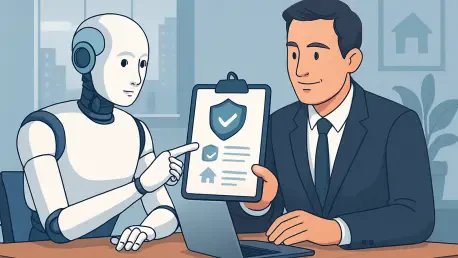
The challenge lies in the sheer lack of standardization; we process several thousand quote submission emails where every broker has their own distinct style of requesting coverage. To manage this, we focus heavily on training our AI software to interpret and extract data from these varied formats, transforming messy, unstructured text into clean, actionable data points. This isn’t just about the AI being “smart”—it’s about the foundational work we do with product managers and architects to walk through every design phase of our AI pipelines. Security is baked into this process from the start because these tools power the core of our business, and we cannot afford vulnerabilities. We spend a significant portion of our time collaborating with the data security and governance teams to ensure that as our automation scales, our defenses against evolving cyber threats remain equally robust and impenetrable.
New graduates entering the workforce often find that corporate adoption of AI lags behind their personal use of tools like ChatGPT. How should businesses bridge this gap during rotations, and in what ways does human expertise remain indispensable in an increasingly automated insurance landscape?
It is a common point of friction for our industrial placement students who are used to the seamless utility of ChatGPT but find that large organizations are often more cautious in their implementation. We bridge this gap by involving them in rotations where they can see the “why” behind this caution, helping them understand that businesses must manage risks and data integrity in ways an individual user does not have to consider. I always remind them that while jobs are certainly evolving, AI still has very real limits that prevent it from replacing the nuance of a seasoned professional. Insurance, at its heart, is built on relationships and human judgment; you simply cannot replace the value of a real human expert when it comes to the complex, high-stakes decisions that define our industry. We encourage graduates to embrace the tools while mastering the interpersonal skills that AI cannot replicate.
Transitioning an engineering team to fully leverage AI-powered coding tools requires significant structural and cultural shifts. What organizational changes are necessary to harness this potential, and how do you navigate the technical roadblocks that arise when pushing for deeper automation and data insights?
Harnessing the potential of AI-powered coding tools is as much about people as it is about the technology itself, requiring us to rethink how our engineering function is structured to support these new workflows. At CFC, we lean into a culture that pushes boundaries and challenges the status quo, which naturally creates a high demand for deeper insights and more sophisticated automation. To navigate the inevitable technical roadblocks, we rely on the extensive networks of our AI product owners, who bring a wealth of outside knowledge and collaborative energy to the table. We hold specific sessions dedicated to understanding the structural shifts needed to evolve our engineering function, acknowledging that we are in new territory and learning from each other as we go. It is a constant process of clearing obstacles and refining our roadmap to ensure our delivery capacity matches our technological ambition.
High-level technical roles often benefit from hobbies that require intense personal focus and no digital distractions, such as precision rifle shooting. How does this “you versus you” mindset translate to professional problem-solving, and why is mental clarity essential when managing complex data portfolios?
After a day of managing complex data portfolios and navigating high-level meetings, precision rifle shooting in the Reigate caves provides a necessary reset because the environment naturally blocks all mobile signals and digital noise. This “you versus you” mindset is vital because it strips away the external chaos and forces a singular, intense focus on the task at hand, which is exactly the kind of mental discipline required for complex problem-solving. In my role, mental clarity is not a luxury—it is a requirement for making sound decisions about data security and architectural integrity. Stepping away from the screen and into a space where there are zero distractions allows me to decompress and return to work with a refreshed perspective. That clarity is what enables me to handle the unpredictable nature of leading a large, technical team while also being a father to five children.
Spontaneous interactions in the office often lead to more meaningful outcomes than scheduled remote meetings. How do you balance the efficiency of a home office with the need for these chance encounters, and what impact does this have on the long-term development of AI products?
I strike a balance by using my “shoffice” at home for focused, high-level planning and one-on-one catch-ups, while dedicating three days a week to the office for collaborative synergy. There is an intangible value in the chance encounters that happen in the coffee queue or by the lifts; these are the moments where crucial, unscripted conversations happen that would never occur in a formal 30-minute video slot scheduled weeks in advance. These interactions are foundational to the long-term development of our AI products because they spark creative solutions and help align the team on the nuances of our roadmap. Being physically present allows us to walk through designs and iterate on ideas in real-time, which builds a level of trust and shared vision that remote work struggles to replicate. This hybrid approach ensures we remain efficient in our individual tasks while staying deeply connected as a creative and technical unit.
What is your forecast for AI in the insurance industry?
I believe we are currently in a major transition phase where the industry is moving past the initial excitement and toward a more mature, practical application of large-scale models. My forecast is that we will see a surge in “agentic” roadmaps, where AI moves from being a simple tool for extraction to acting as a proactive assistant that manages workflows autonomously. However, this progress will depend entirely on how well companies master the less “glamorous” side of the work: data governance, infrastructure, and security. We will likely see a greater adoption of biologically inspired models, like the baby dragon hatchling (BDH) models I’ve been reading about, which could revolutionize how we process complex information. Ultimately, the winners in this space will be those who successfully marry these cutting-edge AI capabilities with the deep, irreplaceable expertise of human underwriters and risk managers.