
As devastating wildfires become an increasingly common feature of the American West, Arizona homeowners are confronting a secondary, slow-burning disaster in the form of a strained and retreating insurance market. A landmark report from the state’s Department of Insurance and Financial Institutions has concluded that this escalating crisis, characterized by skyrocketing premiums and widespread policy nonrenewals, has no single, simple remedy. The comprehensive analysis, born from a 10-month investigation, highlights the complex interplay between environmental risk, economic stability, and public policy, ultimately underscoring that a sustainable solution will require a concerted and continuous effort from every level of society. Rather than prescribing a one-size-fits-all legislative fix, the report offers a strategic “toolkit” designed to guide homeowners, community leaders, and the insurance industry toward a more resilient future, emphasizing that the path forward is not through a single sweeping action but through a thousand deliberate steps taken in unison. This multifaceted approach is presented as the only viable strategy to navigate the intertwined challenges threatening the state.
The Anatomy of a Growing Crisis
Unpacking the Council’s Findings
The state’s Resiliency and Mitigation Council, a specialized body composed of representatives from cities, counties, fire districts, and insurance officials, dedicated nearly a year to investigating the deepening cracks in Arizona’s homeowners insurance market. Through extensive testimony and data analysis, the council identified five core problems that are now impacting residents across the state. The most immediate issue is the dramatic rise in insurance premiums, which affects homeowners statewide, not just those in high-risk zones. This is compounded by an alarming rate of policy nonrenewals, specifically targeting properties in vulnerable areas like dense forestlands and the wildland-urban interface, leaving many longtime residents scrambling for coverage. Furthermore, many of the policies that remain available offer inadequate coverage, failing to account for the full cost of rebuilding in a post-disaster environment. These insurance challenges create significant hurdles for mortgage affordability and availability, as lenders are hesitant to finance uninsured or underinsured properties, effectively locking people out of the housing market in certain regions.
The Cascade Effect on Communities
The challenges identified by the council do not exist in isolation; they create a dangerous cascade effect that threatens the economic and social fabric of entire communities. When insurers pull back from high-risk areas, it triggers a chain reaction. The inability of homeowners to secure or afford insurance directly impacts the real estate market, depressing property values and stalling new construction. This financial instability extends to the mortgage industry, where the lack of traditional insurance policies makes it nearly impossible for prospective buyers to obtain loans, further stagnating local economies. This cycle disproportionately affects residents in the wildland-urban interface, who find themselves trapped between an uninsurable home and an unsellable asset. The council’s report also highlighted the often-underestimated secondary threat of post-fire flooding and mudslides. A landscape scarred by wildfire loses its ability to absorb rainfall, creating extreme flood risks that require separate, often expensive, insurance policies, adding another layer of financial burden and uncertainty for already-strained households.
A Multifaceted Approach to Mitigation
Empowering Homeowners and Communities
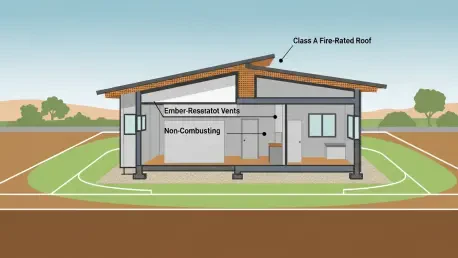
A central theme emerging from the council’s report is that improving insurability begins with proactive risk reduction at the ground level. For individual homeowners, this involves a range of strategies, from no-cost actions like regularly clearing flammable debris and maintaining defensible space around a home to more significant investments. These larger retrofits, such as installing ember-resistant vents, non-combustible siding, and Class A fire-rated roofs, are crucial for hardening structures against ignition from wind-blown embers, which are a primary cause of home loss during wildfires. While these measures are not a guarantee of coverage, the report notes a growing recognition within the insurance industry that such efforts meaningfully reduce risk, potentially leading to more favorable underwriting decisions or even premium discounts. At a broader level, the report stressed that individual actions must be supported by robust community-wide initiatives. The success of local fire districts in sustaining critical mitigation projects, such as creating fuel breaks and managing forest health, was found to be highly dependent on consistent funding and strong community engagement, reinforcing that collective action is the most effective defense.
The Role of Advanced Technology in Risk Assessment
The investigation also explored the transformative potential of technology in creating a more nuanced and accurate picture of wildfire risk. The council examined advanced risk modeling platforms, such as the artificial intelligence system used by ZestyAI, which are moving the insurance industry beyond outdated, broad-stroke assessments based on ZIP codes. These sophisticated tools integrate a vast array of data points, including high-resolution aerial imagery, specific building materials, local topography, and detailed climatology, to generate a precise risk score for an individual property. This granular approach allows insurers to see the direct impact of mitigation efforts, distinguishing a well-maintained, fire-hardened home from a more vulnerable neighboring property within the same high-risk zone. By providing a more objective and comprehensive view of exposure, this technology has the potential to reward proactive homeowners and encourage further investment in risk reduction, creating a more equitable and data-driven insurance market that better reflects on-the-ground reality.
Forging a Path Toward Resilience
Ultimately, the council’s extensive investigation concluded that the key to unlocking a property’s insurability rested squarely on direct actions taken to reduce its likelihood of igniting during a wildfire. The report determined that no single mitigation tactic would be sufficient on its own to solve the crisis. Instead, the evidence presented to the council demonstrated that a layered strategy, combining diligent property-level hardening with coordinated, community-scale mitigation efforts, was the only approach that effectively reduced the risk of structural loss from all primary wildfire threats, including embers, direct flames, and radiant heat. This comprehensive framework provided a clear, albeit challenging, path forward for public and private leaders seeking to build a more fire-adapted and insurable state for the future.