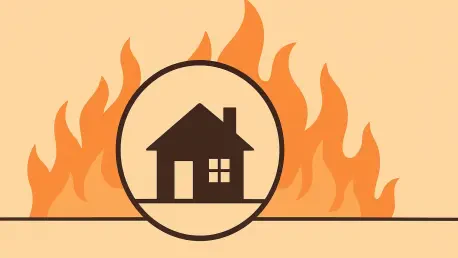

The American dream of homeownership is increasingly colliding with a relentless cycle of extreme weather events that trigger billion-dollar economic losses nearly three times a month. This volatility has turned property ownership into a financial gamble, particularly as traditional insurance giants withdraw from volatile markets like California and Florida. Families are finding themselves stranded without coverage or facing premiums that consume a massive portion of their monthly income. This trend reflects a systemic breakdown in how risk is understood, as legacy systems continue to rely on historical data to predict an increasingly erratic future. Looking in a rearview mirror to navigate a storm-lashed road has proven to be a strategy that leaves both the provider and the protected in a state of constant vulnerability.
The Billion-Dollar Storm Disrupting Every Ten Days
A billion-dollar weather disaster now strikes the United States every ten days on average, transforming the housing market into a zone of high financial risk. As traditional insurance giants retreat from entire states, homeowners are left grappling with sky-high premiums or total policy cancellations. This shift is not merely a seasonal fluctuation but a permanent change in the environmental landscape that legacy models are not equipped to handle.
The volatility stems from a fundamental flaw in the industry: insurers are essentially guessing the future based on the past. This reliance on historical loss data ignores the fact that natural forces are becoming more violent and less predictable. As the total value of property at risk continues to climb, the industry needs a shift from reactive pricing to proactive risk mitigation based on the current physical reality of each building.
Why Legacy Insurance Models Are Failing Modern Homeowners
Traditional insurance models are currently facing a systemic breakdown because their actuarial tables cannot keep pace with the shifting climate. When insurers use broad zip-code-level data to set rates, they often overlook the actual structural integrity of individual properties. This disconnect has created a crisis where even well-maintained, resilient homes are penalized for the risks of their neighbors.
This lack of nuance prevents homeowners from seeing any return on their investments in safety. Without the ability to distinguish between a vulnerable house and one built to modern standards, the market remains unstable. The industry reached a tipping point where reactive pricing no longer provided the stability needed for long-term real estate investment, necessitating a move toward proactive mitigation.
The Stand World Model and the Rise of Physics-Led Underwriting
The InsurTech firm Stand has recently achieved “unicorn” status with a $1 billion valuation by replacing outdated statistics with the laws of physics. Their “Stand World Model” creates a sophisticated digital twin of a specific home to simulate exactly how it would react to wildfires, hurricane-force winds, and other localized hazards. By analyzing specific construction materials, surrounding landscape fuel loads, and local weather patterns, the technology provides a granular view of risk.
This approach has allowed the company to scale its covered property value from $1 billion to over $10 billion within the current year, proving a massive appetite for precision-based coverage. Supported by a $70 million Series C funding round led by Saga Ventures and Lowercarbon, the firm has demonstrated that physics-based underwriting can handle the complexity of the housing market far better than outdated spreadsheets.
Leadership and Expertise Driving a New Global Standard
The shift toward physics-led insurance is being spearheaded by industry veterans who recognize that the old ways are no longer sustainable. CEO Dan Preston argues that aligning insurance with the laws of physics is the only way to protect resilient properties worldwide. To facilitate global expansion, Stand brought on experts like Drew Saad, former President at PURE Insurance, and Tony Landi, formerly of Nephila, to bridge the gap between high-tech modeling and deep reinsurance expertise.
Their goal was to move beyond the current market retreat and create a sustainable alternative for disaster-prone regions. By partnering with entities like the Stand Insurance Exchange and Concert Specialty Insurance Company, they integrated digital simulations with global capital markets. Their leadership helped establish a more resilient global standard that prioritized localized data over regional averages.
A Practical Framework for Achieving Resiliency Discounts
Homeowners moved from being passive policyholders to active risk managers by adopting a new framework for protection. This strategy began with a digital vulnerability assessment to identify specific weak points, such as non-flame-retardant vents or overgrown vegetation. Once these vulnerabilities were identified, the next step involved implementing targeted, cost-effective upgrades like ember-resistant roofing or reinforced garage doors.
By utilizing a verified network of contractors to document these improvements, homeowners secured premium discounts of up to 70%. This model transformed insurance from a mandatory tax on homeownership into a rewarding partnership that prioritized physical safety and financial stability. The transition successfully established a new standard where financial protection was directly tied to the tangible resilience of the structure itself. This model provided the necessary blueprint for homeowners to regain control over their property’s future, ensuring that stability was no longer a casualty of the changing climate.