
The physical toll of manual labor and repetitive tasks has reached a critical juncture in the American workforce, where musculoskeletal disorders now account for a staggering portion of workplace injuries and lost productivity. Historically, the management of these conditions was defined by a reactive posture, where safety protocols were only scrutinized or modified after an employee had already suffered a debilitating strain or chronic injury. This approach created a cycle of high workers’ compensation costs and operational instability, as businesses struggled to fill the gaps left by experienced staff who were sidelined by preventable trauma. However, the landscape of occupational safety is undergoing a profound transformation as organizations move away from these legacy methods toward a proactive, technologically driven paradigm. This shift is characterized by the use of advanced diagnostic tools that can identify precursors to physical trauma long before they manifest as medical claims. By integrating artificial intelligence and computer vision into standard safety protocols, modern enterprises are successfully bridging the gap between limited human oversight and the necessity for continuous, comprehensive ergonomic monitoring. This evolution represents more than just a technological upgrade; it is a fundamental reimagining of how the relationship between human biology and industrial environments is managed to ensure long-term health and efficiency.
Quantifying the Extensive Impact of Workplace Injuries
The financial consequences of a workplace injury are frequently misunderstood because many risk management models focus exclusively on the visible costs, such as medical bills and insurance premiums. In reality, the “true cost” of a musculoskeletal disorder acts as a catalyst for a complex domino effect that ripples through every department of an organization. When a skilled technician or specialist is forced to take leave due to an ergonomic injury, the immediate loss of their specific expertise creates a void that cannot be easily filled. Other staff members are often reassigned to cover the missing person’s duties, which frequently leads to a decrease in overall production speed and a higher rate of errors as people operate outside of their primary competencies. This disruption doesn’t just stall the workflow; it places additional physical and mental stress on the remaining employees, which can paradoxically increase the likelihood of secondary injuries occurring elsewhere in the facility. The capital required to recruit, vet, and train a replacement for a long-term disability case can easily exceed the direct medical expenses of the original injury, making the case for prevention an economic necessity rather than just a safety goal.
Beyond the immediate operational delays and recruitment expenses, workplace injuries exert a corrosive influence on corporate culture and the psychological well-being of the workforce. When employees witness a colleague suffer a career-altering injury that could have been prevented with better equipment or training, it erodes the foundational trust between the workforce and management. This lack of security often translates into lower morale, reduced loyalty, and a general atmosphere of anxiety that hinders creativity and engagement. Furthermore, the administrative burden placed on management teams following an incident is substantial, involving hours of meticulous documentation, accident investigations, and compliance reporting that distract from strategic growth initiatives. By prioritizing ergonomic safety through advanced diagnostics, companies are making a strategic investment in their human capital. This proactive stance signals to every member of the organization that their physical longevity is a corporate priority, which fosters a more resilient and dedicated work environment while simultaneously protecting the company’s bottom line from the unpredictable volatility of workers’ compensation claims.
The Role of Computer Vision in Risk Detection
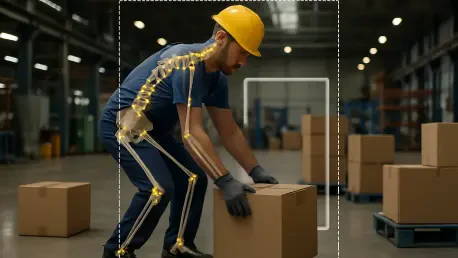
The introduction of computer vision technology has fundamentally democratized the field of ergonomic assessment by removing the traditional barriers of cost and geography. In previous years, a comprehensive ergonomic audit required a physical visit from a specialized consultant, a process that was often too expensive for small-to-mid-sized facilities or remote locations to justify on a regular basis. Today, the diagnostic process has been streamlined through the use of standard video recording devices and AI-driven analysis software. A safety manager can capture a brief, two-minute video of an employee performing their standard duties—whether it is lifting a crate, operating a terminal, or reaching into a storage rack—and upload it to a cloud-based engine for immediate evaluation. The AI applies principles of biology and physics to the footage, meticulously calculating joint angles, spinal alignment, and the precise amount of force exertion required for each movement. This level of detail provides an objective data set that surpasses the capabilities of manual observation, identifying subtle, high-frequency motions that could lead to repetitive stress injuries over time.
The most effective aspect of these modern AI tools is their ability to translate complex biomechanical data into a highly accessible visual narrative for non-experts. Most platforms generate a color-coded digital “avatar” that is overlaid directly onto the video of the employee, using red, yellow, and green indicators to signify varying levels of physical risk. When a manager can show a worker a video where their lower back or shoulders turn bright red during a specific lift, it transforms an abstract safety rule into a tangible reality. This visual evidence is a powerful coaching tool, allowing for immediate feedback and behavioral adjustment without the need for confrontational disciplinary measures. The system also assigns a numerical risk score to every analyzed task, which allows organizations to create a data-driven priority list for safety interventions. By focusing resources on the “red zone” tasks first, safety leaders can ensure that their budget is being spent where it will have the greatest impact on injury reduction, moving away from guesswork and toward a scientific model of risk mitigation.
Integrating Human Expertise with Diagnostic Data
While the diagnostic precision of artificial intelligence is unparalleled, it is critical to recognize that technology serves as a partner to, rather than a replacement for, human expertise. The AI excels at identifying exactly where a risk exists and quantifying its severity, but it lacks the contextual understanding to determine the most feasible solution within a specific business environment. This is where the professional ergonomist or safety consultant becomes indispensable, using the data provided by computer vision to design targeted interventions. A high risk score for a reaching task might be solved in several different ways: an engineering control like a mechanical lift, an administrative change such as job rotation, or a behavioral intervention like specialized coaching. The human expert evaluates these options against the company’s operational constraints and budget, ensuring that the proposed solution is both effective and sustainable. By offloading the time-consuming work of data collection and initial analysis to the AI, specialists can spend their time on higher-value activities like solution design and implementation.
To address the diverse needs of the modern business landscape, many organizations are now utilizing a tiered service model that matches the level of professional intervention to the complexity of the risk. For routine or low-complexity job functions, companies often use self-service smartphone applications that allow for quick, virtual feedback based on AI analysis. This entry-level tier provides an affordable way for businesses to maintain basic safety oversight without continuous consulting fees. For mid-range risks, generalist safety consultants who have been trained to interpret AI data can provide effective guidance and standardized improvements. In high-volume or high-severity environments, such as heavy manufacturing or complex logistics hubs, professional ergonomists are deployed to perform deep-dive analyses and develop custom engineering solutions. This structured approach ensures that safety resources are allocated with maximum efficiency, allowing companies to scale their ergonomic programs as their operations grow. This hybrid model creates a synergy where technology provides the clarity of data, and human professionals provide the wisdom of experience.
Real-World Success and Sustainable Safety Habits
The measurable success of AI-driven ergonomics is perhaps most evident in the manufacturing sector, where heavy manual labor has historically led to high injury rates. In several notable implementations, facilities that integrated computer vision into their safety audits were able to pinpoint specific “bottleneck” tasks that were disproportionately responsible for workers’ compensation claims. For instance, a facility might discover that a single manual palletizing station is the source of half of its annual back injuries. By using the visual data provided by the AI, management can justify the investment in a mechanical assist device or an automated lifting system. These interventions frequently result in a multi-dimensional return on investment: physical strain on the workforce is virtually eliminated, production speeds often increase because the task is no longer limited by human fatigue, and the company sees a dramatic decrease in the frequency and severity of medical claims. These real-world outcomes demonstrate that ergonomics should be viewed not as a cost center, but as a primary driver of operational excellence and corporate integrity.
However, the long-term success of any ergonomic program depends on its ability to influence human behavior consistently over time. Engineering out a risk with a new machine is a permanent fix, but many workplace tasks still rely on the way an individual chooses to move. This is why forward-thinking organizations are increasingly incorporating principles of behavioral economics into their safety strategies. Instead of using diagnostic data as a “policing” tool to catch mistakes, they use it as an incentive-based coaching tool to reinforce safe habits. Continuous monitoring and periodic re-evaluation are used to combat “habit drift,” where employees slowly revert to less safe movements as they become comfortable with a task. By rewarding departments that maintain low risk scores and providing ongoing visual feedback, companies can cultivate a culture where safety is a shared responsibility rather than a top-down mandate. The transition to AI-supported ergonomics was characterized by early adopters seeking simple cost savings, but it has matured into a sophisticated strategy for ensuring the long-term sustainability of the American workforce.