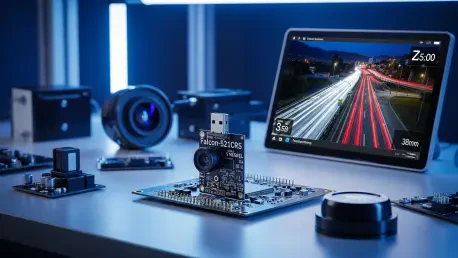

In the complex arena of modern transportation, where legal disputes often hinge on split-second visual data, the limitations of conventional consumer-grade cameras have created a significant gap in insurance adjustability and forensic accident reconstruction. This technological deficit frequently results in ambiguous liability determinations and protracted legal battles that cost the industry billions annually. To address these systemic issues, the launch of the Falcon-521CRS by Vadzo Imaging represents a major shift toward a new category of specialized hardware designed for the rigors of professional telematics. This 5-megapixel color USB 3.0 camera, built around the sophisticated Onsemi AR0521 image sensor, is engineered to transform the vehicle cabin into a hub for high-fidelity data collection. By prioritizing raw image integrity over the smoothed, compressed aesthetics common in consumer dashcams, this system provides the forensic clarity needed to withstand the scrutiny of courtroom testimony and rigorous insurance audits. The transition from simple video recording to evidence-grade imaging is not merely an incremental upgrade but a fundamental reimagining of how mobile visual data is captured, stored, and utilized in 2026.
Navigating the Complexities of High-Motion Environments
Mobile imaging operates within what engineers frequently describe as an optically hostile environment, characterized by extreme fluctuations in light and rapid physical motion. A camera mounted on a vehicle must maintain clarity while traveling at highway speeds, often moving from the deep shadows of an overpass into direct sunlight within a fraction of a second. This scenario frequently causes standard sensors to wash out or lose detail in the highlights, rendering license plates and road signs illegible. Furthermore, the nighttime environment introduces the challenge of high-intensity discharge and LED headlights, which can blind a camera sensor if it lacks the sophisticated gain control and dynamic range required to balance local exposure levels. When these technical failures occur during a collision, the resulting footage is often dismissed as inconclusive, leaving fleet managers and insurers without the objective proof required to defend their positions or process claims efficiently.
Beyond the challenges of lighting, the mechanical realities of vehicle operation introduce significant issues with motion blur and electronic interference. High-speed travel necessitates extremely short exposure times to freeze the action and capture sharp details of moving objects, yet these short exposures typically lead to dark, noisy images in low-light conditions. Standard imaging systems often struggle to find a middle ground, resulting in video that looks acceptable to the human eye but fails when a forensic expert attempts to zoom in on a specific detail, such as a driver’s hand position or a distant street sign. Additionally, the prevalence of LED-based infrastructure, including traffic signals and brake lights, creates a phenomenon where lights appear to be flashing or turned off entirely in digital recordings. This flicker effect occurs because LEDs pulse at high frequencies that are often out of sync with the camera’s frame rate, a technical hurdle that can compromise an entire investigation into a red-light violation.
Technical Specifications of the Onsemi AR0521 Sensor
The foundation of the Falcon-521CRS is the Onsemi AR0521 CMOS image sensor, which utilizes a 2.2 µm pixel pitch to achieve a delicate balance between light sensitivity and spatial resolution. This specific pixel architecture allows the sensor to gather a significant amount of photonic data even in poorly lit rural settings, reducing the reliance on digital gain that often introduces distracting “salt and pepper” noise. With a native resolution of 2592 x 1944 pixels, the sensor provides the high-density information required to identify vehicle makes and models from a distance, which is critical for hit-and-run investigations. Unlike lower-resolution sensors that may only provide a general overview of a scene, the 5-megapixel output of this system ensures that every frame contains enough data for a forensic analyst to perform a meaningful pixel-by-pixel examination of the environment during a critical event.
To combat the inherent difficulties of high-contrast road scenes, the system integrates advanced High Dynamic Range technology that processes multiple exposure levels simultaneously. This capability allows the sensor to preserve detail in the darkest corners of a cabin or a nighttime road while preventing the bright spots from oncoming headlights from becoming overexposed “blooms.” This hardware-level processing is essential for maintaining the legibility of reflective license plates, which often become unreadable white rectangles when hit by a vehicle’s own high beams. By managing these extreme luminance levels at the sensor level rather than through software interpolation, the camera ensures that the final image is an accurate representation of the physical world. This accuracy is a cornerstone of evidentiary standards, as it prevents the introduction of digital artifacts that could be questioned or misinterpreted by legal counsel during a trial.
The inclusion of LED Flicker Mitigation technology further distinguishes this sensor from generic alternatives by synchronizing the image capture window with the pulse-width modulation of modern lighting. Because traffic lights and vehicle signals do not stay continuously lit, a standard camera might “blink” at the exact moment a red light is technically off during its cycle, creating a false record that the light was unlit. The Falcon-521CRS addresses this by extending the exposure period or using intelligent synchronization to ensure that the actual state of the signal is always recorded. This feature is particularly vital for autonomous driving assistance and law enforcement applications, where the state of a traffic signal is the primary factor in determining the legality of a maneuver. By solving this problem at the hardware level, the system eliminates a major point of failure in digital evidence collection.
The Evolution from Observation to Admissible Evidence
In the current landscape of 2026, the telematics industry is witnessing a definitive shift away from subjective video recording toward the pursuit of temporal and visual authenticity. In previous years, the success of a vehicle camera was often measured by how “cinematic” the footage appeared or how small the file size could be compressed for cloud storage. However, the legal and insurance sectors have realized that heavy compression and artificial sharpening often destroy the very metadata needed to reconstruct an accident accurately. The Falcon-521CRS addresses this by prioritizing the integrity of the raw data, ensuring that every frame is a mathematically sound record of the incident. This focus on “evidence-grade” output means that the camera acts more like a calibrated scientific instrument than a simple recording device, providing a foundation for forensic engineering that was previously unavailable in a compact form factor.
This new standard of imaging requires a focus on three specific failure modes that have historically plagued vehicle-mounted cameras: luminance mismanagement, temporal inaccuracy, and motion distortion. By utilizing the USB 3.0 interface, the Falcon-521CRS can transmit large amounts of uncompressed or minimally compressed data to an onboard processing unit, preserving the fine details that are usually lost in wireless transmission or low-bandwidth connections. This allows for a level of forensic detail where experts can analyze the reflection in a side mirror or the specific timing of a turn signal activation with millisecond precision. When a camera can provide this level of certainty, it transitions from being a mere observer to being a reliable witness, significantly reducing the time required for insurance adjusters to reach a conclusion and lowering the overall cost of claims processing.
Furthermore, the reliability of the data captured by such a system serves as a powerful deterrent against insurance fraud and staged accidents, which have become increasingly sophisticated. Fraudsters often rely on the ambiguity of low-quality footage to make false claims about vehicle positioning or driver behavior. When a fleet is equipped with high-resolution, HDR-stabilized imaging, the clarity of the record often leads to the immediate dismissal of fraudulent claims before they ever reach a courtroom. This creates a proactive defense mechanism for fleet operators, who can now rely on a “black box” style of visual recording that is far more difficult to challenge than traditional video files. The shift toward these rigorous standards reflects a broader industry recognition that in a data-driven world, the quality of the input determines the validity of the legal outcome.
Physical Architecture and Modular Design Principles
The engineering of the Falcon-521CRS takes into account the physical constraints of vehicle integration, utilizing a compact 38mm x 38mm board design that allows it to be embedded into diverse locations. This small footprint is essential for modern vehicle designs where space behind rearview mirrors or within dashboard assemblies is extremely limited. Despite its size, the board is robust enough to handle the thermal demands of continuous operation, a critical factor for cameras that may be running for twelve or more hours a day. The use of a standard S-Mount lens holder provides developers with the flexibility to choose specific optics ranging from wide-angle fisheye lenses for cabin monitoring to narrow-angle telephoto lenses for long-distance license plate recognition. This modularity ensures that the same core imaging platform can be adapted to various use cases without requiring a complete redesign of the hardware.
Integration simplicity is further enhanced by the camera’s compliance with the USB Video Class standard, which allows for immediate functionality across a variety of operating systems without the need for specialized drivers. In the fast-paced world of fleet technology, the ability to “plug and play” on Windows, Linux, or Android platforms significantly reduces the development cycle for new telematics solutions. For companies managing thousands of vehicles, this ease of deployment means that system updates and hardware replacements can be handled with minimal downtime. The UVC compliance also ensures long-term stability, as the camera will remain compatible with future OS versions, protecting the initial investment made by the fleet operator. This standardized approach to hardware communication is a key factor in making high-end imaging accessible to a broader range of commercial applications.
In addition to its standard connectivity, the hardware is designed to withstand the vibration and mechanical stress inherent in heavy-duty trucking and public transportation. Vehicle electronics are subjected to constant jarring from uneven road surfaces, which can cause focus shifts or connector failures in less durable equipment. The Falcon-521CRS is built to maintain its optical alignment and electrical integrity through these conditions, ensuring that the camera does not fail at the very moment it is needed most. This physical resilience, combined with its sophisticated sensor capabilities, makes it an ideal choice for the demanding environment of commercial transit, where equipment failure is not just an inconvenience but a potential liability. By focusing on both the internal sensor logic and the external physical housing, Vadzo has created a balanced tool for the modern road.
Operational Impact on Fleet Management and Law Enforcement
For fleet operators, the primary value of evidence-grade telematics lies in the ability to protect the company’s bottom line through accurate driver monitoring and incident verification. High-resolution imaging allows managers to distinguish between aggressive driving and necessary evasive maneuvers, providing a more nuanced view of driver performance than telematics data alone. For example, a sudden braking event might be flagged as a safety violation by an accelerometer, but the Falcon-521CRS can show that the driver was actually responding to a pedestrian stepping into the road. This context is essential for fair driver coaching and for building a culture of safety based on facts rather than raw sensor triggers. Moreover, the clarity of the footage allows for the identification of distracted driving behaviors, such as mobile phone use, which can then be addressed before they lead to a costly accident.
Law enforcement agencies also stand to gain significantly from the adoption of 5-megapixel USB 3.0 cameras in their mobile units and stationary enforcement kits. Automated License Plate Recognition systems require a high degree of image sharpness and contrast to function accurately, especially when vehicles are moving at high speeds or in poor weather conditions. The Falcon-521CRS provides the necessary pixel density to feed these AI-driven systems, increasing the “hit rate” for stolen vehicles or expired registrations. Additionally, the LED Flicker Mitigation feature is a strict requirement for signal enforcement cameras, as the ability to prove a traffic light was red at the exact moment a vehicle crossed the line is essential for a legally binding citation. By providing a reliable stream of high-quality data, these cameras help law enforcement agencies maintain public safety with greater efficiency and transparency.
Furthermore, the technology supports the growing field of forensic accident reconstruction, where experts use video footage to calculate vehicle speeds and impact angles. Because the Falcon-521CRS maintains a stable frame rate and produces images free from geometric distortion, it allows for more accurate photogrammetry. Analysts can use known landmarks in the frame, such as road markings or signs, to calibrate the scene and determine the exact trajectory of the vehicles involved. This level of detail is often the difference between a case that drags on for years and one that is settled quickly based on undeniable physical evidence. As these imaging standards become more common, the entire ecosystem of road safety and legal accountability is elevated, creating a more predictable environment for all stakeholders involved in transportation.
Software Integration and Programmable Control Frameworks
To maximize the potential of the hardware, the Falcon-521CRS is supported by the VISPA ARC SDK, a comprehensive software development kit that provides engineers with granular control over the sensor’s parameters. This level of access is crucial for developers who need to customize the camera’s behavior for specific environmental conditions or specialized vehicle types. Through the SDK, users can programmatically adjust variables such as exposure time, white balance, and digital gain, allowing the camera to be fine-tuned for a specific mounting position or lighting scenario. This is particularly useful for multi-camera setups where several units must work in perfect synchronization to provide a 360-degree view of a vehicle’s surroundings. The ability to control these settings through common programming languages like C++ or Python makes it easier for software teams to integrate the camera into existing telematics platforms.
One of the standout features of the programmable interface is the ability to define a specific Region of Interest within the 5-megapixel frame. This allows the system to prioritize processing power and bandwidth for the most important parts of the image, such as the area where license plates are most likely to appear or the driver’s face for fatigue monitoring. By focusing on an ROI, the system can maintain high frame rates and lower latency, which is essential for real-time applications like collision avoidance warnings. Additionally, the SDK supports trigger synchronization, enabling the camera to capture a frame at the exact moment an external sensor, such as a radar or LIDAR unit, detects an object. This cross-sensor synchronization is a fundamental requirement for the advanced driver-assistance systems that are becoming standard in commercial fleets in 2026.
Beyond basic image capture, the software framework allows for the implementation of advanced metadata tagging, where information such as GPS coordinates, vehicle speed, and timestamps are embedded directly into the video stream. This creates a tamper-proof record where the visual data is inextricably linked to the operational data of the vehicle. For insurance purposes, this linked data is invaluable, as it prevents any disputes regarding where or when a specific piece of footage was recorded. The SDK also facilitates the integration of AI-based edge processing, where the camera’s output can be analyzed locally for objects or behaviors of interest before being sent to the cloud. This reduces data transmission costs and allows for immediate alerts in the event of a safety-critical incident, providing a faster response time than traditional cloud-only systems.
Long-Term Reliability and Economic Viability
The economic argument for implementing high-end telematics hardware like the Falcon-521CRS centers on the reduction of total cost of ownership through durability and efficiency. Vehicles are subject to extreme thermal cycling, with interior temperatures often reaching 150 degrees Fahrenheit in the summer and dropping well below zero in the winter. Standard electronics often suffer from delamination or sensor degradation under these conditions, leading to a “fuzzy” image or complete hardware failure within a few years. In contrast, the Falcon-521CRS is engineered with industrial-grade components that are designed to survive the entire lifecycle of a commercial vehicle. By avoiding the need for frequent hardware replacements, fleet operators can maintain a consistent level of protection without the recurring costs associated with cheaper, less durable alternatives.
In the insurance sector, the move toward automated First Notice of Loss systems is heavily dependent on the quality of the data generated at the time of an accident. When a crash occurs, the Falcon-521CRS can immediately provide a high-resolution, HDR-stabilized record of the event to a cloud-based AI for analysis. If the footage is clear enough to determine fault instantly, the insurance company can initiate the claims process within minutes rather than weeks. This “instant claim” model significantly reduces administrative overhead and improves customer satisfaction for the policyholder. However, this automation is only possible if the AI can rely on the quality of the input; blurry or flickered video requires human intervention, which slows the process and increases costs. Therefore, investing in superior sensor technology is a strategic move that pays dividends in operational efficiency.
Ultimately, the philosophy behind evidence-grade telematics is that the most accurate record is the one captured correctly at the moment of the event. While software-based post-processing can improve the look of a poor-quality video, it can also introduce artifacts that make the footage inadmissible in court. By ensuring that the truth of the physical world is recorded accurately the first time, Vadzo Imaging provides a level of certainty that is beyond reproach. This reliability is the foundation upon which the next generation of transportation safety and legal accountability is being built. As the industry continues to evolve through 2026 and beyond, the focus will remain on the integrity of the data, ensuring that every vehicle on the road is equipped with a witness that cannot be silenced or confused by the challenges of the environment.
Strategic Implementation and Future Considerations
The deployment of evidence-grade telematics systems should be approached as a comprehensive strategy rather than a simple hardware installation, beginning with a thorough audit of existing fleet vulnerabilities and legal requirements. Organizations must evaluate how their current imaging solutions handle high-speed motion and extreme lighting, as these are the primary points of failure in insurance disputes. Transitioning to a platform like the Falcon-521CRS allowed many early adopters to standardize their data formats, making it easier to integrate visual evidence into existing management software. By selecting hardware that supports advanced SDKs and universal standards like UVC, companies ensured that their technology stack remained flexible enough to incorporate future AI advancements without needing to replace the underlying camera infrastructure. This forward-thinking approach reduced long-term capital expenditure while maximizing the utility of every frame of data collected.
Moving forward, the focus had to shift toward the ethical and secure management of the high-fidelity data these sensors produced, particularly concerning driver privacy and data encryption. As the resolution and clarity of vehicle cameras improved, so did the responsibility to protect the individuals being recorded. Implementers were encouraged to use the programmable features of the SDK to mask non-essential areas of the frame or to automate the deletion of data that did not contain safety-critical events. Furthermore, the integration of blockchain-based timestamping and secure hardware modules became a recommended step for ensuring the chain of custody for digital evidence. These measures transformed the camera from a potential privacy liability into a secure, objective tool for corporate and public accountability.
Ultimately, the successful integration of high-performance imaging required a cultural shift within organizations, moving from a “surveillance” mindset to one of “professional protection.” Drivers were more likely to accept advanced camera systems when the benefits of being cleared of false accusations were clearly demonstrated through the use of high-definition, HDR-stabilized footage. By providing training on how the technology worked and how it protected both the driver and the company, fleet managers were able to improve safety outcomes and reduce turnover. The lessons learned during this period of technological transition highlight that while the sensor is the heart of the system, its true value is realized through strategic integration and a commitment to data integrity. These actions established a new benchmark for what is expected from vehicle-mounted technology in a modern, litigious, and data-driven society.