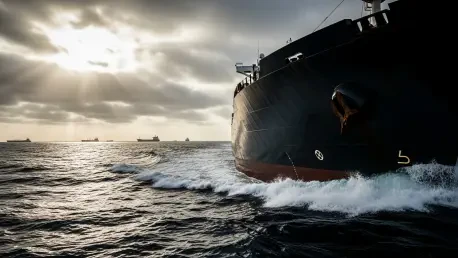

The geopolitical instability currently radiating through the Persian Gulf and the strategic bottleneck of the Strait of Hormuz has transformed one of the world’s most vital maritime arteries into a zone of high-stakes financial risk for global shipping conglomerates. Recent military escalations involving U.S. and Israeli forces against Iranian interests have left the region in a state of near-paralysis, affecting a corridor responsible for approximately twenty percent of global oil transit. Since the onset of these coordinated strikes in late February, the maritime landscape has deteriorated rapidly, with at least one hundred and fifty vessels currently stranded or unable to secure safe passage through the volatile waters. The human and material toll is mounting, as damaged tankers and the tragic loss of life underscore the physical dangers inherent in this conflict. While the physical blockade is a primary concern, the underlying economic shockwaves are rippling through the international insurance markets, forcing a radical recalculation of how risk is priced in an environment where historical data no longer provides a reliable roadmap for security.
Divergence: Rhetoric Versus Economic Reality
The official stance of major industry bodies often presents a veneer of managed stability that stands in stark contrast to the lived experience of shipowners navigating the current crisis. Organizations such as the International Underwriting Association and the International Union of Marine Insurance continue to assert that coverage remains available, emphasizing the resilience of established risk management protocols. They argue that the market possesses the structural integrity to ensure trade continuity even under extreme duress. However, this availability is increasingly theoretical for many smaller operators who find that active coverage is now restricted to single-voyage policies. These agreements are often contingent upon specific government authorizations and the adherence to extremely stringent, often cost-prohibitive, navigation protocols. This discrepancy creates a stratified market where only the most well-capitalized firms can maintain operations, while others are forced to anchor their fleets and wait for a de-escalation that shows no signs of arriving in the near term.
Building on this tension, the major Protection and Indemnity clubs, including industry leaders like Gard and NorthStandard, have taken more drastic measures to protect their capital reserves. By issuing formal notices of cancellation for war risk cover effective in early March, these entities have signaled a profound lack of confidence in the immediate safety of Gulf transit. This move has effectively shifted the burden of risk directly onto the shipowners, who must now seek specialized, high-premium alternatives in a shrinking secondary market. The reality is that while the maritime insurance community attempts to project a professional facade of stability, the operational environment is actually grappling with unprecedented logistical bottlenecks that now affect nearly ten percent of the global container fleet. This disconnect between public institutional reassurance and the aggressive defensive postures of P&I clubs highlights a widening gap in the industry’s ability to absorb the shock of modern state-level maritime warfare.
Financial Strain: The Escalating Price of Transit
The immediate financial impact of these geopolitical maneuvers is most visible in the meteoric rise of war risk insurance rates, which have soared from a standard 0.25 percent to 1.25 percent of a vessel’s total value in a single week. To put this into perspective, a high-value tanker appraised at one hundred million dollars now faces a premium leap from two hundred fifty thousand dollars to over one million dollars for a single transit through the danger zone. Such exponential increases are not merely marginal operational costs; they represent a fundamental shift in the profitability of maritime trade in the Middle East. Furthermore, freight rates for Very Large Crude Carriers have reached historic peaks, with daily costs exceeding four hundred twenty-three thousand dollars. These figures suggest that the market is currently pricing in the high probability of a total loss, reflecting a level of anxiety that surpasses previous regional conflicts. The sheer velocity of these price hikes has left many logistics companies scrambling to renegotiate contracts.
Beyond the immediate premiums, the total insurance requirement for vessels operating in the Gulf has reached a staggering three hundred fifty-two billion dollars according to recent estimates by financial analysts at JPMorgan. This figure represents a volume of risk that far exceeds the current capacity of the private insurance market, leading to concerns about a systemic failure if multiple high-value assets were lost simultaneously. The private market is reaching its saturation point, and the resulting scarcity of coverage is driving a wedge between regional energy security and global supply chain stability. As capacity diminishes, the remaining available insurance becomes a luxury commodity, further inflating the final cost of delivered goods and energy products worldwide. This approach naturally leads to a situation where the maritime industry must look toward state-backed guarantees or international consortia to fill the void left by private underwriters. The strain is palpable, as every day of continued tension pushes the global logistics network closer to a breaking point.
Strategic Responses: Navigating Future Instability
Facing an environment where traditional insurance models are failing to provide adequate protection, shipowners and global energy firms have begun to implement diversified risk-mitigation strategies. These measures include the adoption of advanced real-time satellite tracking and AI-driven threat assessment tools to identify safer corridors, although such technology offers little defense against state-sponsored military action. Some operators have turned toward dark port maneuvers or ship-to-ship transfers in less volatile waters to minimize their exposure to the most dangerous zones. However, these tactical shifts often introduce their own set of regulatory and environmental risks, creating a complex web of liability that complicates the underwriting process even further. The industry is also seeing a rise in the use of private security details, though this adds another layer of significant expense to an already bloated budget. This fragmented response indicates that the maritime sector is currently in a defensive crouch.
In response to these unprecedented challenges, stakeholders in the maritime industry recognized that relying on 2026-era private insurance models was no longer sufficient for long-term survival. Decision-makers moved toward creating sovereign-backed insurance pools to provide a backstop for essential trade, ensuring that energy supplies remained fluid despite the regional volatility. Companies that successfully navigated this period prioritized the integration of robust contingency planning into their core business models rather than treating geopolitical risk as a peripheral concern. Moving forward, the industry must emphasize the development of alternative transit routes and the expansion of domestic refining capacities to reduce the strategic importance of any single waterway. Actionable steps for the coming years include investing in automated vessel technologies that reduce crew risk and pursuing diplomatic efforts to establish blue corridors protected by international law. By decoupling global trade from localized military conflicts, the maritime sector began building a more resilient infrastructure.