
The escalating conflict in the Strait of Hormuz has transformed one of the world’s most vital maritime chokepoints into a high-stakes theater of kinetic warfare. With Brent crude surging past $111 a barrel and more than 5,500 lives lost since the conflict ignited on February 28, the traditional rules of maritime insurance and security have been rendered obsolete. In this exclusive conversation, we sit down with Simon Glairy, a distinguished expert in risk management and marine insurance, to dissect the implications of recent drone strikes, the shifting nature of naval protection, and the precarious future of global energy logistics. We explore the tactical realities facing merchant crews, the legal hurdles of “layered defense” insurance claims, and the broader geopolitical deadlock that threatens to permanently alter international trade routes.
With U.S. helicopters destroying Iranian small boats while attempting to maintain a “one-way lane” for commercial traffic, how do these tactical engagements change the risk profile for merchant sailors? What specific defensive protocols must a crew implement when operating within these designated security zones?
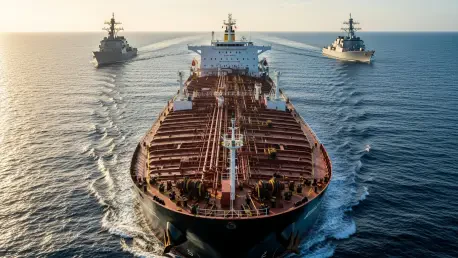
The risk profile has shifted from one of potential harassment to active, high-intensity combat where merchant ships are essentially caught in the crossfire. When U.S. Apache and SH-60 Seahawk helicopters are engaging and destroying six Iranian small boats in the same waters you are navigating, the “one-way lane” feels less like a corridor and more like a gauntlet. Sailors now face the sensory overload of nearby cruise missile launches and the constant threat of drone swarms, which fundamentally alters the psychological and operational burden on the bridge. Crews must strictly adhere to the “Project Freedom” protocols, which include maintaining radar silence where possible and following the granular vetting process that requires full disclosure of beneficial ownership and cargo origins. Beyond the digital paperwork, the physical protocol involves keeping all non-essential personnel below the waterline and preparing for immediate damage control, as the margin for error in a 33-kilometer-wide strait is virtually non-existent.
The recent drone strikes on the VTTI terminal in Fujairah have targeted a critical bunkering hub once considered a safe alternative. How does this expansion of hostilities outside the Strait impact global energy logistics, and what immediate steps should terminal operators take to mitigate fire and injury risks?
The strike on the VTTI terminal is a watershed moment because it shatters the illusion that Fujairah is a sanctuary from the volatility of the Strait. When three Indian nationals are injured and a major fire breaks out at a facility jointly managed by global giants like Vitol and ADNOC, the entire regional logistics chain is thrown into chaos. This expansion forces operators to recognize that any staging point within range of Iranian drones is now a primary target, regardless of whether it sits inside or outside the Arabian Gulf. Immediate mitigation requires terminal operators to deploy advanced missile defense intercepts, similar to those the UAE recently used to stop three Iranian missiles, and to compartmentalize fuel storage to prevent the kind of “major fire” we just witnessed. Furthermore, emergency medical response teams must be stationed on-site to handle blast injuries and inhalation trauma, ensuring that the 20,000 seafarers currently stuck in the region have a fighting chance if their shore-side support is compromised.
Marine insurers are facing uncertainty because current military operations provide a “layered defense” rather than direct ship-to-ship escorts. How does this distinction affect the filing of war-risk claims, and what legal precedents from previous maritime conflicts are most relevant for shipowners navigating these insurance hurdles?
The move away from direct ship-to-ship escorts to a “layered defense” involving electronic warfare and airborne early warning systems creates a massive gray area for underwriters. When a vessel like the HMM Namu catches fire, the lack of a formal naval escort makes it much harder to prove that “all reasonable measures” were taken to avoid the loss, which is a standard requirement in war-risk policies. We are looking at legal precedents like the Yugoslav conflict in the 1990s, where arbitration focused on whether a conflict was formally declared; since “Project Freedom” isn’t a declared war by traditional standards, insurers may struggle to apply certain exclusion clauses. This ambiguity is precisely why war-risk premiums have surged fivefold, as insurers are forced to price the invisible protection of a “defensive arrangement” rather than the tangible safety of a destroyer sitting alongside a tanker.
With conflicting reports regarding whether any merchant ships have successfully transited the Strait, how can shipping companies verify the actual safety of the waterway? Given the recent fire on the HMM Namu, what specialized emergency training is now required for crews operating in high-tension zones?
Verifying safety has become an exercise in navigating propaganda, with the U.S. military claiming safe transits while Iranian officials dismiss these reports as “baseless lies.” For a shipping company, the only reliable metrics are the real-time thermal signatures of vessels in the lane and the status of the “Project Freedom” vetting facility. The fire in the engine room of the HMM Namu, though reported as having no casualties, highlights the desperate need for specialized “hot zone” emergency training. Crews must now be proficient in rapid-response firefighting under the threat of secondary drone strikes, focusing on engine room isolation and emergency propulsion protocols. This isn’t just standard fire drill practice; it’s about tactical survival where seafarers must manage mechanical failures while hearing the roar of Seahawk helicopters overhead.
As some nations ignore sanctions on private refiners and diplomatic proposals remain stalled, how is the geopolitical deadlock affecting the long-term viability of the Strait as a trade route? What specific economic metrics are most indicative of a permanent shift away from this chokepoint toward alternative corridors?
The geopolitical deadlock, fueled by China ordering its companies to ignore U.S. sanctions, is rapidly eroding the Strait’s status as a reliable global artery. When a 14-point diplomatic proposal involving the withdrawal of U.S. forces and the payment of reparations remains stalled, the “commercial closure” of the waterway becomes a long-term reality rather than a temporary disruption. The most telling economic metric is the 80 percent collapse in tanker traffic that occurred even before a physical blockade was declared, suggesting that the market has already “de-risked” by avoiding the area entirely. If Brent crude stays above the $111 threshold and war-risk premiums remain five times higher than their February levels, we will see a permanent shift in investment toward pipelines and corridors that bypass the Musandam peninsula altogether.
What is your forecast for the security and stability of the Strait of Hormuz?
My forecast is one of “managed volatility” where the Strait remains physically open but commercially paralyzed for the foreseeable future. We will likely see more “kinetic exchanges” where the U.S. Navy maintains its layered defense perimeter, but the frequency of drone strikes on regional hubs like Fujairah will keep insurance premiums at prohibitive levels. Until the 30-day ceasefire proposal or a similar diplomatic breakthrough is achieved, the 20,000 seafarers caught in this fracture zone will remain at the mercy of a conflict that has already claimed 5,500 lives. For the global economy, this means the Strait of Hormuz will no longer be viewed as a reliable passage, but as a high-cost combat zone where only the most desperate or the most protected vessels dare to transit.