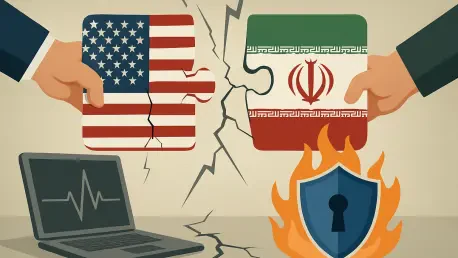

The silent hum of a corporate data center in Ohio carries no hint of the geopolitical storm brewing thousands of miles away, yet a single line of malicious code born from Middle Eastern friction can trigger a financial catastrophe more devastating than any physical blockade. For decades, the friction between the United States and Iran played out through naval maneuvers and diplomatic sanctions, but the modern battlefield has expanded into the microscopic world of packets and protocols. This digital front line has transformed the global cyber insurance market into a high-stakes laboratory where the resilience of private-sector policies is being tested against the weight of state-sponsored aggression. As Iranian IP addresses surge with reconnaissance activity, a critical question emerges for every risk officer: Is this a fundamental transformation of global peril, or simply the loudest background noise the industry has ever encountered?
The shift in the digital landscape serves as a stark reminder that modern conflict is no longer a localized affair. When state actors target critical infrastructure or major financial hubs, the ripples move through the fiber-optic cables that underpin global commerce, dragging every interconnected business into the fray. This evolution forces insurers to rethink how they quantify risk in a world where a local manufacturing plant could become collateral damage in a standoff between world powers. The current atmosphere is not just about a temporary spike in threats; it represents a systemic recalmission of how the insurance industry perceives the “grey zone”—those hostile acts that fall short of declared war but far exceed the scope of common street-level cybercrime.
Beyond the Strait of Hormuz: The Digital Frontline
When geopolitics reach a boiling point, the resulting heat no longer stays confined to desert borders or maritime corridors. It now vibrates through the very infrastructure that allows global trade to function in real time. Recent escalations between the United States and Iran have forced the cyber insurance sector to confront a new era of state-sponsored digital aggression that bypasses physical boundaries entirely. This shift has turned standard policy renewals into complex negotiations about whether a modern insurance contract can withstand the financial fallout of a sophisticated, government-backed campaign. The focus has moved from protecting against isolated thieves to defending against entities with the resources of a nation-state behind them.
The tension currently felt in the market serves as a bellwether for the future of global risk transfer. For years, the industry operated under the assumption that most cyber incidents were financially motivated and predictable. However, the involvement of Iranian-linked actors brings a different motivation—disruption and political leverage. This shift complicates the actuarial models used to set premiums and determine coverage limits. As these actors map out digital vulnerabilities far from the actual conflict zone, the insurance industry is being forced to define the boundaries of what constitutes an insurable event in a world where the distinction between a criminal act and a military strike is increasingly blurred.
Why Geopolitical Volatility Dictates Insurance Premiums
The intersection of international conflict and private-sector insurance is more than a theoretical academic concern; it is a direct driver of market stability and pricing. In an environment where a single state-linked breach can cause billions of dollars in damages, insurers are forced to reassess the fundamental definition of a covered event. This pressure matters because it highlights the vulnerability of businesses operating in the digital grey zone. For a business owner, the current geopolitical climate dictates whether a claim is paid in full or denied under an increasingly scrutinized war exclusion clause. The instability in the Middle East has become a primary factor in how underwriters calculate the likelihood of a catastrophic loss across their entire portfolio.
The volatility seen in the current US-Iran relationship has fundamentally altered the conversation around risk accumulation. Insurers are no longer just looking at individual company security; they are looking at how a single geopolitical trigger could lead to a wave of simultaneous claims across multiple industries. This systemic risk is what drives premiums upward, as carriers seek to build a capital cushion against the possibility of a large-scale offensive. For many organizations, the rising cost of coverage is a direct reflection of the geopolitical temperature, proving that the digital economy is inextricably linked to the stability of traditional international relations.
Analyzing the Friction: Threat Signals versus Underwriting Reality
The cyber insurance industry currently finds itself divided between security researchers monitoring live attack telemetry and underwriters managing the financial aftermath of claims. From the front-end perspective, the operational change is measurable and alarming. Security experts at firms like Coalition have documented a massive surge in reconnaissance activity, noting that digital infrastructure is being mapped at an unprecedented scale. Data shows that Iranian scanning events have peaked at nearly 400,000 in a single day, specifically probing for weaknesses in U.S. infrastructure. This telemetry is often a lead indicator of intent, as state-linked actors identify “low-hanging fruit” like exposed Remote Desktop Protocol connections or aging VPN software before launching a coordinated strike.
Honeypot data further reveals that the geography of risk is highly surgical. U.S. systems consistently face significantly higher pressure from Iranian IP addresses than those in allied nations like Australia or Canada. This suggests that the digital targeting is not random but is instead a direct extension of political animosity. For businesses, this surge in scanning represents a precursor to exploitation. It means that vulnerabilities that might have gone unnoticed by common criminals are now being cataloged by sophisticated adversaries who have the patience and the mandate to wait for the optimal moment to strike. The digital world has effectively removed the safety that physical distance once provided to domestic corporations.
In contrast to these alarming telemetry signals, many global underwriters maintain that the core risk profile for the average business remains surprisingly stable. Experts like Scott Bailey of CFC emphasize that much of the observed activity involves “hacktivism”—website defacements and themed phishing—that generates headlines but rarely triggers catastrophic insurance payouts. Despite the geopolitical drama, the primary drivers of insurance claims continue to be unpatched vulnerabilities and social engineering rather than exotic state-sponsored malware. Small and medium enterprises are often considered collateral rather than primary targets, meaning their actual loss frequency has not yet spiked in tandem with the political rhetoric.
The reality of the risk lies at the intersection of these two viewpoints. While the intent of the adversary has clearly increased, the actual probability of a devastating loss depends on the intersection of intent and infrastructure. The specific focus on remote-access tools suggests that attackers are looking for direct paths into corporate networks. Geopolitical tension increases the likelihood that a routine security failure will be discovered by a sophisticated actor who otherwise might not have bothered with a smaller target. This synthesis suggests that while the “background noise” of the internet has become more dangerous, the fundamentals of defense remain the most effective way to prevent a geopolitical event from becoming a financial disaster.
Expert Insights into Market Adaptation and Portfolio Stability
Industry leaders are utilizing recent incidents as stress tests to refine how they approach accumulation and concentration risk. High-profile breaches, such as the $90 million loss at the Nobitex exchange and the disruptions to state-owned banks like Bank Sepah, serve as critical case studies for what grey zone warfare looks like in practice. These events underscore a difficult reality for the insurance market: while the motivation behind an attack might be political, the fallout is purely financial. This complicates the task for insurance adjusters who must determine whether an event was an act of “war,” which is typically excluded from coverage, or a standard cyberattack.
To address this ambiguity, carriers are moving away from vague phrasing toward more precise definitions of state-sponsored activity. There is a concerted effort across the industry to overhaul how acts of war are interpreted in a digital context. Experts emphasize that the blurring lines between independent criminal groups and government-backed actors require a total transformation of policy language to ensure carrier solvency without alienating policyholders. The goal is to create a framework where businesses can still find protection against state-linked threats while insurers are protected from the kind of systemic, multi-billion dollar losses that could collapse the market entirely.
This evolution has also accelerated a shift toward real-time risk selection. Modern insurers are increasingly moving away from static, annual assessments in favor of dynamic monitoring. By using live telemetry to adjust their underwriting appetite on the fly, insurers can issue urgent alerts to clients when specific geopolitical triggers are detected. For instance, an uptick in Iranian scanning for a specific vulnerability can trigger an immediate notification to all policyholders using that software, allowing them to patch before the reconnaissance turns into an active breach. This proactive approach marks a departure from the traditional “wait and see” model of insurance, turning carriers into active partners in their clients’ security posture.
Strategic Frameworks for Navigating the New Risk Landscape
Brokers and business owners must move beyond reactive measures and adopt a proactive stance to maintain insurability in this increasingly volatile climate. One of the most critical steps involves the hardening of remote-access infrastructure. In response to the surge in VPN and RDP scanning, insurers have significantly raised the bar for minimum security requirements. Multi-factor authentication is no longer considered an optional layer of protection; it has become an absolute prerequisite for coverage. Companies must demonstrate a disciplined schedule for updating internet-facing services to close the window of opportunity for state actors who are constantly searching for entry points.
Beyond technical controls, brokers are facilitating deeper discussions regarding policy audits for grey zone events. Understanding the nuances of attribution—the process of determining who was behind an attack—is essential for managing expectations before a crisis occurs. Businesses need to know how their policy responds to a state-linked attack that is not officially declared as part of a war. These proactive audits allow organizations to identify gaps in their coverage and make informed decisions about their risk appetite. By clarifying these definitions during the underwriting process, companies can avoid protracted legal battles during the claims process.
Technical prevention must be paired with operational resilience to mitigate the potential for collateral damage from politically motivated strikes. Maintaining robust, air-gapped offline backups ensures that even a destructive “wiper” attack does not lead to total business failure. Furthermore, companies are increasingly engaging in live simulation drills that rehearse the response to a state-linked breach. These rehearsals help organizations minimize downtime and manage the complex public relations and legal challenges that inevitably follow a high-profile, politically motivated attack. Building this kind of resilience is the only way to ensure that a business can survive in an era where the digital and political worlds are permanently intertwined.
The landscape of risk underwent a permanent shift as the industry looked back at the lessons learned from recent geopolitical cycles. Carriers recognized that waiting for a formal declaration of war was no longer a viable strategy for determining coverage in the digital age. Instead, the focus moved toward creating more flexible, data-driven policies that accounted for the reality of state-sponsored disruption. This transition allowed for a more honest dialogue between insurers and policyholders, where the limitations of the market were clearly defined alongside the responsibilities of the insured. The industry prioritized the development of standardized attribution frameworks to help adjusters make faster, more accurate decisions during high-stress events.
Moving forward, the emphasis shifted toward continuous education and the integration of geopolitical intelligence into everyday security operations. Organizations began to view their cyber insurance not just as a financial safety net, but as a component of their broader strategic defense. The successful companies were those that treated cybersecurity as a dynamic, ongoing process rather than a check-the-box exercise for their annual renewal. By embracing real-time monitoring and strict adherence to hygiene standards, the market demonstrated that it could remain resilient even in the face of escalating international tensions. The final takeaway was a renewed focus on the human element, ensuring that incident response teams remained prepared for the psychological and operational pressure of a nation-state confrontation.