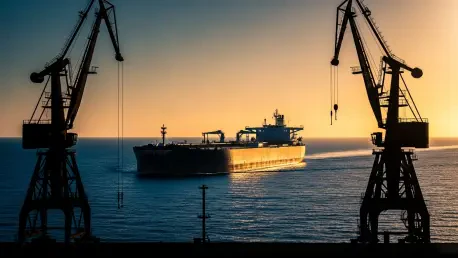

While Iranian patrol boats slice through the turquoise waters of the Persian Gulf, a much more formidable barrier is being erected by underwriters in the quiet office towers of London and Singapore. A sudden 500% spike in operating costs has the power to paralyze almost any global industry, but when that industry is responsible for moving one-fifth of the planet’s oil supply, the result is a global economic cardiac arrest. This burgeoning “virtual blockade” is proving to be just as effective as a physical naval minefield, as the sheer price of a single transit now threatens to eclipse the profit margins of the very energy cargo being transported.
The current crisis is not merely a military standoff; it is a profound failure of the financial safety nets that keep global trade afloat. For decades, the Strait of Hormuz has served as the primary artery for 20% of global oil, yet its reliability has been shattered by a volatile mix of military escalation and diplomatic ambiguity. As the price of crude oil begins to fluctuate wildly, the realization is setting in that the maritime industry is facing a challenge it cannot simply sail around. The cost of risk has become the new border, and it is a border that many shipowners are finding impossible to cross.
The Fivefold Tax on Global Energy
The economic math of a voyage through the Middle East has been completely rewritten overnight. War risk premiums, which usually hover at a negligible 0.2% of a ship’s total hull value, have surged to 1.0% or higher within a matter of days. For a modern supertanker valued at $100 million, this represents a massive $1 million expense for a single seven-day transit. This “insurance tax” creates a hard stop for many operators because the slim margins of the energy trade cannot absorb such radical overhead.
Furthermore, this financial pressure is not distributed evenly across the sector. Smaller independent carriers are being squeezed out of the market entirely, leaving only state-backed fleets or the largest conglomerates to navigate the channel. When the cost of protection becomes more expensive than the physical operation of the vessel, the market essentially ceases to function. This reality is forcing energy stakeholders to reconsider the viability of long-standing trade routes that were once considered the bedrock of global energy security.
A Fragile Truce Shattered by Geopolitical Reality
The instability currently gripping the region stems from a collapse in diplomatic clarity following intense military strikes in Lebanon. A tentative ceasefire brokered between the United States and Iran appeared to offer a path toward stability, but the agreement disintegrated when the scope of its protections was called into question. The exclusion of Lebanon from the truce—a point clarified by the Trump administration—prompted Tehran to immediately reseal the strait. This move was not just a military gesture but a targeted strike against the commercial predictability of the region.
The breakdown of this truce has nullified the immediate benefits of months of negotiations, leaving the maritime channel in a state of high-alert limbo. Iran’s coast guard has stepped up patrols, threatening to destroy any vessel attempting unauthorized transit. This aggressive posture, combined with the lack of a clear diplomatic off-ramp, has signaled to the global community that the strait is no longer a neutral zone of commerce. Instead, it has become a high-stakes bargaining chip in a larger regional conflict.
The Mechanics of a Virtual Blockade
The transition from a military threat to a commercial impossibility is driven by the specific mechanics of marine insurance contracts. Maritime transit requires a synchronized triad of hull, cargo, and Protection & Indemnity (P&I) insurance. When insurers withdraw capacity or shift to complex voyage-by-voyage assessments, the administrative burden alone can ground a fleet. Insurers are no longer offering blanket annual policies for the region; instead, they are scrutinizing every single movement with an eye toward total loss scenarios.
Moreover, the withdrawal of insurance capacity creates a vacuum that even the most daring shipowners cannot fill. Without P&I coverage, a vessel is legally prohibited from entering most international ports, as it lacks the guarantee to cover environmental disasters or third-party liabilities. This creates a cascading effect where a ship might be physically able to sail through the strait, but it becomes a “pariah vessel” the moment it exits, unable to dock or offload its cargo in any major global hub.
Industry Perspectives on a Fundamental Market Shift
Market analysts, including those from firms like Howden Re, observe that the insurance industry is undergoing a structural transformation rather than a temporary price hike. There is a growing consensus that the “risk appetite” for Middle Eastern transits has vanished, leading to a restricted pool of available coverage. This is not a standard cyclical fluctuation; it is a permanent repricing of geopolitical risk that will affect how every energy contract is written for the foreseeable future.
Expert opinion suggests that the market will not immediately revert to previous rates even if a new diplomatic resolution is reached tomorrow. The volatility has forced a fundamental rethink of trade credit and political violence sectors, reflecting a new era of heightened sensitivity to regional instability. This shift means that the “volatility premium” is being baked into the global economy, ensuring that even in times of relative peace, the cost of doing business in the Middle East will remain significantly higher than it was in previous years.
Navigating the New Economic Perimeter
Moving forward, shipowners and energy stakeholders had to shift toward aggressive risk management and operational flexibility. Companies began to factor in the “volatility premium” as a permanent line item rather than a temporary spike. Practical strategies that emerged included diversifying transit routes through more expensive but stable alternatives and securing long-term insurance capacity well before crises peaked. The utilization of real-time geopolitical intelligence became a mandatory requirement for anticipating “hard stops” in coverage before vessels even left port.
In the end, the ability to manage insurance complexity proved to be the deciding factor in whether global energy markets remained fluid or ground to a halt. As long as the threat of military escalation remained, the industry had to accept that the virtual blockade was a permanent feature of the modern landscape. Stakeholders eventually realized that the only way to bypass the insurance barrier was to invest in regional bypass pipelines and alternative energy sources, effectively beginning the long process of decoupling global prosperity from the narrow, troubled waters of the Strait of Hormuz.