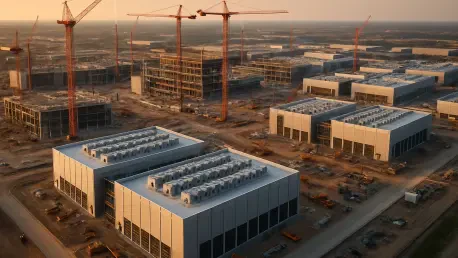

The global race to achieve artificial intelligence supremacy has ignited a physical construction frenzy that is currently reshaping the foundations of international finance and industrial planning. This unprecedented expansion is anchored in a massive build-out of specialized data centers, a phenomenon that has evolved into what many economists now characterize as the largest peacetime investment project in modern human history. Projections indicate that global spending on these critical facilities is set to reach a staggering $7 trillion by 2030, with the vast majority of this capital being funneled into AI-optimized campuses designed to house thousands of high-performance chips. As these facilities become more complex and capital-intensive, they are presenting a profound stress test for the global insurance and financial sectors, which were previously accustomed to more predictable infrastructure cycles. This scale of investment has necessitated a rapid departure from traditional corporate funding methods, moving away from the internal balance sheets of technology giants toward more intricate and less transparent private equity and credit structures.
The Shift Toward Opaque Private Financing
A significant transformation is currently occurring in the way these massive AI projects are funded, marking a clear move away from the traditional reliance on the cash reserves of Big Tech hyperscalers. Landmark transactions for new infrastructure developments now regularly exceed the $10 billion mark, with several high-profile consortia involving industry leaders like Nvidia and Microsoft managing deals that reach as high as $40 billion. These entities frequently utilize special-purpose vehicles and off-balance sheet financing to manage the sheer volume of capital required for next-generation facilities. By moving these liabilities off the primary balance sheet, companies can maintain their credit ratings while continuing to fuel aggressive expansion. However, this trend has introduced a layer of complexity that makes it difficult for analysts to track the total debt load within the sector. Private credit has stepped in to fill the gap left by traditional banks, offering flexible but often more expensive and less regulated capital to developers who are racing against time to bring capacity online.
This shift toward off-balance sheet structures has triggered urgent warnings from financial experts and federal regulators regarding a systemic lack of market transparency. Many observers are drawing uncomfortable comparisons to the financial climate that preceded the 2008 global crisis, noting a distinct sense of “deja vu” regarding the limited visibility and astronomical scale of these emerging debt markets. US lawmakers have already signaled their concerns to oversight agencies, arguing that these complex financial arrangements could lead to destabilizing losses for a wide range of downstream investors. Pension funds and insurance companies, often seeking stable long-term yields, may inadvertently find themselves exposed to high-risk AI debt without fully understanding the underlying collateral or the volatility of the technology. The opacity of these private deals means that if the projected demand for AI services fails to meet expectations, the resulting financial contagion could spread through the global economy far more quickly than anticipated, as the interconnections between private lenders and public institutions remain largely unmapped and unregulated.
Challenges in Insurance Capacity and Bespoke Risk
The concentration of immense physical and digital value in single geographic locations has created a severe capacity bottleneck within the global insurance marketplace. In the current landscape, a single AI data center campus can easily reach a valuation of $20 billion, representing a concentration of risk that was virtually unheard of only a few years ago. Historically, data centers were viewed by underwriters as highly attractive and manageable risks due to their robust fire suppression systems and controlled environments. However, the sheer dollar amount required to cover a modern AI site now frequently exceeds the maximum limits that even the largest individual insurance carriers are willing or able to provide. By 2026, the industry is struggling to adapt, often relying on the creation of specialized consortia where dozens of insurers must pool their resources just to provide basic property coverage for a single facility. This fragmentation of risk management makes the claims process significantly more complex and can lead to lengthy disputes over liability when high-value equipment is damaged.
To address these mounting pressures, major insurance brokers are fundamentally evolving their business models by establishing multi-disciplinary teams focused exclusively on digital infrastructure. These specialists are crafting bespoke policies that go far beyond traditional property and casualty coverage, moving toward hybrid models that simultaneously address real estate value, specialized technology assets, and complex business interruption risks. For instance, new facility-style products like the “Nimbus” initiative have been launched to offer multi-billion dollar construction limits in key regions like the UK and Europe. Furthermore, insurers are being forced to close significant coverage gaps in cargo and marine insurance, as high-performance AI components are often stockpiled in third-party warehouses for months before they are officially installed in a data center. This “middle period” of storage creates a unique risk profile where traditional policies may not apply, leaving developers vulnerable to massive losses if high-value components are stolen, damaged, or lost during the transit and staging phases of a project.
Operational Hazards and Grid Stability
The environmental and operational demands of modern AI facilities have added significant layers of complexity for underwriters, particularly concerning the unprecedented level of power consumption required. Current projections suggest that these data centers could account for nearly 8% of the total electricity demand in the United States by 2030, a figure that has effectively doubled in a very short timeframe. This massive energy appetite introduces a critical “power-availability risk,” where the stability and reliability of the local electrical grid become primary factors in determining both risk assessment and premium pricing. Insurers are no longer just looking at the physical structure of a data center; they are now performing deep-dive audits of the surrounding utility infrastructure. If a regional grid is deemed too fragile to support the continuous, high-intensity load of an AI cluster, developers may find it nearly impossible to secure the necessary insurance or may be forced to pay exorbitant rates that threaten the overall profitability of the project.
Geographic concentration further complicates this risk profile, as many of the world’s most prominent AI clusters are situated in regions that are increasingly vulnerable to natural disasters. From windstorms along the US East Coast to flooding risks in Northern Europe, the accumulation of billions of dollars in hardware in disaster-prone areas means that a single catastrophic event could result in an unprecedented insurance payout that dwarfs previous industrial losses. Consequently, insurers are now factoring long-term power purchase agreements and rigorous sustainability targets into their core underwriting models. They are incentivizing developers to invest in redundant power sources and on-site energy storage to mitigate the impact of grid failures. This shift ensures that the long-term viability of these projects is not just dependent on the technology itself, but on a holistic integration with the physical environment and the local energy ecosystem, forcing a level of transparency in operational planning that was previously absent from the sector.
The GPU Debt Treadmill and Asset Obsolescence
A particularly volatile development in the AI sector is the rise of GPU-backed financing, a model where high-performance chips are used as collateral for multi-billion dollar loans. This practice creates a fundamental and dangerous mismatch between the long lifespan of a physical data center building and the incredibly short functional life of the hardware housed within it. While a well-built facility may stand and operate for decades, the specialized GPUs that serve as the collateral for these massive loans often become technologically obsolete within five to seven years. This creates a “treadmill” effect where operators are forced to constantly raise more debt to upgrade their hardware before the previous loans have even been fully settled. If the pace of technological advancement continues to accelerate, the value of the collateral could plummet long before the debt is retired, leaving lenders with assets that are worth only a fraction of their original purchase price and creating a potential for widespread defaults across the industry.
For the insurance and reinsurance industry, this rapid technological turnover complicates the process of valuing and insuring assets with any degree of accuracy. Carriers must now grapple with the challenge of structuring replacement cost provisions for equipment that loses its market value far faster than traditional industrial infrastructure. This tension is driving a much more cautious approach from global lenders and is forcing the insurance market to refine how it prices the risks associated with fast-evolving and rapidly depreciating technological assets. To manage this uncertainty, some insurers are moving toward “agreed-value” clauses that strictly limit the payout based on the age of the hardware, while others are demanding more frequent audits of the technology stack. Moving forward, financial institutions and developers must prioritize the creation of more sustainable debt structures that align repayment schedules with the actual lifecycle of the hardware. Establishing secondary markets for older chips and implementing more robust recycling and refurbishment programs will be essential steps in stabilizing the financial ecosystem and preventing a bubble driven by technological churn.