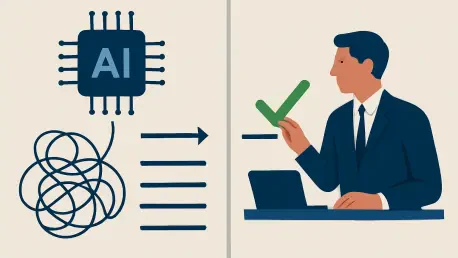

The insurance industry’s journey with artificial intelligence has reached a pivotal inflection point, moving beyond the initial promise of complete automation to embrace a far more nuanced and powerful collaborative model. The initial vision of algorithms single-handedly managing the complexities of underwriting, claims, and policy administration has given way to the practical reality that technology, for all its processing power, lacks the critical judgment, contextual understanding, and intuitive reasoning that define human expertise. This has led to the rise of a hybrid strategy known as the Human-in-the-Loop (HITL) model, a framework built on the philosophy of “AI first. Humans when it matters.” This approach leverages AI for what it does best—ingesting and processing vast quantities of data at incredible speeds—while strategically integrating experienced insurance professionals to handle the exceptions, inconsistencies, and complex scenarios that require sophisticated cognitive skills. It is not a retreat from technological advancement but a sophisticated evolution, recognizing that the true transformation lies in the synergy between machine efficiency and human insight, creating a system that is both scalable and trustworthy.
The Symbiotic Relationship of AI and Human Expertise
Redefining Accuracy and Accountability
The Human-in-the-Loop model fundamentally reshapes the traditional structure of data processing responsibility within an insurance organization by shifting the burden of data accuracy away from the insurer’s internal teams and placing it squarely on the service provider. In this integrated workflow, the provider’s own seasoned insurance experts are embedded directly into the AI-driven process. After the AI completes its initial pass of ingesting documents and extracting key data points, these human specialists step in to perform a crucial validation phase. They meticulously review, correct, and normalize the AI-generated output, ensuring that every piece of information is consistent, structured, and free from ambiguity. This direct intervention addresses the inherent limitations of automation, catching nuanced errors or interpreting non-standard information that an algorithm might miss. The ultimate benefit for the insurer is profound: they receive a final data set with near-perfect accuracy, ready for immediate application in underwriting, claims, or analytics. This eliminates the time-consuming and costly rework that often plagues data-heavy processes, freeing up internal staff to focus on their core, high-value responsibilities and accelerating the entire decision-making lifecycle.
This operational shift is not merely a matter of convenience; it is a necessary evolution driven by the inherent complexities of insurance documentation. Standalone AI, while powerful, often struggles to interpret the vast spectrum of unstructured and semi-structured information it encounters. This can include anything from handwritten notes on a submission form and non-standard policy language crafted for a unique risk to ambiguous phrasing that requires deep industry context to decipher correctly. A human expert, by contrast, brings a wealth of experience and cognitive flexibility to the table. They can apply contextual knowledge, understand industry jargon, recognize subtle patterns, and make intuitive judgments that are currently beyond the reach of even the most advanced algorithms. The HITL model strategically deploys this human intelligence at the most critical junctures, transforming the AI from a potentially unreliable tool into a highly effective assistant. This ensures that the final data product is not just fast but also verifiably accurate, forming a dependable foundation for critical business functions like risk assessment and pricing.
Practical Applications in the Insurance Workflow
During the critical submissions processing stage, the Human-in-the-Loop model acts as a powerful quality control gateway, ensuring that underwriters receive pristine, reliable information from the very start. When a submission package arrives, the AI system first performs the heavy lifting, rapidly ingesting documents and extracting dozens or even hundreds of data points. However, before this information ever reaches an underwriter’s desk, it is funneled to a team of human experts for a comprehensive pre-review. These specialists validate every extracted field, correct any errors the AI may have made, fill in missing information, and resolve inconsistencies between different documents within the submission. This meticulous validation process transforms a raw, potentially flawed data stream into a clean, structured, and fully vetted submission file. As a result, underwriters can begin their risk assessment immediately, confident in the integrity of the data before them. This eliminates the tedious and time-consuming task of data verification, allowing them to dedicate their expertise entirely to the strategic work of evaluating risk, which in turn leads to faster quote generation, higher productivity, and more consistent underwriting decisions across the organization.
The value of the HITL framework extends well beyond the initial submission and into the post-issuance phase of the insurance lifecycle, where accuracy is paramount for binding and distribution. After a quote has been generated or a policy has been issued, the model is employed to conduct a detailed validation and comparison of the final documents. Human experts, augmented by AI tools, meticulously compare the terms, limits, sub-limits, and conditions outlined in the quote against the binder or the final policy. This systematic review ensures that what was quoted is precisely what was issued, catching any discrepancies that could lead to significant downstream problems, such as coverage gaps, client disputes, or errors and omissions (E&O) exposure. By guaranteeing an exact match across all related documents, this process provides a crucial layer of assurance for all stakeholders. It allows insurers to bind policies with full confidence and enables seamless, error-free distribution to clients and partners, reinforcing the company’s reputation for precision and reliability in a highly competitive market.
Building Trust and Fostering Adoption
The Psychological Impact of Human Validation
A primary catalyst for the widespread adoption of the Human-in-the-Loop model is its profound impact on building trust in artificial intelligence systems, a factor that has historically been a significant barrier to implementation. Research indicates that the simple act of having a human expert validate AI-generated outputs can increase an organization’s trust in the technology by a staggering 83%. This dramatic rise in confidence stems from the model’s ability to demystify the “black box” nature of many AI solutions. When the decision-making process of an algorithm is opaque, stakeholders are naturally hesitant to rely on its output for high-stakes decisions. The HITL model injects a crucial layer of transparency and accountability into the process. The human review serves as a tangible quality guarantee, assuring underwriters, managers, and executives that the data has been vetted for accuracy and context by a knowledgeable professional. This visible oversight transforms AI from a mysterious and potentially fallible technology into a dependable and verifiable tool, making it far more palatable to the risk-averse culture that characterizes much of the insurance industry and paving the way for deeper, more confident integration.
The fusion of machine speed with human reliability creates a powerful framework for achieving scalable and trustworthy automation. Purely algorithmic solutions can certainly scale in terms of volume and speed, but this often comes at the expense of accuracy, as the rate of exceptions and errors can grow in tandem with the workload. This erosion of reliability quickly undermines trust and can negate the very efficiencies the technology was meant to create. The HITL model circumvents this problem by creating a self-reinforcing cycle of improvement. The AI handles the vast majority of routine data processing, freeing up human experts to concentrate their efforts on the most complex and ambiguous cases. Their resolutions to these exceptions can then be used as training data to refine the AI model, making it smarter and more accurate over time. This collaborative dynamic ensures that as the system scales, its dependability does not degrade; it actually improves. It is this unique ability to deliver both efficiency and trustworthiness at scale that makes the HITL approach a sustainable and superior long-term strategy for implementing AI in the complex, high-stakes environment of the insurance industry.
A New Paradigm for Insurtech
The industry’s evolution demonstrated a significant shift away from the binary debate of human versus machine. It became clear that the most effective path forward was a hybrid approach that capitalized on the distinct strengths of both. This collaborative framework, which paired the processing power of AI with the nuanced judgment of human professionals, rapidly became the new standard for digital transformation. Insurers who adopted this model found they could not only accelerate their workflows but also dramatically improve the quality and reliability of their data. This synthesis of technology and expertise laid the groundwork for a new era in insurtech, one defined by pragmatic innovation and verifiable results, proving that the most powerful solutions were those that augmented human skill rather than attempting to replace it. The successful integration of this model set a new benchmark for accuracy, efficiency, and trust across the sector.