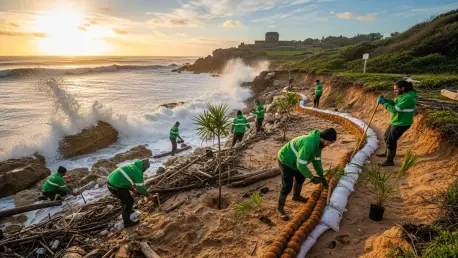

What happens when the places that define a nation—think historic treasures like Hampton Court Palace or the Giant’s Causeway—face the unrelenting force of a changing climate? Today, in 2025, the insurance industry stands at a pivotal crossroads, tasked not just with managing fallout but with forging a resilient future. Leading this charge is Aviva, a global insurer protecting 25.2 million customers across the UK, Ireland, and Canada, setting a bold example for how the sector can confront climate threats head-on. This story isn’t just about numbers or policies; it’s about safeguarding heritage, homes, and hope against an unpredictable tomorrow.
The stakes couldn’t be higher. Climate change isn’t a distant concern—it’s a present crisis, with flooding, subsidence, and extreme heat threatening millions of properties and iconic landmarks. Aviva’s latest Building Future Communities report paints a stark picture: by 2050, eight million UK properties could be at risk of flooding, while 1.4 million face potential subsidence. Beyond statistics, these risks touch the heart of cultural identity, endangering sites that draw visitors from around the world. The insurance industry, with its knack for risk assessment and deep financial resources, is uniquely positioned to turn this tide, making climate resilience not just a choice but an urgent priority.
Why Climate Resilience Defines the Insurance Frontier
Delving deeper, the shift toward resilience marks a new chapter for insurers. No longer confined to processing claims, companies like Aviva are stepping into a proactive role, driven by the reality that inaction could lead to spiraling costs. Floods and erosion don’t discriminate, impacting both modest family homes and storied castles alike. This evolving landscape demands innovative thinking, positioning the sector as a key player in protecting both physical spaces and economic stability.
Moreover, the ripple effects extend far beyond property lines. When landmarks suffer, local economies tied to tourism take a hit, and communities lose pieces of their shared history. Insurers hold the tools—data, funding, and influence—to bridge these gaps, making their involvement a societal imperative. Aviva’s leadership in this space signals a broader industry awakening to the need for adaptation over mere reaction.
The Growing Threat of Climate Impacts
Focusing on the challenges, climate change brings a cascade of dangers that are intensifying rapidly. Coastal erosion threatens to reshape shorelines, while extreme weather events grow more frequent, putting pressure on infrastructure and heritage sites. Edinburgh Castle, perched on its historic hill, faces risks from slope instability, a reminder that even the most enduring symbols are vulnerable. These threats aren’t abstract—they translate into real losses for homeowners and businesses alike.
Equally concerning is the economic fallout. Unchecked climate impacts could inflate insurance claims to unsustainable levels, straining both insurers and policyholders. The industry’s expertise in forecasting risks offers a pathway to mitigate these burdens, but only if action is taken now. This urgency underscores why adaptation isn’t a luxury—it’s a necessity for survival in a warming world.
Aviva’s Game-Changing Strategies for Resilience
Turning to solutions, Aviva has rolled out a multifaceted approach that’s redefining industry standards. Its Building Future Communities report isn’t just a warning; it’s a blueprint, using data to predict vulnerabilities and inform protective strategies. These insights help prioritize areas most at risk, ensuring that both tangible assets and intangible heritage are shielded from future harm.
Additionally, Aviva’s £80 million (about US$105.8 million) investment in nature-based projects stands out as a visionary move. By funding initiatives like carbon capture and habitat restoration, the company tackles flood resilience at its root, reducing potential claims while boosting ecosystems. This dual benefit—environmental and financial—illustrates how strategic investments can create widespread positive impact.
Not stopping there, Aviva’s pledge to reach net zero by 2040 cements its role as a sustainability leader. Embedding green practices into its core operations, including dedicated roles like Director of Environmental Sustainability, shows a commitment that goes beyond rhetoric. This holistic strategy offers a model for others in the sector to follow, blending ambition with actionable change.
Voices Shaping the Climate Conversation
Behind these efforts are leaders driving the narrative forward. Jason Storah, CEO of Aviva UK & Ireland General Insurance, captures the challenge succinctly: “It’s about tackling climate change head-on while getting climate-ready—through bold, large-scale moves and small, local steps.” His words highlight the balance between systemic solutions and community-level action, urging a collective push for preparedness.
Equally impactful is Leah Ramoutar, Aviva’s Director of Environmental Sustainability, whose vision resonates globally. Speaking at a major sustainability summit this year, she emphasized the sector’s potential to fuel low-carbon growth by underwriting renewable energy and supporting electric vehicle adoption. Representing Aviva in forums like the UNEP FI Principles for Sustainable Insurance, Ramoutar’s influence extends industry-wide, advocating for policies that align profit with planet.
This momentum isn’t isolated. Across the insurance landscape, sustainability roles are gaining prominence, reflecting a shared recognition of climate’s centrality to business strategy. Aviva’s efforts, while pioneering, are part of a growing chorus of companies and experts collaborating to reshape how risks are managed in an era of environmental uncertainty.
Practical Pathways to a Resilient Future
Drawing lessons from Aviva, actionable steps emerge for building resilience. Data remains a cornerstone—insurers and communities alike can harness predictive analytics to spotlight at-risk areas and tailor responses. Such proactive planning shifts the focus from recovery to prevention, saving resources in the long run.
Investment in protective measures also proves critical. Nature-based solutions, like those Aviva champions, offer a scalable model for reducing climate impacts while enhancing local environments. Governments and private entities can replicate this by funding projects that address immediate threats, such as flooding, with lasting ecological benefits.
Finally, collaboration stands as the linchpin. Insurers, policymakers, and residents must unite on initiatives ranging from infrastructure upgrades to grassroots efforts. Aligning corporate goals with sustainability—through dedicated leadership and clear targets like net zero—ensures that climate readiness becomes a shared mission, woven into the fabric of decision-making across all levels.
Looking back, Aviva’s journey through 2025 showed a remarkable pivot, transforming the insurer from a traditional risk handler into a vanguard of climate resilience. Its blend of data-driven foresight, substantial investments, and vocal leadership carved a path that others began to tread. As the industry reflected on these strides, the next steps became clear: scaling these efforts demanded even broader partnerships and deeper commitments. The challenge then was to inspire every stakeholder—from global firms to local councils—to invest in protective innovations and advocate for policies that prioritized a sustainable, secure future for all.