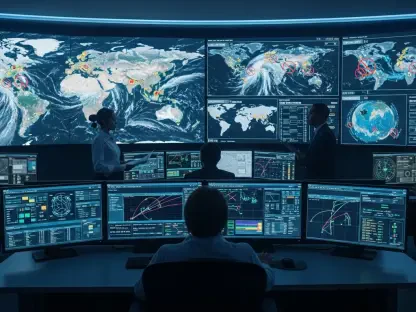

The global economy currently rests upon a fragile foundation of atmospheric predictability that is being tested by both natural volatility and shifting federal priorities. For the insurance sector, the National Oceanic and Atmospheric Administration (NOAA) represents far more than a scientific body; it is the primary engine generating the raw data required to price risk, maintain solvency, and protect trillions of dollars in assets. Recent legislative developments, specifically the Weather Research and Forecasting Innovation Reauthorization Act (S. 3923), have revealed a powerful alliance between private insurance giants and federal meteorologists. This partnership highlights a growing recognition that the survival of America’s weather infrastructure is now a non-negotiable cornerstone of national economic security.
The High-Stakes Battle: America’s Weather Infrastructure
The stability of the modern marketplace is increasingly tethered to the accuracy of environmental forecasting. As we navigate the current landscape, the insurance industry finds itself in an aggressive lobbying position to reverse a 20% decline in the federal weather workforce. This shortfall is not merely a bureaucratic concern but a direct threat to the data pipeline that allows companies to forecast catastrophic events. Without a fully functional National Weather Service (NWS), the private sector faces a “data blackout” that could render many regions uninsurable.
Legislative efforts are currently focused on stabilizing an agency that has been plagued by budget uncertainty. While some federal proposals have sought to reduce funding by over a billion dollars, a bipartisan coalition in Congress is pushing back, viewing the protection of NOAA as a defensive measure for the economy. The industry argues that the $170 million annual investment in weather research outlined in current bills is a minor price to pay compared to the multi-billion dollar losses incurred when forecasts fail to provide adequate lead times.
The Evolution of Weather Policy: From 2017 to the Present
The current urgency is rooted in the legacy of the 2017 Weather Act, which transformed hurricane tracking and significantly extended the warning window for tornadoes. These advancements provided insurers with the granular insights needed to issue more precise policies and advise clients on effective loss mitigation strategies. However, since the start of 2025, the trajectory has shifted toward austerity. A combination of aggressive budget cuts and a shrinking pool of specialized talent has left many NWS offices unable to maintain 24-hour operations in critical zones.
Understanding this historical shift is essential to recognizing why the insurance sector views current “operational gaps” as an existential business threat. The transition from a period of robust technological growth to one of “skeleton crew” staffing has created a volatile environment for risk managers. Consequently, the push for reauthorization is an attempt to regain the momentum lost to recent fiscal tightening and to ensure that the progress made over the last decade is not permanently erased by short-term political maneuvering.
The Symbiotic Relationship: Data and Risk
Financial Safeguards Through Accurate Forecasting
The American Property Casualty Insurance Association (APCIA) has emerged as a leading voice for S. 3923, asserting that the private market cannot function effectively in a data vacuum. Every actuarial model used to set premiums for homes, vehicles, and commercial properties relies on the historical and predictive datasets generated by NOAA. When the margin for error in these models widens due to poor data, the result is either skyrocketing premiums for consumers or catastrophic financial hits for providers.
Monitoring Specialized and Regional Hazards
Beyond general daily forecasts, the insurance industry is advocating for specialized programs that target localized catastrophes. New legislative frameworks aim to establish rigorous protocols for fire weather, atmospheric rivers, and landslide preparedness—events that have historically accounted for massive insured losses. By modernizing radar systems and integrating artificial intelligence, the bill promises a level of precision that the private sector is incapable of achieving independently. For rural farmers and urban developers, this data represents the difference between a manageable setback and a total financial wipeout.
Addressing the Human Capital Crisis in Meteorology
The most pressing challenge currently facing the weather enterprise is a personnel shortage that undermines the reliability of federal observations. With hundreds of positions vacant at the NWS, the industry is wary of a future where the “raw materials” of their risk models are based on incomplete analysis. This crisis is exacerbated by political tensions that have targeted research laboratories for closure. The insurance industry’s intervention focuses on preserving the “brain trust” of federal meteorology, recognizing that even the most advanced AI tools require human expertise to interpret complex atmospheric shifts accurately.
Technological Shifts: The Future of Public-Private Partnerships
The landscape of weather observation is moving toward a hybrid model where government agencies and private firms share the burden of data collection. Current legislative proposals authorize $100 million annually for commercial data programs, signaling a shift where NOAA acts as a central hub for information purchased from private satellite and sensor companies. This evolution allows for the integration of machine learning to process massive data streams, potentially providing hyper-local forecasts that were previously impossible to generate.
However, experts suggest that this technological leap requires a stable regulatory and budgetary environment to succeed. If federal funding remains volatile, the private sector may hesitate to invest in the infrastructure needed to support these innovations. A reliable partnership between the public and private spheres is the only way to ensure that the insurance industry has the high-frequency data it needs to stay profitable in an increasingly turbulent climate.
Strategic Implications: Businesses and Policyholders
For businesses and consumers, the outcome of this legislative struggle will dictate the availability and cost of coverage. If NOAA’s capabilities continue to erode, we can expect the expansion of “insurance deserts”—geographic areas where the lack of reliable data makes the risk too high for insurers to operate. Stakeholders must prepare for a future where data-driven mitigation becomes mandatory; companies that proactively invest in resilience measures based on federal data will likely secure more favorable terms.
Furthermore, professionals in the real estate and agricultural sectors should monitor the progress of companion bills like H.R. 5089. The passage of such legislation will determine the precision of the tools available for long-term land-use planning and crop insurance. As the reliability of government data becomes a competitive advantage, staying informed on these policy shifts is essential for any entity with significant exposure to environmental risks.
Safeguarding the Foundation of National Security
The movement to stabilize NOAA focused on protecting the financial architecture that allows society to recover from large-scale disasters. The insurance industry demonstrated that certain public goods are too vital to be subject to the whims of shifting political budgets. As the atmosphere became more volatile, the interdependence between federal science and private finance deepened significantly. Ultimately, the preservation of federal weather infrastructure served as a prerequisite for a resilient economy, ensuring that when storms arrived, the nation possessed both the data to withstand them and the financial mechanisms to recover. The strategic alignment between meteorologists and insurers proved that protecting scientific data was, in reality, an act of protecting the nation’s wealth and future stability.