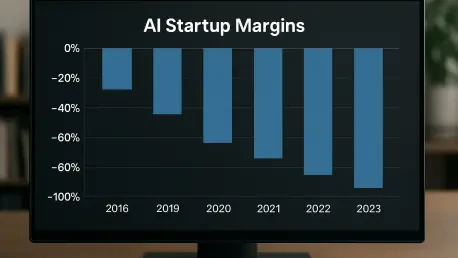

Simon Glairy has spent years at the intersection of risk management and the digital economy, helping organizations navigate the volatile landscape of Insurtech and AI-driven assessment. As artificial intelligence moves from a speculative tool to a core operational expense, the challenge of maintaining profitability while scaling has become a central concern for fintech leaders. In this discussion, we explore the shift from traditional subscription models toward automated, usage-based pricing, examining how new financial tools allow companies to transform raw API costs into sustainable profit centers while managing the inherent risks of agentic workflows.
Traditional subscription models often struggle with high token consumption. How does implementing an automated markup percentage on raw LLM costs change a startup’s unit economics, and what specific steps should developers take to ensure this usage-based pricing remains transparent to the end user?
Moving toward an automated markup is a fundamental shift that protects a startup’s bottom line from the unpredictability of user behavior. In the past, a heavy user could easily force a company to operate in the red because the cost of underlying tokens exceeded the fixed subscription fee. By implementing a consistent margin, such as a 30% markup over raw costs, a developer transforms a volatile expense into a reliable revenue stream where every single interaction contributes to the margin. To maintain transparency, developers should integrate real-time dashboards that show customers exactly how many tokens they are consuming and what the associated costs are. It is vital to provide clear notifications or budget alerts so that the transition from a flat fee to a “pay-as-you-go” model doesn’t feel like a predatory surprise, but rather a fair exchange for the value provided.
Agentic workflows often consume massive amounts of tokens across various providers like Anthropic, OpenAI, or Google. When integrating a gateway to manage these different models, how do you balance cost optimization with performance, and what metrics determine if a specific profit margin is sustainable?
The beauty of a modern AI gateway is the ability to route tasks to the most efficient model, whether it is a high-reasoning provider like Anthropic or a faster, cheaper alternative. In agentic workflows, where an autonomous agent might trigger dozens of API calls to solve a single problem, the risk of a “token run” is incredibly high. Sustainability is determined by monitoring the delta between the provider’s fluctuating API prices and the recorded customer usage. If a startup sets a profit-margin markup, they must ensure that this margin covers not just the token cost, but also the overhead of the gateway and the infrastructure supporting the agent. I always look at the cost-to-value ratio; if a 30% margin makes the service too expensive for the end-user to see a return on their own investment, the model will eventually fail regardless of how well it tracks backend costs.
Automated billing systems can now track API prices in real-time to prevent startups from operating in the red. What are the technical challenges of syncing third-party gateways with these financial tools, and how can teams successfully transition from manual rate-limiting to a fully automated profit-center model?
One of the biggest hurdles is the sheer complexity of syncing real-time pricing data across multiple providers like Google Gemini and OpenAI, as these rates can change or vary by specific model versions. Teams often struggle with latency and the precision required to record token usage at the moment of the request while applying a markup through a third-party gateway like Vercel or OpenRouter. To transition successfully, companies must move away from the “safety net” of manual rate-limiting, which often frustrates users, and instead embrace granular tracking that feeds directly into their billing engine. This requires a robust middleware layer that can interpret the gateway’s output and immediately translate it into a billable event. When the system is automated, it removes the human error of manual adjustments and allows the business to scale its operations without fearing a sudden spike in popularity will bankrupt them.
Some platforms offer low-tier markups around 5.5%, while newer tools allow for significantly higher margins. What factors should a company consider when setting their percentage above raw costs, and how do these decisions impact long-term customer retention compared to using tiered subscription caps?
Choosing between a modest 5.5% markup or a more aggressive 30% margin depends entirely on the unique value proposition of the software layer built on top of the AI. If your tool is providing heavy orchestration or specialized risk assessment, customers are generally more willing to pay a premium for the convenience and the “intelligence” of the workflow. However, if the markup is too high, you risk pushing users toward providers that offer simpler tiered subscriptions with usage-rate caps, which provide more budget predictability. The danger of a cap is that it kills the user experience once the limit is hit, potentially driving customers away when they need the tool most. A well-calibrated markup model provides a “ceiling-less” experience that scales with the user’s needs, fostering long-term loyalty as long as the cost feels proportional to the outcomes achieved.
What is your forecast for AI monetization strategies?
I believe we are entering an era where the “all-you-can-eat” subscription model will become a relic for any company relying on third-party LLMs. We will see a rapid standardization of the “cost-plus” pricing model, where the underlying token cost is a transparent pass-through and the software’s true value is captured in a dynamic markup. Expect to see platforms offering over 300 models to become the norm, with gateways automatically switching between them to protect the startup’s 30% margin while optimizing for the user’s budget. This shift will force developers to stop acting as middlemen for compute and start focusing entirely on the proprietary logic that justifies their specific percentage. Ultimately, the winners in this space will be those who can provide the most “agentic” value while using automated billing to ensure they never spend more on a customer than they earn.