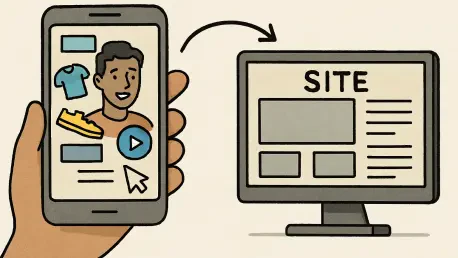

Simon Glairy is a recognized expert in the fields of insurance and Insurtech, with a specialized focus on risk management and AI-driven risk assessment. His insights into how large, regulated enterprises adopt new technologies are particularly relevant today. In our conversation, we explore the shift from static websites to dynamic, one-to-one experiences powered by autonomous AI. We’ll delve into how this technology dismantles traditional bottlenecks in marketing, builds trust within conservative industries like banking and healthcare, and is positioning itself for a future where AI agents, not just humans, are the primary visitors to a company’s digital front door.
The traditional model for website personalization involves a slow and costly mix of agencies, engineers, and software. How does Fibr AI’s autonomous agent model specifically dismantle these bottlenecks, and what does the implementation process look like for a new enterprise client?
The old model is fundamentally broken because it’s people-heavy. You have a marketing agency, an engineering team, and a stack of software, and any simple change requires weeks of coordination. It’s expensive and, frankly, agonizingly slow. Our approach completely replaces that. We position ourselves as both the software and the agency, but our “workforce” is a fleet of autonomous AI agents. For a new client, the implementation is designed to be an “infra afterthought layer.” We connect to their existing advertising, analytics, and customer data systems. Once it’s set up, it runs continuously in the background. The goal is that nobody has to think about it again, which is why we’ve been successful in securing three- to five-year contracts.
You’ve described a shift from running a few dozen A/B tests per year to thousands of micro-experiments in parallel. Could you walk me through how your AI agents decide which variations of copy, imagery, and layout to test and how they measure success in real-time without human oversight?
It’s a complete paradigm shift from sequential A/B testing. Instead of a human manually setting up a handful of tests, our agents treat every URL as a living system that needs to learn and optimize. The agents connect to a company’s ad and analytics data to infer what a visitor is likely looking for the moment they arrive. Based on that intent, they autonomously generate and assemble countless variations of page content—different headlines, images, layouts, you name it. They then run these as thousands of micro-experiments in parallel, systematically measuring which combinations drive conversions. It’s not about finding one “winner”; it’s about continuously adjusting the experience as traffic flows in from different channels, all in real time.
Gaining traction in conservative, regulated industries like banking and healthcare can be challenging, yet these were some of your early adopters. What were the key security or compliance concerns these clients raised, and what specific results did you demonstrate to secure those long-term contracts?
You’re right, it was a slow burn at first. For much of our first two years, we only had one or two customers as these large enterprises took their time evaluating our approach. The biggest concerns were, as you’d expect, around data security and the stability of their core website infrastructure. They wanted to ensure our system wouldn’t break anything or introduce compliance risks. The turning point came when we could demonstrate that our platform was not just an add-on but a stable infrastructure layer. The fact that major banks and healthcare providers were not only willing to pilot the technology but also to sign three- to five-year contracts was the ultimate validation. When these regulated, conservative industries say, “We need this, and we’re willing to pay for it,” it sends a powerful signal.
You position Fibr AI as an “infra afterthought layer” that connects to existing systems. For a large enterprise, what does the technical integration actually involve, and can you provide an example of how your platform uses signals from ad and analytics data to personalize a session?
The integration is designed to be seamless. Technically, our platform operates as a layer on top of a company’s existing website. We connect directly into their ecosystem of tools—their advertising platforms, analytics suites like Google Analytics, and any customer data platforms they use. This is crucial because it gives our AI agents the context they need. For example, a visitor might click on a highly personalized ad targeting them as a potential small business banking client. The signal from that ad campaign is immediately passed to our platform. Instead of landing on a generic homepage, the visitor sees a version of the page with copy, imagery, and calls-to-action all tailored to the needs of a small business owner. It bridges that frustrating gap where a one-to-one ad leads to a one-to-many webpage.
Looking ahead, online discovery is shifting towards users interacting with AI chatbots before visiting a site. How is your platform being designed to personalize a webpage for an AI agent acting on a user’s behalf, and what new types of signals will you need to interpret?
This is the next frontier, what we call the “agentic-commerce era.” While most of our work today is personalizing for human visitors, we are absolutely building for this shift. Imagine a user asks an AI chatbot to find “the best credit card with travel rewards.” That AI agent will then “visit” several bank websites on the user’s behalf. Our platform is being designed to recognize these AI-driven visits and adapt the webpage based on the context the agent carries. The signals will be different; instead of just clickstream data, we’ll be interpreting the summarized intent or the shortlist criteria from the AI chatbot. The website will need to dynamically present the most relevant information to that agent to ensure it gets shortlisted for the human user. It’s still early, but being ready for that shift is key.
With a goal of reaching $5 million in annual recurring revenue and 50 enterprise customers this year, your team is split between the U.S. and India. How do you structure your sales and technical operations to effectively serve large U.S. clients with this distributed model?
We’ve been very intentional with our structure. Our core technical and product development base, which consists of 17 of our 23 employees, is in India. This allows us to tap into an incredible pool of engineering talent. Meanwhile, our sales and customer-facing teams, the remaining six employees, are based here in the U.S., close to our target enterprise clients. This hybrid model gives us the best of both worlds: deep technical innovation and strong, direct relationships with our U.S. customers. The new $5.7 million in funding is largely dedicated to expanding those U.S.-based teams to support our aggressive growth targets of hitting 50 enterprise customers and $5 million in ARR this year.
What is your forecast for the future of website personalization?
I believe the future of website personalization is one where the concept of a static, manually-updated website becomes completely obsolete. The idea that you would build one page and show it to millions of different people will seem as archaic as placing a single newspaper ad to reach a global audience. Instead, every website will become a dynamic, continuously learning system. It won’t be about running occasional “experiments” managed by a marketing team; it will be a core, autonomous function of the business infrastructure, just like cloud computing is today. The winners will be the platforms that can deliver this one-to-one experience reliably and at scale, not just for humans, but for the AI agents that will increasingly mediate our digital lives.