
Conor Allison is a veteran voice in the wearable technology space, having spent years testing the boundaries of how we interact with personal electronics. From navigating urban environments in wearable airbags to evaluating real-time translation tools in high-stakes social settings, his hands-on experience provides a unique perspective on the intersection of hardware and human biology. In this conversation, we explore the evolution of the Samsung Galaxy Buds 4 Pro, specifically how they transition from traditional audio accessories into sophisticated AI-driven interfaces. We discuss the structural shifts in the new “Blade” design, the nuances of head-gesture controls, and the ways in which super-wideband technology and adaptive acoustics are redefining our expectations for mobile communication.
Moving toward a flatter “Blade” design involves thousands of simulations to ensure stability and comfort. How does this specific stem shape improve the placement of sensors for manual controls, and what trade-offs occur when balancing a secure fit with the physical requirements for all-day wear?
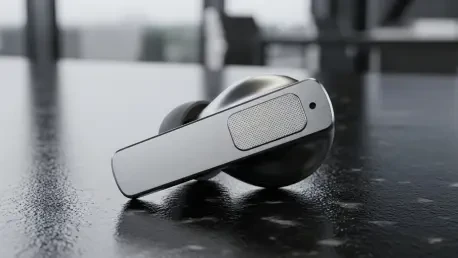
The transition to the Blade design was backed by over 10,000 anatomical simulations, which allowed engineers to pinpoint exactly where the human hand naturally reaches when adjusting an earpiece. By flattening the stem and adding an engraved pinch control area, the hardware provides a tactile landmark that makes finding sensors instantaneous even while moving. This structural change solves the common frustration of fumbling with rounded surfaces where touch sensitivity can be inconsistent. However, the trade-off involves managing the weight distribution; while the flatter stem offers a more secure fit for vigorous activity, it requires a delicate balance of materials to ensure the device doesn’t feel cumbersome during 12-hour shifts. The result is a premium brushed-metal finish that feels substantial yet sits flush enough against the ear to remain comfortable for all-day use.
Wearable hardware now allows users to nod or shake their head to manage calls and AI prompts. How do these head gestures change the user’s relationship with their virtual assistant, and what technical steps are necessary to prevent accidental triggers during normal daily activities or exercise?
Integrating head gestures like nodding to accept a call or shaking to decline a notification fundamentally shifts the virtual assistant from a voice-command tool to a more intuitive, non-verbal partner. It removes the social awkwardness of speaking to oneself in public and allows for discreet interactions with Bixby or Gemini in crowded environments. To ensure these aren’t triggered by a sudden look across the street or a rhythmic bob while running, the system utilizes highly sensitive motion sensors tuned to specific directional patterns. The software must distinguish between the purposeful, sharp motion of a “confirm” nod versus the natural bounce of a gait. This technical layer is crucial because it transforms a gimmick into a reliable interface that feels like a natural extension of your body’s own communication style.
Super-wideband technology aims to double the bandwidth for voice calls while adaptive EQ adjusts audio based on the user’s specific ear anatomy. How do these real-time adjustments impact environmental safety, and what metrics best measure the improvement in call clarity for the person on the receiving end?
The implementation of Super Clear Call technology is a massive leap forward because it doubles the standard Bluetooth bandwidth, allowing the person on the other end to hear a much fuller spectrum of the user’s voice. We measure the success of this through the reduction of “robotic” compression artifacts that usually plague calls made in windy or noisy outdoor settings. Simultaneously, the Enhanced Intelligence ANC and Adaptive EQ work together to scan the user’s ear canal in real time, ensuring that while the audio is immersive, it doesn’t leave the wearer dangerously isolated. By balancing these frequencies, the earbuds can boost the clarity of a conversation while still allowing sharp, high-frequency environmental sounds—like a car horn or a siren—to pass through the digital filter. This creates a safer auditory environment without sacrificing the high-resolution 24-bit audio quality that users expect from a Pro-level device.
Real-time translation tools now support over 22 languages directly through an earpiece. What are the practical steps for using this feature effectively in a live, face-to-face conversation, and how does the processing speed affect the natural flow of a multi-lingual interaction?
To use the Interpreter mode effectively, the user typically activates the feature through the Galaxy ecosystem, allowing the earpiece to act as the primary translator for the wearer while the connected phone handles the external speaker duties. The process is designed to be low-friction, moving the heavy lifting of language processing to the cloud or on-device AI to minimize lag. When you are dealing with 22 different languages, the processing speed is the difference between a natural conversation and a disjointed, frustrating exchange. If the translation happens within a few hundred milliseconds, it preserves the rhythm of human speech, allowing for emotional nuance and immediate responses. This advancement effectively turns the earbuds into a “universal translator” that sits quietly in your ear, ready to bridge communication gaps during travel or business meetings.
New audio hardware features wider woofers and high-resolution 24-bit audio support. How does increasing the effective speaker area by nearly 20% change the acoustic profile for the listener, and what specific types of media or environments benefit most from this jump in audio fidelity?
Increasing the effective speaker area by nearly 20% allows for a much more move-heavy displacement of air, which translates directly into a richer, more natural bass response that doesn’t muddy the mid-tones. This two-way speaker system, supporting 24-bit/96kHz Hi-Fi audio, provides a depth of sound that was previously reserved for high-end over-ear headphones. Media that features complex soundscapes—such as orchestral soundtracks, action-heavy films, or lossless FLAC music files—benefits the most because the hardware can reproduce subtle textures that smaller drivers simply miss. In noisy environments like a subway or a crowded office, this extra power ensures that the music maintains its integrity and punch even when the active noise cancellation is working at its maximum capacity. It creates a “spatial” feeling where the audio feels like it’s happening around you rather than just being piped into your ear canal.
Simplified pairing processes and dedicated case buttons for finding lost devices are becoming standard for high-end accessories. How does removing the requirement for dedicated apps during initial setup affect the broader user experience, and what role does a translucent design play in the functional aesthetics of modern hardware?
By allowing the Galaxy Buds 4 Pro to pair simply by opening the lid—bypassing the Galaxy Wearable app—Samsung is removing the “digital tax” that often frustrates users when they get a new gadget. This immediate gratification builds a stronger bond between the user and the ecosystem, making the technology feel less like a software product and more like a seamless utility. The translucent design of the charging case lid serves a dual purpose: it is a modern, “tech-forward” aesthetic choice, but it also provides a functional view of the hardware inside, letting you confirm the buds are docked and charging at a glance. Additionally, the inclusion of a physical button on the case to trigger a “Find My” chime is a grounded, practical solution for the very real human problem of losing small electronics in a couch or a gym bag.
What is your forecast for the future of AI-integrated earbuds as they move toward becoming standalone computing portals?
I believe we are rapidly approaching a “post-screen” era where earbuds will serve as the primary gateway to our digital lives, eventually operating independently of the smartphone. As we see with the integration of over 22 languages and head-gesture controls, the earbuds are becoming the “eyes and ears” of AI, capable of sensing our environment and our physical reactions to it. In the near future, expect these devices to integrate more biometric sensors and perhaps even work in tandem with AR hardware like Galaxy Glasses to provide a fully holographic and spatial audio experience. The $249 price point of the Pro model is an investment in a device that is no longer just for music, but is a persistent, intelligent companion that manages our communications, translations, and environmental interactions without us ever having to look at a piece of glass in our hands.