
The traditional space heater has long been the unsightly stepchild of interior design, a clunky plastic box that whirs and glows in the corner of an otherwise curated room. However, the arrival of the Boldr Kelvin has sparked a heated debate among tech critics and home stylists who wonder if a utility appliance can truly double as a high-end architectural statement. This roundup explores the polarized reception of this minimalist glass panel, weighing the glowing aesthetic reviews against the stark thermodynamic realities reported by early adopters and efficiency experts. By examining the intersection of far-infrared technology and smart-home software, this analysis seeks to determine if the Kelvin is a genuine leap forward or merely a beautiful distraction from the basic need for warmth.
Beyond the Aesthetic: Understanding the Boldr Kelvin Phenomenon
The Boldr Kelvin has emerged as a viral sensation in the smart home market, captivating tech enthusiasts with its promise of merging high-end interior design with sustainable heating technology. As traditional space heaters remain stuck in an era of bulky plastic and noisy fans, the Kelvin positions itself as a disruptive architectural element designed for the modern, minimalist home. This article dives deep into the reality of owning this “iPhone of heaters,” evaluating whether its innovative far-infrared technology and sleek glass facade deliver on their premium promises or if the device is simply a case of style over substance.
Designers frequently point out that the appliance landscape has been stagnant for decades, making the Kelvin’s entry feel particularly radical. Its origins as a project from a multi-national startup reflect a shift toward “stealth tech,” where the goal is to hide the machine behind a facade of elegance. While the device certainly wins points for its visual impact, many industry observers suggest that the hype may be outpacing the actual utility, creating a divide between those who buy for looks and those who buy for BTU output.
Evaluating Form, Function, and the Reality of Radiant Heat
The Design Revolution: When a Space Heater Becomes Wall Art
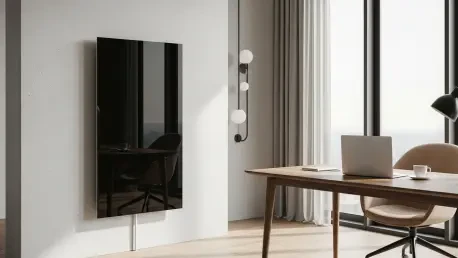
The Boldr Kelvin fundamentally reimagines the appliance’s role in a room, moving away from a tucked-away utility to a centerpiece of “stealth tech.” With its frame-less glass panel and ultra-slim profile, it mimics the look of a high-definition television or a piece of contemporary sculpture rather than a heating unit. This aesthetic shift appeals to homeowners who find traditional heaters disruptive to their decor, offering a silent, fan-less operation that preserves the tranquility of a home office or bedroom. However, this commitment to minimalism introduces unique installation constraints, as its 20-pound weight and permanent wall-mounting requirement demand a level of spatial commitment rarely seen in portable heating solutions.
Critics of the design argue that the permanent nature of the installation negates one of the primary benefits of a space heater: portability. Unlike a ceramic unit that can be moved from the kitchen to the study, the Kelvin becomes a fixed part of the room’s geography. This means that if the initial placement is incorrect, the homeowner is left with a very heavy, expensive piece of wall art that fails to provide warmth where it is needed most. The trade-off for such a sleek profile is a lack of flexibility that many users might find frustrating in a dynamic household environment.
The Physics of Comfort: Infrared Waves vs. Forced Air
Unlike conventional convection heaters that struggle to warm the air by blowing it across hot coils, the Kelvin utilizes far-infrared energy to heat objects and people directly. This method, often compared to the sensation of sunlight on a cool day, avoids the dry, stuffy atmosphere common with forced-air systems. While this approach is theoretically more efficient for localized warmth, it faces significant practical hurdles in a standard living environment. Data from real-world usage suggests a notable lag in performance, as the ceramic glass panel can take up to an hour to reach peak temperature, making it a poor choice for users seeking “instant” relief from a cold draft.
Furthermore, the “sunlight” sensation is highly dependent on the user’s proximity and orientation to the glass. Because infrared waves travel in straight lines, any furniture or architectural feature blocking the path acts as a literal shield against the heat. This creates a “shadow effect” where a person might feel perfectly warm while facing the unit but notice a significant chill the moment they step behind a desk or chair. This directional limitation forces a specific room layout that may not always align with the user’s lifestyle or the room’s original purpose.
The Thermal Efficiency Paradox and the “Heat Splash” Controversy
A critical point of contention lies in Boldr’s marketing of the Kelvin as an ultra-efficient energy saver. While the unit draws a modest 450 watts compared to the industry-standard 1,500 watts, thermodynamics dictates that all electric resistance heaters are roughly 100% efficient at converting electricity to heat. The perceived “savings” stem from the heater providing less total thermal output, which may leave larger rooms under-heated. Furthermore, a significant design flaw has emerged regarding backward heat distribution; testing reveals that the mounting hardware can reach 120 degrees Fahrenheit, potentially discoloring wall paint or damaging wallpaper—a phenomenon known as “heat splash” that redirects valuable energy into the wall rather than the room.
The inefficiency of heating a wall instead of a person is a major hurdle for those looking to lower their utility bills. When a significant portion of the 450 watts is absorbed by the drywall and studs behind the unit, the effective output into the living space is further reduced. This suggests that the Kelvin is not necessarily “saving” energy through superior technology, but rather by simply outputting less heat and losing a portion of that limited output to the building’s structure. For users in older, less-insulated homes, this loss could make the device almost entirely ineffective during the peak of winter.
Navigating the Ecosystem: Smart Integration and Software Hurdles
Boldr aims to be a software company as much as a hardware manufacturer, offering an app-driven experience that includes geofencing, energy cost estimation, and localized automation. These features allow the Kelvin to activate based on the user’s proximity or local weather patterns, offering a level of sophistication rarely found in climate control. However, the user experience is frequently marred by “startup growing pains,” including connectivity issues on 2.4-GHz Wi-Fi bands and glitchy AI cost calculators that require manual overrides. While the potential for a fully integrated smart home ecosystem is present, the current software state requires a tech-savvy user willing to troubleshoot frequent updates and privacy-heavy data requirements.
The reliance on a cloud-based app also introduces questions about the long-term viability of the product. If the company’s servers experience downtime or if the software ecosystem changes, a user might find their high-tech heater suddenly relegated to a manual “on-off” device. Additionally, the requirement for constant location tracking to enable geofencing features has raised eyebrows among privacy-conscious consumers. While the automation is impressive when it functions correctly, the complexity of the setup process often stands in stark contrast to the simple, plug-and-play nature of the traditional heaters it seeks to replace.
Strategic Insights: Who Should Actually Buy the Kelvin?
For the discerning consumer, the Boldr Kelvin is less of a general-purpose heater and more of a specialized climate tool. It is best implemented in small, well-insulated spaces where the user remains in a fixed position, such as a dedicated workstation or a reading nook. To maximize the device’s potential, owners should ensure an unobstructed line of sight and consider additional wall insulation to mitigate backward heat loss. It is not recommended for households with curious toddlers or pets due to the 200-degree surface temperature of the glass, nor is it a viable primary heat source for large, drafty rooms.
Strategically, the Kelvin serves as a supplemental heat source rather than a primary one. It excels in environments where maintaining a silent atmosphere is paramount, such as a recording studio or a nursery where the sound of a clicking thermostat or a whirring fan would be disruptive. Prospective buyers must view this purchase through the lens of luxury home improvement rather than strictly utilitarian survival. It is an investment in a specific type of aesthetic comfort that requires the right environment to flourish.
Final Verdict: Balancing Innovation Against Practical Utility
The Boldr Kelvin presented a fascinating case study in how disruptive design challenged long-standing industry norms, yet it served as a reminder that hardware ultimately had to fulfill its primary function. While it succeeded brilliantly as a silent, beautiful addition to a modern home, its thermodynamic limitations and the “fatal flaw” of backward heating prevented it from being a universal recommendation. As the smart home sector continued to evolve, the Kelvin stood as a bold first step toward integrated climate furniture, but one that required the buyer to prioritize aesthetic prestige over raw heating performance. For those who valued the future of home design, it was a piece of living history; for those just trying to stay warm, a traditional heater remained the more pragmatic choice.
Looking forward, the evolution of this product category will likely depend on solving the radiant loss issue through advanced aerogel insulation or reflective backing materials. Consumers interested in this technology should explore secondary insulation kits that can be applied to the wall behind the unit to recover the lost “heat splash.” Furthermore, integrating the Kelvin with a more robust third-party smart home hub could mitigate some of the native app’s connectivity frustrations. Ultimately, the lessons learned from the Kelvin’s reception will pave the way for a new generation of appliances that do not force a compromise between how a room looks and how it feels.