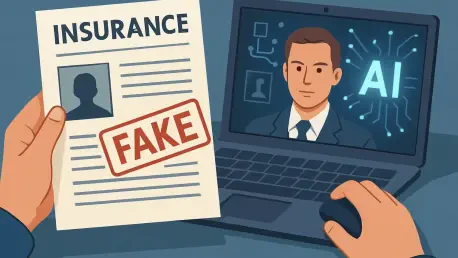

Deep within the digital architecture of modern underwriting, a silent and highly sophisticated adversary is currently rewriting the rules of deception by using generative artificial intelligence to fabricate entire identities before a single premium is even calculated. The traditional image of insurance fraud—the staged car accident or the exaggerated home damage claim—is rapidly becoming an outdated stereotype. While these “downstream” crimes still occur, a more insidious threat is emerging at the very beginning of the insurance lifecycle. Today, the most sophisticated battles are being fought before a policy is even issued. Fraudsters are no longer just lying about what happened; they are using high-level technology to lie about who they are and the risks they represent, effectively poisoning the well of the insurer-customer relationship at the point of inception.
For decades, the claims department was the primary gatekeeper against fraud, but the digital revolution has shifted the front line “upstream” toward the underwriting and onboarding phases. This transition is not accidental; it is a calculated move by bad actors to exploit the industry’s push for “frictionless” digital experiences. As insurers compete to offer the fastest quotes and easiest sign-ups, they inadvertently create windows of opportunity for deception. With detection specialists reporting a 31% surge in fraudulent documents at the policy stage in just the last year, it is clear that the industry is facing a systemic attempt to compromise the integrity of the global insurance market from the ground up. This shift represents a fundamental reorganization of criminal priorities. In the past, the risk was manageable because the fraudster had to interact with the system multiple times before a payout occurred. Now, the goal is to compromise the data foundation itself, creating a “patient zero” effect where a single fraudulent policy can lead to years of undetected losses across multiple lines of business.
Understanding the Shift to Upstream Deception
The migration toward upstream fraud signals a significant change in how risk is managed in 2026. By targeting the point of quote and inception, criminals can bypass the robust scrutiny usually reserved for the claims process. This tactical shift is particularly effective because it capitalizes on the competitive nature of the modern insurance market. Companies are under immense pressure to reduce “friction” during the application process to prevent customer drop-off. Consequently, the verification steps that once took days have been compressed into seconds, often relying on automated systems that may not be fully equipped to handle the latest generation of synthetic documents.
Moreover, the volume of these attempts has reached an unprecedented scale. Statistics indicate that policy manipulation is not just a localized issue but a global trend affecting diverse sectors, from personal auto to commercial property. The speed of digital quote generation has provided the perfect cover for automated scripts and AI tools to test thousands of variations of an application. These scripts can determine the exact combination of lies—whether it is a slightly different address or a falsified no-claims history—that results in the lowest premium. This “automated probing” allows fraudsters to find and exploit weaknesses in an insurer’s pricing algorithm before a human ever sees the file.
The AI Revolution: Lowering the Barrier to Forgery
The democratization of generative AI and advanced image manipulation software has fundamentally changed the economics of fraud, turning what was once a specialized skill into a widely accessible commodity. Tools that can generate convincing fake utility bills, bank statements, or No-Claims-Bonus (NCB) certificates are now available to anyone with an internet connection, leading to a massive increase in the volume of fraudulent submissions. This accessibility has effectively “industrialized” forgery, allowing even low-level actors to produce documents that were once the domain of professional counterfeiters. The sheer quality of these AI-generated documents means that they often lack the obvious “red flags” that manual investigators were trained to spot.
Unlike the crude “cut-and-paste” jobs of the past, AI allows fraudsters to create a cohesive narrative across multiple documents. A fake driver’s license, vehicle registration (V5), and residency proof can now be perfectly synchronized to present a flawless, yet entirely fabricated, identity. This consistency is the greatest challenge for legacy detection systems, which often look for individual anomalies rather than cross-document discrepancies. Beyond simple identity theft, general policy manipulation has increased by 89%, as applicants use AI to “tweak” their history and demographics to secure lower premiums they aren’t entitled to. By using sophisticated models, they can alter the text within a document while maintaining the complex security patterns and watermarks that usually authenticate official records.
Profiles in Deception: From Desperate Consumers to Organized Syndicates
The move to upstream fraud is driven by two very different types of actors, each with their own motivations and methods. The opportunistic consumer, driven by the rising cost of living, often views “adjusting” a document to save money as a victimless shortcut. Because AI makes these changes look professional, the psychological barrier to committing this “soft fraud” has significantly lowered. These individuals do not see themselves as criminals but rather as savvy shoppers using technology to bypass what they perceive as unfair pricing structures. They might use an AI tool to change the date on a utility bill or remove a speeding conviction from a driver record, believing that such small modifications are undetectable and harmless.
In contrast, organized crime groups (OCGs) utilize policy-stage fraud as a tactical gateway. For professional syndicates, establishing a “clean” record with a forged identity is a necessary first step for more ambitious projects. By bypassing initial scrutiny, they can execute much larger, more lucrative schemes like staged accidents once the policy is active. They often submit “test” documents they know might be flagged to map out the company’s defensive weaknesses. By observing how an insurer reacts, they can determine if the perimeter is soft enough for a high-value attack or if they should move on to a different target. This strategic reconnaissance makes them far more dangerous than the average opportunistic fraudster, as they are intentionally searching for the cracks in an insurer’s digital armor.
Advanced Evasion and the Metadata Battleground
As insurance companies deploy more advanced digital forensic tools, fraudsters are evolving their tactics to hide the digital “fingerprints” of their work. A primary focus of this evolution involves fabricated metadata. Knowing that investigators look for altered file data, such as dates, GPS coordinates, or software signatures, criminals are now injecting fake, authentic-looking metadata into forged files to trick automated verification systems. This creates a digital trail that appears perfectly legitimate, even if the visual content of the file has been synthesized by an AI model. This “counter-forensics” approach is becoming increasingly common in high-value fraud attempts where the potential payout justifies the extra technical effort.
Another common tactic involves the physical-to-digital “reset.” This process is remarkably simple yet highly effective: a fraudster prints a high-quality AI-generated forgery and then scans or photographs that physical print-out to submit to the insurer. This act severs the digital trail of the original manipulation, making it nearly impossible for standard software to detect the AI’s involvement or the traces of image editing. Furthermore, fraudsters often intentionally fail digital identity checks to force a manual review. They bet on the fact that an overwhelmed human operator in a fast-paced environment is less likely to spot a high-tier forgery than a specialized algorithm. By creating a situation where a person must make a judgment call under pressure, they turn the insurer’s own “human touch” into a security vulnerability.
Strategies for a Resilient Defense
To counter the rise of AI-driven upstream fraud, insurers must move beyond isolated document checks and adopt a more holistic, behavioral approach to risk. This means prioritizing context over individual pixels. Rather than just analyzing a single image, insurers should look for broader behavioral patterns and “re-use histories” across the industry to identify if a document has appeared in other suspicious contexts. If a utility bill has been used for five different applications with five different names across multiple companies, the document itself is irrelevant; the pattern is the evidence. This shift toward “entity-level” detection allows insurers to see the fraudster behind the document, rather than just the document itself.
Cross-industry intelligence sharing is becoming the cornerstone of this new defense. Utilizing databases like the National SIRA platform allows companies to collaborate in real-time. When a fraudulent utility bill is flagged by a bank, that information can instantly protect an insurer from the same bad actor. Moreover, insurers must integrate fraud detection seamlessly into the customer journey. By using “silent” background checks that do not interrupt the user experience, companies can maintain high security without alienating legitimate customers. This balance is vital for survival in a market that demands both absolute speed and absolute security. Continuous frontline training also remains essential; staff must be educated on the latest AI trends to ensure that the “human fall-back” remains a point of strength rather than a point of failure.
The insurance industry recognized that the era of reactive fraud prevention had ended. Stakeholders pivoted toward proactive, intelligence-led strategies that treated every piece of incoming data as part of a larger, interconnected web of risk. Organizations that invested in continuous frontline training for contact center staff found that human intuition, when combined with AI-powered detection, created a much more resilient barrier against sophisticated forgery. These companies also championed the move toward industry-wide data sharing, which proved highly effective in dismantling the tactical gateways used by organized crime groups. Ultimately, the focus shifted from identifying fakes to understanding the intent and behavior of the applicant, ensuring that the integrity of the insurance pool remained protected for all honest policyholders. This transition demonstrated that while technology increased the threat, a collaborative and multi-layered response restored confidence in the digital onboarding process.