
Speed now decides winners in commercial insurance as brokers expect quotes in minutes while carriers confront tight margins, volatile capacity, and mounting demands for data transparency across product lines. This shift has elevated submission intake from back-office chore to front-line differentiator, turning document intelligence and configurable rules into measurable edge. The INSTANDA–DataCrest integration lands squarely in this arena, converting messy submissions into underwriter-ready data and pushing early decisions closer to real time.
The analysis here examines how no-code configuration paired with AI-driven intake reshaped quoting economics. It also outlines the adoption curve, likely KPI ranges, and the operational levers that separate top performers from stalled pilots. The goal is to help insurers and MGAs assess value creation, not just technology novelty.
Body
Market behavior has favored platforms that compress cycle time without eroding control. Reported outcomes—turnaround falling from hours to minutes, quote volumes rising up to 25%, and outsourcing trimmed by as much as 76%—signal a step-change in throughput. Moreover, cleaner intake reduces back-and-forth with agents, lifting hit rates by aligning appetite earlier and improving preliminary pricing fidelity.
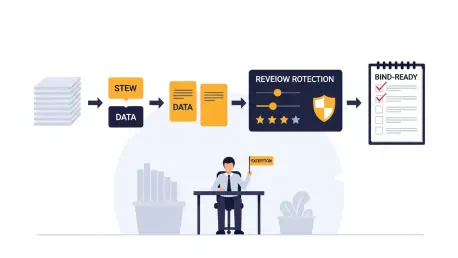
Under the hood, DataCrest’s AppEase parses ACORDs, supplements, schedules, and loss runs, applying AI to extract, validate, and reconcile fields before passing structured data to INSTANDA. Business teams then adjust eligibility, rating, and forms in days, tightening feedback loops between market signals and product logic. Human review remains a governor on edge cases, sustaining accuracy in specialty and complex commercial risks.
Looking ahead, the growth path points toward end-to-end digital quoting that links intake, appetite scoring, pricing, and bind-ready workflows. Expect heavier use of third-party data prefill, richer explainability to satisfy oversight, and expanded governance to protect audit trails as volumes scale. Financially, leaders target expense-ratio relief and higher capacity utilization, while operationally they emphasize gradual integration: start with submission intake and pre-quote checks, then layer appetite alignment, prefill, and straight-through capabilities. Key risks—model drift, uneven submission quality, and change fatigue—are mitigated by clear data standards, exception thresholds, and service-level commitments to distribution partners.
Conclusion
The evidence pointed to a pragmatic playbook: use intelligent intake to cleanse submissions, harness no-code to iterate pricing logic quickly, and keep humans on exceptions that move the loss ratio. Carriers and MGAs that anchored programs on tight KPIs, staged rollouts, and strong agent communication realized faster quotes, steadier hit rates, and lower external spend. Most importantly, the integration reframed underwriting as a disciplined, data-first motion, positioning adopters to scale profitably while competitors chased incremental fixes.