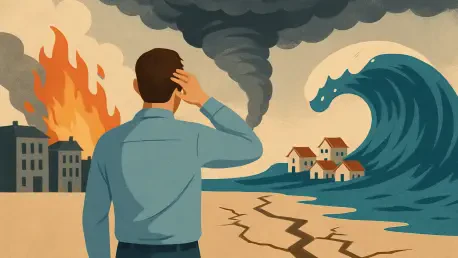

The global insurance industry stands at a precarious crossroads where the traditional reliance on historical meteorological patterns no longer provides a reliable map for future financial liabilities. For decades, the fundamental pillar of risk assessment was the assumption that physical hazard probabilities, derived from decades of weather data, could accurately predict the potential for catastrophic loss. However, this established paradigm is rapidly fracturing as the correlation between the physical intensity of a storm and the resulting insurance payout weakens. Today, the most significant drivers of financial destruction are found not in the velocity of wind or the depth of floodwaters, but in a complex interplay of socioeconomic factors. These “non-hazard” variables, including rampant economic inflation, fractured global supply chains, and the unprecedented concentration of high-value assets in disaster-prone corridors, are redefining what it means to be vulnerable. As the industry grapples with this shift, it becomes clear that the science of the storm is merely one piece of an increasingly volatile and multi-dimensional puzzle.
A profound “decoupling” is currently taking place between the severity of atmospheric events and the magnitude of the financial fallout they generate. While climatological changes remain a critical concern, the data suggests that they are no longer the primary engine behind the staggering increase in annual insurance claims. In the United States, for instance, a significant majority of losses attributed to severe convective storms are actually tied to human and economic variables rather than the specific intensity of the meteorological event itself. This discrepancy highlights a growing “protection gap,” evidenced by the massive distance between total economic damages and the portion covered by insurance policies. As billions of dollars in losses go unmitigated, the industry faces a systemic challenge: its current models are often blind to the human-made factors that turn a standard weather event into a fiscal catastrophe. This widening gap necessitates a fundamental reevaluation of how risk is quantified, moving beyond the physical properties of a hazard to account for the socioeconomic environment it impacts.
The Influence of Economic and Legal Pressures
The concept of reconstruction costs has undergone a permanent structural change, moving away from the cyclical nature that once allowed insurers to predict recovery expenses. Historically, the price of essential building materials like lumber, asphalt, and steel followed the ebb and flow of global commodity markets, eventually returning to a baseline after a period of volatility. In the current economic landscape, however, these costs have become remarkably “sticky,” remaining at elevated levels even when the prices of raw materials begin to stabilize or decline. This phenomenon is driven by a combination of persistent labor shortages in the skilled trades and a shift in the manufacturing of finished construction products. When a disaster strikes today, the financial burden of rebuilding is significantly higher than in previous decades, as the industry can no longer count on a post-crisis deflationary period. This permanent shift in the cost structure of property restoration means that even a moderate storm can now trigger an outsized financial drain on insurance reserves.
Compounding these economic pressures is the rise of “social inflation,” a term that captures the escalating costs of claims driven by aggressive legal strategies and shifting regulatory frameworks. In many jurisdictions, the insurance claim process has been transformed into a highly litigious environment where legal action is often the first, rather than the last, resort. Practices such as the assignment of benefits and the proliferation of third-party litigation funding have created a scenario where the final settlement for a property claim can far exceed the actual value of the physical damage sustained. This legal environment introduces a layer of systemic risk that traditional scientific models were never designed to calculate or even acknowledge. Because these legal and regulatory shifts occur independently of weather patterns, they represent a “hidden” inflation that erodes the profitability of insurers and complicates the underwriting process. To maintain solvency and provide fair pricing, the industry must find a way to integrate these volatile legal trends into their broader risk assessment frameworks.
Evolving Assets and Demographic Shifts
Demographic trends in recent years have dramatically altered the geographical distribution of risk, as millions of people migrate toward regions that are historically prone to severe natural hazards. This mass movement of the population toward coastal areas, wildfire-prone wildland-urban interfaces, and the “tornado alley” of the American interior has led to a massive increase in the density of “exposed assets.” When a standard meteorological event occurs today, it no longer passes over empty fields or sparse settlements; instead, it encounters a landscape saturated with high-value residential developments and commercial infrastructure. This increased density means that the “footprint” of a storm now overlaps with a much higher concentration of property than it would have twenty-five years ago. Consequently, the sheer volume of value in the path of a hazard has become a more significant predictor of loss than the hazard’s physical strength. The insurance industry is now forced to contend with a reality where suburban sprawl in high-risk zones has effectively turned common weather events into multi-billion-dollar disasters.
As the location of assets changes, the nature and complexity of those assets are also undergoing a radical transformation that complicates repair and replacement efforts. Modern residential and commercial buildings are no longer simple structures of wood, brick, and mortar; they are increasingly integrated with sophisticated technological systems that are highly sensitive to environmental stressors. The widespread adoption of rooftop solar panels, advanced home battery storage, and complex smart-grid integrations means that a hail storm or high-wind event can cause damage that is far more expensive to remediate than traditional roofing failures. Furthermore, the explosion of the artificial intelligence sector has led to a construction boom in massive data centers, which represent extreme concentrations of digital and physical value. These facilities often house billions of dollars in specialized hardware and are frequently located in regions where building codes for wind and hail may not yet reflect the critical nature of the infrastructure. This creates a significant “aggregation risk,” where a single localized event could result in a claim equivalent to a major industrial or pharmaceutical loss.
Toward a Holistic Approach to Risk
The traditional catastrophe models that have served as the industry’s backbone for decades are now showing signs of significant strain under the weight of modern economic realities. These legacy systems were primarily designed to answer a singular, scientific question: what is the likelihood of a hazard of a certain magnitude occurring in a specific geographic location? While this remains an important data point, it is no longer sufficient for accurate financial forecasting in an era of globalized supply chains and hyper-inflation. Modern risk management requires a more nuanced approach that can account for how various external pressures—such as the availability of skilled labor, the fluctuation of the US dollar, and the stability of local building codes—will interact with a physical event to determine the final indemnity bill. The industry is reaching a consensus that understanding the physics of a hurricane or the seismology of an earthquake is merely the starting point; the true challenge lies in modeling the chaotic economic and social aftermath that follows.
Despite these mounting challenges, the global insurance and reinsurance markets currently maintain a robust capital base that provides a necessary cushion against immediate shocks. This financial stability is a testament to the industry’s resilience, but it should not be mistaken for a permanent solution to the flaws in current modeling techniques. The path forward demands a transition from “hazard-centric” risk assessment to a truly holistic methodology that incorporates macroeconomic indicators, demographic shifts, and geopolitical stability into the core underwriting process. To accurately price risk in a world where the only constant is volatility, insurers must look beyond the physical characteristics of the storm and address the hidden economic drivers that are redefining the true cost of catastrophe. This shift will involve deeper collaboration between data scientists, economists, and sociologists to create a new generation of predictive tools. By acknowledging the interconnectedness of physical and economic vulnerabilities, the industry can better prepare for a future where the financial impact of a disaster is dictated as much by human systems as by the forces of nature.
The conclusion of this analytical transition must be rooted in the proactive integration of real-time socioeconomic data into long-term capital allocation strategies. Insurers previously viewed economic inflation and social trends as peripheral noise, but these factors have now proved to be the central determinants of loss severity and frequency. Moving forward, companies should prioritize the development of dynamic modeling platforms that can adjust risk appetite based on shifting litigation landscapes and the fluctuating costs of high-tech construction materials. This evolution will likely require a move away from static, annual pricing models toward more agile frameworks that reflect the rapid pace of technological and demographic change. Furthermore, the industry must take an active role in advocating for modernized building codes and land-use policies that reflect the current reality of asset density and sensitivity. By shifting the focus from simply reacting to disasters to actively analyzing the underlying economic fuel that drives loss, insurers can maintain their role as the primary stabilizers of the global economy. The transition to a holistic risk perspective is not merely a technical upgrade; it was a necessary survival strategy for an industry facing a world where the nature of catastrophe has been fundamentally transformed.