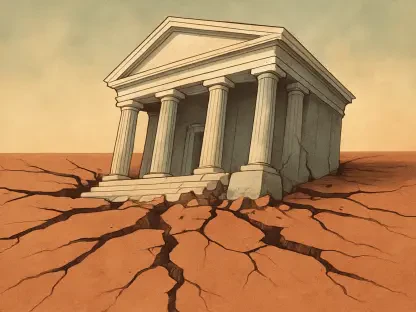

High-volume, short-duration rainfall events are challenging urban drainage systems that were originally designed for the historic arid stability of the Arabian Peninsula. This meteorological shift has catalyzed a profound transformation in how the United Arab Emirates perceives and manages environmental hazards, moving away from a mindset of total immunity to one of active risk mitigation. The unprecedented rainfall events observed recently served as a critical wake-up call, exposing a stark five-billion-dollar protection gap where economic losses significantly outpaced insurance payouts. As these climate-driven incidents become more frequent and severe, the regional financial sector is undergoing a rigorous period of introspection. Industry leaders are now questioning whether the existing frameworks, which supported decades of rapid urban growth, remain robust enough to safeguard the balance sheets of multinational corporations and local enterprises alike against the volatility of a changing climate.
Closing the Protection Gap
Identifying Coverage Vulnerabilities
The protection gap currently observed across the Emirates is rarely a matter of a complete absence of insurance coverage; rather, it is often buried within the technicalities and specific exclusions of existing contracts. Many organizations are discovering that their stated asset values fail to account for the skyrocketing costs of modern reconstruction or the intricate complexities of contemporary infrastructure. This phenomenon of underinsurance is particularly prevalent among commercial entities that have not updated their valuation assessments to reflect current market realities or the increased price of sustainable building materials. When a disaster occurs, these businesses find themselves partially self-insuring for losses they believed were fully covered. The misalignment between policy limits and actual replacement costs creates a financial vulnerability that ripples through the economy, affecting debt repayment schedules and future capital expenditure plans.
Analyzing Business Interruption Factors
Beyond physical property damage, standard policies frequently omit specific coverage for natural disasters or acts of God unless an additional endorsement is purchased by the policyholder. This omission often leaves small and medium enterprises in a precarious position, as they may lack the sophisticated risk management departments necessary to navigate complex policy language. For these organizations, physical property damage is only one facet of the problem; the subsequent business interruption often proves far more lethal to their long-term survival. Without adequate coverage for lost revenue during downtime, a business may face insolvency even if its physical storefront is eventually repaired. The inability to service fixed costs like payroll or rent during recovery periods highlights a critical need for more comprehensive, integrated insurance solutions that address the full spectrum of climate-induced operational disruptions.
Evolving Risk Assessment
Shifting to Predictive Frameworks
Underwriting practices are undergoing a significant evolution as insurers move away from traditional models that rely predominantly on historical weather data to determine future premiums. In a landscape where past patterns no longer provide an accurate roadmap for the future, the industry is rapidly adopting forward-looking climate scenarios that account for intensifying environmental shifts. This transition requires a fundamental change in mindset, treating climate change as an immediate operational hazard rather than a distant or theoretical threat. By integrating predictive modeling into their core operations, insurance firms can better anticipate the frequency and severity of extreme weather events before they manifest as claims. This proactive approach allows for more accurate risk pricing and helps ensure that the insurance market remains solvent and competitive in the face of increasing atmospheric volatility across the region.
Assessing Networked Infrastructure Risks
Risk assessment has expanded to include a networked view of physical assets, recognizing that a business can be paralyzed even if its own specific property remains entirely unscathed. This shift in perspective acknowledges the systemic interdependence of modern urban life, where the functionality of a single facility is tied to the reliability of regional power grids and municipal road networks. If submerged transportation routes prevent employees from reaching their workplace or if a localized power failure shuts down data centers, a company’s operations are compromised regardless of its individual resilience measures. Insurance evaluations are consequently looking beyond the immediate building perimeter to analyze the surrounding infrastructure health and the potential for secondary losses. This wider lens allows underwriters to assess the external risks that could trigger business interruption claims, providing a realistic picture of exposure.
Technological and Market Signals
Leveraging Advanced Analytics
Artificial intelligence and machine learning have emerged as the primary instruments for bridging information gaps through highly granular risk assessments. By processing vast quantities of satellite imagery and topographical data, insurers can now differentiate between two virtually identical buildings based on their specific elevation or the quality of their localized drainage systems. This level of precision was previously impossible with traditional manual surveys, which often relied on broad geographical generalizations. The implementation of AI-driven analytics allows for a more equitable distribution of risk, as property owners are no longer penalized for the vulnerabilities of their neighbors. Instead, premiums are increasingly tailored to the specific characteristics of an individual asset, providing a much clearer picture of where the greatest dangers lie. This technological leap is also enabling insurers to offer dynamic pricing models.
Evaluating Economic Impacts
Insurance serves as a critical economic signaling mechanism that fundamentally influences where capital is invested and which industries are considered viable in the long term. As premiums rise and coverage terms become more restrictive in high-risk zones, the pricing of risk provides an immediate and unambiguous feedback loop for urban planners, real estate developers, and institutional investors. This market-driven signaling often acts more quickly than government regulations, forcing stakeholders to reconsider the feasibility of projects in areas that are increasingly prone to flooding or extreme heat. If a particular location becomes uninsurable, it effectively becomes uninvestable, leading to a natural redirection of capital toward more resilient and sustainable developments. This process, while sometimes disruptive, ensures that economic growth is built on a foundation of realistic risk assessment rather than short-term convenience.
Strategy and Regulation
Navigating Systemic Challenges
The intersection of climate volatility and regional geopolitical instability creates a unique double burden for the business environment within the United Arab Emirates. Disruptions in global shipping routes or localized conflicts can significantly extend the time it takes for a company to recover from a climate event, as materials and labor become harder to source. These external factors amplify the cost of business interruption claims, as the recovery period is stretched far beyond what might be expected in a more stable global context. Insurers must now account for these overlapping threats when drafting policies and calculating potential losses, leading to more complex and multifaceted risk management strategies. This holistic approach recognizes that the impact of a storm is not just a localized event but is filtered through a global network of supply chains and political relationships that can hinder restoration.
Fostering Collaborative Resilience
The transition toward a more resilient future focused on actionable steps that integrated risk management into every level of urban and corporate planning. Decision-makers successfully implemented new drainage standards and reinforced critical utility networks, which significantly reduced the potential for systemic failure during subsequent weather events. Businesses adopted more rigorous self-assessment protocols and invested in onsite mitigation technologies, while the insurance industry refined its predictive models to provide more transparent and fair pricing. Government authorities also played a vital role by ensuring that regulatory frameworks evolved in tandem with emerging threats, providing the necessary oversight to protect the most vulnerable sectors of the economy. These coordinated actions established a foundation for sustainable prosperity, demonstrating that a proactive response to climate risk was the most effective way to secure the future.