
The transition from internal combustion engines to battery-powered mobility represents one of the most ambitious industrial shifts in human history, yet this revolution often encounters a significant hurdle in the form of insurance premiums that can catch even the most diligent car buyers off guard. As city streets increasingly hum with the sound of electric motors rather than the rumble of exhaust pipes, the financial landscape for vehicle ownership is undergoing a radical transformation. While the promise of zero-emission travel is a powerful motivator for many, the practical reality of protecting that investment involves navigating a complex and often expensive insurance market. The discrepancy in cost between insuring a traditional gasoline vehicle and its electric counterpart has become a primary point of discussion for consumer advocates and industry analysts alike.
This financial tension is not merely a byproduct of new technology but is a reflection of a broader systemic challenge within the automotive sector. Currently, the adoption of battery-electric vehicles has reached a pivotal point, with market share figures moving from a small niche toward nearly 30% of new registrations as of early 2026. However, the systems that support these vehicles—from repair shops to salvage yards—have not matured at the same pace as the cars themselves. This lag creates an environment where high-tech transportation meets a legacy support structure, resulting in higher risks and higher costs for the insurance providers who must foot the bill for accidents and malfunctions.
The Price of Innovation: Why Electric Mobility Comes with a Significant Insurance Surcharge
While the shift to electric vehicles marks a milestone for environmental sustainability, owners are increasingly confronted with an inconvenient financial reality: a 10% to 27% premium hike compared to traditional cars. For many, the joy of bypassing the gas station is quickly tempered by an insurance quote that can reach hundreds of dollars more than expected, highlighting a significant friction point in the transition to green energy. This surcharge is often viewed as a “pioneer tax,” where the early adopters of cutting-edge technology must absorb the costs of a market that is still learning how to accurately price the risks associated with high-voltage electronics and complex battery chemistries.
The elevated premiums are not arbitrarily assigned by insurers but are driven by a lack of historical actuarial data and the intrinsic value of the vehicles themselves. Electric vehicles often command a higher purchase price than comparable internal combustion models, and since insurance premiums are fundamentally tied to the cost of replacing the asset, the baseline for coverage starts at a higher level. Furthermore, the specialized nature of these vehicles means that insurers must account for a wider range of expensive outcomes during a claim. Even a minor fender bender can involve sensors and safety systems that are significantly more costly to calibrate or replace than the mechanical components of the past decade.
Contextualizing the Crisis: The Rapid Shift to Battery Power and the Lagging Aftermarket
The adoption of battery-electric vehicles has surged from a mere 2% of new registrations in 2019 to over 26% by 2026, yet the infrastructure required to support these cars has failed to keep pace. This rapid growth has created a disconnect where high-tech automotive design meets a legacy repair and insurance system that is currently ill-equipped to handle high-voltage components efficiently or affordably. While manufacturers are pumping out thousands of new models every month, the number of independent shops capable of servicing these vehicles remains limited, creating a bottleneck that drives up repair durations and labor rates.
This imbalance is further exacerbated by the proprietary nature of many electric vehicle platforms. Unlike traditional gasoline engines, which can often be serviced using a wide array of aftermarket parts and universal diagnostic tools, electric vehicles frequently require specialized software and manufacturer-approved components to remain roadworthy. This lack of a competitive aftermarket for parts means that insurers are often forced to pay premium prices for original equipment manufacturer components, leaving them with little room to negotiate lower claim costs. As the fleet of electric cars on the road continues to grow toward the end of the decade, the pressure on the existing repair network will only intensify until a more robust and widespread infrastructure is established.
Structural Obstacles: High-Voltage Batteries, Specialized Labor, and Logistical Bottlenecks
The high cost of insurance is driven largely by the battery pack, which typically accounts for up to 50% of the vehicle’s total value. Minor accidents often result in a total loss because a single battery replacement can cost upwards of $30,000—frequently exceeding the car’s resale value. Because the battery is often integrated into the chassis of the vehicle for structural rigidity and weight distribution, even a slight impact to the underside or the side panels can compromise the integrity of the entire energy storage system. Insurers, wary of the potential for latent defects that could lead to fires later, frequently choose the safer but more expensive path of declaring the vehicle a total loss.
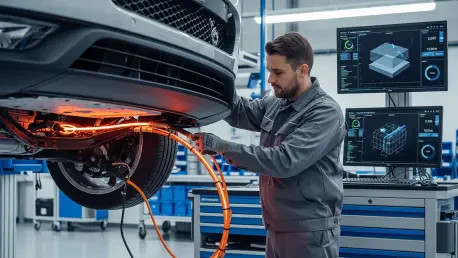
Furthermore, a severe shortage of certified technicians and the mandatory 48-hour safety quarantine for damaged batteries create massive logistical delays that inflate claim costs. When an electric vehicle is involved in a collision, safety protocols often require that it be stored in a specialized isolation zone to monitor for thermal runaway, a process where a damaged cell can catch fire hours or even days after the initial impact. This requirement occupies valuable real estate at repair centers and towing yards, adding storage fees to every claim. Additionally, with only about one in five automotive technicians currently trained to handle high-voltage systems safely, the demand for specialized labor allows for much higher hourly rates than what is typical for standard mechanical work.
The physical footprint required for these safety measures also limits the capacity of the repair industry. A storage facility that could normally accommodate a hundred gasoline-powered cars can only safely house a small fraction of that number if they are damaged electric vehicles requiring isolation. This reduction in effective capacity leads to longer wait times for assessments and repairs, forcing insurance companies to provide rental car coverage for extended periods. Every day a vehicle sits in quarantine or waits for a specialized technician adds to the total cost of the claim, a burden that is eventually passed back to the consumer through higher annual premiums.
The Thatcham Research Blueprint and the Reality of Economic Write-Offs
To combat the rising trend of “uninsurable” vehicles, industry experts at Thatcham Research have introduced a strategic blueprint focused on modular battery design and improved diagnostic access. This initiative highlights a critical industry failure where one in five electric vehicles is written off after minor collisions, prompting a push for manufacturers to move away from disposable battery architectures toward repairable, cost-effective systems. The blueprint argues that for the electric transition to be sustainable, the cars must be as fixable as the ones they are replacing. Without the ability to swap out individual battery modules or repair the outer casing of a pack, the economic viability of used electric cars remains in jeopardy.
This movement toward repairability is essential because the current “total loss” threshold is being met far too early in the life cycle of the vehicle. When a car that is only a few years old is scrapped because of a localized battery issue, it undermines the environmental benefits that the vehicle was supposed to provide. Improved diagnostic tools would allow technicians to pinpoint exactly which cells or modules are damaged, enabling targeted repairs that cost a fraction of a full pack replacement. By standardizing these diagnostic processes, the industry could provide insurers with the confidence they need to approve repairs rather than defaulting to a write-off, which would eventually lead to a stabilization of premium costs across the board.
Financial Planning for the EV Transition: Maximizing Total Cost of Ownership Benefits
Prospective owners can mitigate high insurance rates by analyzing the total cost of ownership, where significant savings in home charging and reduced maintenance often outweigh premium spikes. While the insurance bill might be higher, the lack of oil changes, spark plug replacements, and exhaust system repairs creates a significant cushion in the monthly budget. Regenerative braking technology also means that brake pads and rotors last significantly longer than they do on traditional vehicles. When these operational savings are calculated over a five-year period, the electric vehicle often emerges as the more economical choice despite the higher cost of coverage.
By prioritizing models with modular battery designs and utilizing specialized insurance products that cover charging hardware, drivers can navigate the current market volatility while the industry works toward achieving price parity with internal combustion engines. Some insurance providers have started offering policies that specifically protect home wall boxes and charging cables, recognizing that these are essential components of the electric lifestyle. Additionally, as the pool of insured electric vehicles grows, the increased data will allow underwriters to refine their risk models, potentially lowering costs for drivers with a proven track record of safety. Utilizing telematics and usage-based insurance programs can also provide a pathway for cautious drivers to prove their lower risk profile and secure more competitive rates.
The automotive market eventually recognized that the sustainability of the electric movement hinged as much on financial predictability as it did on engineering prowess. Manufacturers and insurers collaborated to reduce the frequency of total loss declarations by integrating modular parts into new chassis designs. Vehicle owners prioritized home energy management systems to recoup their initial investments, while the broader repair industry expanded its capacity for high-voltage diagnostics. These collective adjustments allowed the sector to move past the initial era of “uninsurable” risks, ensuring that the transition toward green energy remained economically viable for the average consumer. The industry successfully stabilized the cost of protection, proving that technical innovation could indeed be matched by fiscal responsibility.