
As a seasoned agricultural economist and advisor, Simon Glairy has spent years deciphering the complex relationship between climate volatility and commodity markets. His deep expertise in risk management and AI-driven assessment allows him to look beyond the immediate devastation of a storm or drought to understand the systemic shifts affecting the global food supply. Today, we sit down with him to discuss the harrowing conditions facing winter wheat producers, the economic ripple effects of a 25% production decline, and the difficult choices farmers must make when their livelihood is hammered by “ping-pong size” hail and persistent dry spells.
When hail destroys 70% of a wheat yield just before harvest, how do you decide whether to salvage the grain or till it under? What are the specific soil benefits of tilling damaged stalks, and how does this decision influence your communication with insurance adjusters?
When you lose 70% of your yield to hail just a week before harvest, the decision often comes down to the clock and the cost of fuel. For a farmer like Dennis Schoenhals, it may be too late to bail the wheat for hay, so running a combine to salvage the remaining 30% is the only way to recoup any direct cash from the grain. Tilling the damaged stalks back into the earth serves as a vital investment in the future, as this organic matter decomposes to improve soil structure and nutrient levels for the next planting cycle. Throughout this process, your communication with insurance adjusters must be transparent and immediate; they need to verify the damage—such as stalks bent in half by icy chunks—before you disturb the field. Maintaining that 70% damage estimate on record ensures that the indemnity payment reflects the true loss while you transition to soil recovery.
Yield estimates in major wheat-producing regions have dropped from 53 to roughly 39 bushels per acre. How does this shortfall impact local grain elevators, and what specific metrics or field conditions should agricultural economists monitor to understand the resulting strain on the regional supply chain?
A drop from a forecasted 53 bushels per acre to a meager 38.9 bushels represents a massive volume deficit that leaves local grain elevators with high overhead and very little throughput. These facilities rely on volume to stay profitable, and a Kansas wheat production pegged at only 218 million bushels—one of the lowest since 1972—means elevators will struggle to fulfill existing contracts. Economists should be closely monitoring abandonment rates and the prevalence of diseases like wheat streak mosaic, which can further degrade the quality of what little grain is left. When fields are being scouted and yield projections are slashed, the resulting strain moves rapidly from the farm gate to the global market, often hitting daily trading limits as buyers scramble for supply.
With extreme drought affecting over 70% of winter wheat acreage, some producers are grazing cattle on stunted crops rather than harvesting grain. What are the practical steps for transitioning a field to grazing, and how much moisture must return before it is safe to replant?
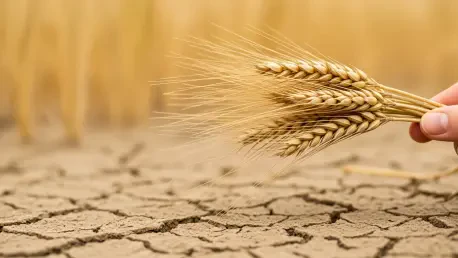
When a drought sweeps across 71% of growing areas, “failing” a crop for grazing is a pragmatic way to extract value from stunted, moisture-stressed plants that won’t ever fill out a head of grain. The transition involves an official assessment by an adjuster, followed by fencing and moving cattle onto the acreage to consume the biomass before the plants wither completely. After the cattle are moved off, the field is typically fallowed to prevent further moisture loss through transpiration. Producers are then forced to wait until they can build up significant subsoil moisture before they “roll the dice” on a new crop, as planting into dry, crumbly soil is a recipe for a second failure.
Deep cracks in the soil are currently preventing the planting of secondary crops like soybeans in many areas. When moisture is this scarce, how do you adjust your nitrogen and phosphate applications, and what financial strategies help mitigate the rising costs of these essential inputs?
The presence of deep cracks in the soil is a physical indicator that the ground is too thirsty to support new life, leading many farmers to shut off their planters and skip the soybean season entirely. In these conditions, heavy applications of nitrogen and phosphate are risky because without rain, the plants cannot uptake the nutrients, and you essentially “burn” the crop or lose the investment to the wind. Smart financial strategies involve forward-buying inputs; for example, some successful producers managed to secure their fertilizer before prices spiked due to geopolitical tensions like the Iran war. If you missed that window, the best move is often to rely on residual nitrogen from previous crops, such as alfalfa, and scale back new applications to match the realistic yield potential of a drought-stricken field.
Market prices for wheat recently hit daily trading limits, leaving grain buyers in a difficult position. Beyond price, how does a harvest dominated by lower-quality grain alter buyer contracts, and what are the broader implications of a 25% decline in winter wheat production?
A 25% decline in US winter wheat production creates a vacuum in the market that pushes buyers into a state of “sweating bullets” as they realize the grain they’ve contracted may not exist. When the harvest is dominated by drought-stressed, lower-quality grain—what some farmers call “chicken feed”—buyers are often forced to renegotiate contracts or look for higher-quality blending stocks to meet flour milling standards. This scarcity doesn’t just raise prices; it triggers volatility that can stop trading entirely when daily limits are hit, disrupting the entire supply chain from the baker to the consumer. The broader implication is a shift toward a “sellers’ market” where the remaining high-quality Hard Red Winter wheat commands a massive premium, leaving many international buyers priced out.
What is your forecast for the US winter wheat market?
I forecast a period of extreme price volatility and tightening stocks as we contend with the second-lowest Kansas wheat production since the early 1970s. With 71% of growing areas under drought stress and a confirmed 25% drop in national winter wheat output, the market is no longer just speculating on damage; it is now reacting to the reality of empty silos. We will likely see a surge in “abandonment,” where farmers choose to plow under or graze their fields rather than harvest, further shrinking the available supply. For the remainder of the year, I expect grain buyers to pivot toward aggressive procurement strategies, as the scarcity of high-quality milling wheat will keep prices near historic highs regardless of short-term market fluctuations.