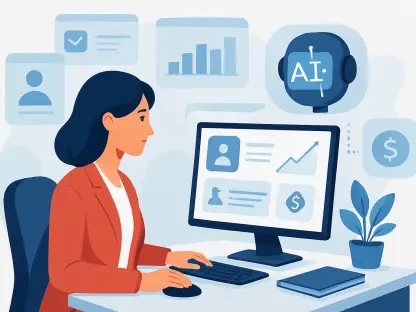

The rapid acceleration of generative and agentic AI has reached a tipping point where the standard practices of insurance distribution are no longer merely evolving but are being fundamentally redefined by autonomous systems. Moody’s Ratings has brought this transformation to light through its “Bank of the Future” series, which designates retail property and casualty (P&C) insurance distribution as the sector most susceptible to immediate technological disruption. This vulnerability arises because personal lines, such as auto and homeowners insurance, have become heavily commoditized, making them ideal targets for automated systems that can handle high-volume, repetitive tasks. In this landscape, the emergence of specialized cybersecurity models like Mythos AI underscores a double-edged sword: while these tools can identify complex vulnerabilities, they also represent the high level of technical sophistication that traditional firms must now integrate or compete against.
The purpose of traditional insurance distribution has historically been to act as a vital bridge, where human intermediaries resolve the information gap between complex carrier products and the specific needs of the policyholder. Brokers and agents provided a localized, human-centric interface that added value through personal relationships and manual risk interpretation. In contrast, the purpose of AI automation is to eliminate these friction points by streamlining routine administrative processes and delivering instantaneous results. Retail P&C is currently the primary battleground for this shift, as the predictable nature of personal insurance products allows for a seamless transition toward algorithmic management, putting the traditional role of the human middleman under unprecedented pressure.
Foundations of AI Integration and Traditional Insurance Intermediation
Traditional insurance intermediation relies on the premise that human judgment is necessary to navigate the nuances of risk and policy language. For decades, the retail P&C sector functioned through a network of local agents who used their personal reputations to build trust with homeowners and drivers. These professionals spent significant time on manual data entry, physical inspections, and face-to-face consultations to ensure that a policy was appropriate for a client’s specific circumstances. This model, while effective for building long-term loyalty, is inherently limited by the speed and cost of human labor, creating a cost structure that is becoming increasingly difficult to justify in a market where consumers prioritize speed and price.
AI integration, particularly through agentic models, offers a fundamental alternative by replacing manual oversight with automated decision-making frameworks. Systems are now capable of analyzing vast quantities of data to perform underwriting tasks that previously required human intervention. Organizations like Moody’s Ratings have identified that the “Bank of the Future” will likely rely on these AI foundation models to manage the high volume of routine tasks that currently define the retail insurance experience. By shifting administrative burdens to AI, carriers can reduce overhead significantly, though this transition risks alienating the human intermediaries who have traditionally been the primary drivers of sales and service.
Analyzing the Shift: AI Capabilities vs. Traditional Distribution Models
Information Asymmetry and Market Knowledge
The historical value proposition of an insurance broker was built upon a significant information gap, where the broker held the specialized knowledge and market access required to find the best coverage. Traditional brokers spent years cultivating relationships with various carriers, giving them an “insider” view of risk appetite and pricing trends that was inaccessible to the average consumer. This monopoly on market knowledge allowed intermediaries to charge a premium for their services, acting as the essential filter through which all insurance transactions had to pass.
In contrast, modern AI tools are effectively democratizing this knowledge, allowing the end consumer to access the same level of product comparison and risk assessment that once required a professional license. AI-driven platforms can scan hundreds of policy options in seconds, identifying the most cost-effective solutions based on real-time data rather than historical relationships. This shift erodes the traditional advisory moat, as customers no longer need a human to explain market trends or compare basic policy features. The value chain is moving toward platforms that provide transparency, forcing human brokers to find new ways to differentiate their services beyond mere information retrieval.
Operational Efficiency and the Transactional Lifecycle
The transactional lifecycle of “quote, bind, and issue” represents the core of the insurance distribution process, and it is here that the contrast between human and machine is most stark. Traditional manual advisors often involve a multi-step process that can take hours or even days to complete, especially when small commercial policies or non-standard personal lines are involved. Each step requires human verification, which introduces delays and increases the operational margin necessary to keep a brokerage profitable. These manual workflows are increasingly viewed as a liability in a market that demands instant gratification.
Automated AI tools perform these routine administrative tasks at a fraction of the cost and time, offering a streamlined path that eliminates the need for manual data entry. By leveraging automated underwriting and instant document generation, AI systems can issue policies for standard homeowners and auto insurance in real-time. This lower overhead allows digital-first competitors to offer more aggressive pricing, putting intense pressure on the margins of traditional firms. As these automated tools move from simple personal lines into small commercial sectors, the traditional human-led transactional model is being squeezed out of the high-volume market.
Risk Management and Specialized Complexity
While AI excels at standardized, high-volume tasks, it still faces significant technical hurdles when attempting to automate bespoke or complex specialty risks. A human broker’s ability to manage non-linear problems, such as a large-scale commercial property development or a multifaceted liability package, remains a critical advantage. Human intermediaries provide a layer of accountability and nuanced judgment that algorithms currently cannot replicate, particularly when a situation requires a deviation from standard data patterns. In complex sectors, the broker acts as a sophisticated risk manager who can tailor a policy to unique needs that an AI might flag as an error.
The benefit of human accountability becomes most evident during catastrophic losses, where the relationship between the client and the advisor is tested. An AI can provide a quote and issue a policy, but it cannot offer the empathetic advocacy or the creative problem-solving required to navigate a complex claim after a major disaster. In niche sectors or high-value commercial lines, the technical difficulty of automating the “gray areas” of risk provides a temporary sanctuary for the human professional. However, as agentic AI continues to improve its ability to reason through complex scenarios, even these specialty moats are beginning to feel the ripples of technological advancement.
Critical Challenges and Strategic Barriers in the AI Era
One of the most pressing structural challenges is the “mid-market squeeze,” a phenomenon where mid-sized distribution firms are trapped between two extremes. Small, boutique startups are often agile enough to adopt new AI tools quickly without the baggage of legacy systems, while global platforms have the massive capital reserves needed to develop proprietary agentic AI. Mid-tier players often lack both the agility and the capital, making them prime targets for acquisition as the industry consolidates. This hollowing out of the middle market is accelerating as firms realize that maintaining a competitive edge requires technological investments that are beyond their current financial reach.
Systemic risks also loom large due to an increasing vendor dependence on a small number of cloud providers and AI foundation models. As insurance firms rush to integrate these technologies, they create a centralized bottleneck where a single failure at a major tech provider could paralyze the entire distribution network. Furthermore, the speed of cyber threats is outstripping the pace of organizational remediation. Tools like Mythos AI demonstrate how quickly vulnerabilities can be exploited, creating a gap that traditional insurance governance is struggling to close. Moody’s Core Scenario suggests that firms have only a 12-to-18-month window to implement the operational execution necessary to stay ahead of these compounding risks.
Strategic Outlook: Selecting the Path to Resilience
To survive the ongoing transition, distribution businesses must focus on creating moats that prioritize high switching costs and deep operational integration. Specialized intermediaries can maintain their relevance by pivoting away from simple transactional brokerage and toward complex claims advocacy and risk advisory. By embedding themselves into the client’s long-term business strategy, human brokers can build a level of friction that makes it difficult for an AI-native competitor to lure a client away with a slightly lower premium. The future belongs to those who use technology to enhance their advisory roles rather than those who try to compete with AI on speed and price alone.
Strategic growth will also depend on the effective use of proprietary assets that AI startups cannot easily replicate, such as audited risk data and decades of transaction histories. These data moats provide a unique foundation for creating custom risk profiles that are far more accurate than generic market data. Additionally, there is a growing opportunity in the market for Technology Errors and Omissions (E&O) insurance as more firms become dependent on AI ecosystems. The analysis of the current landscape indicated that the most resilient firms were those that recognized the limitations of automation and doubled down on human-centric, high-stakes advisory roles. By the time the full impact of agentic AI was felt, the industry had clearly bifurcated into a high-volume automated layer and a high-value specialized layer. The successful firms were those that made the hard decision to move up-market and secure their proprietary data before the window for operational change closed. Proper alignment with these trends ensured that the human broker remained an essential, albeit more specialized, part of the financial landscape.