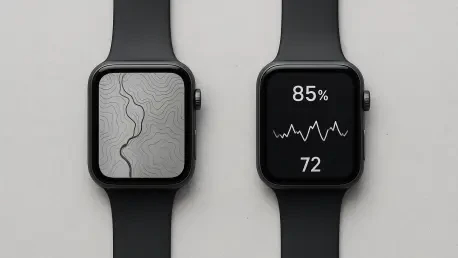

The Apple Watch Ultra 3 demonstrated remarkable efficiency by consuming less than one percent of its battery life during a full hour of active GPS tracking and heart rate monitoring. This milestone marks a significant moment in the 2026 wearable market, where the rivalry between Apple and Samsung has shifted from basic feature sets to extreme sensor precision and energy optimization. To evaluate these flagship devices, a controlled 6,500-step walk test was conducted, using a manual tally counter as the objective source of truth. The methodology relied on a manual tally counter to establish an absolute ground truth for movement, while a secondary reference from an iPhone 16 Plus provided distance and elevation data. This controlled environment allowed for a direct comparison of how each watch’s internal algorithms interpret physical activity. As athletes and outdoor enthusiasts increasingly rely on these metrics for training, understanding the subtle differences in accuracy between the industry’s top two competitors becomes essential for making an informed purchase.
Precision in Movement and Location
Comparing Step Count Accuracy
When measuring the primary metric of step counting, both the Apple Watch Ultra 3 and the Samsung Galaxy Watch Ultra proved to be exceptionally precise, though they deviated from the manual count in opposite directions. The Apple Watch recorded 6,455 steps, resulting in a slight undercount of only 45 steps, or roughly a 0.7 percent margin of error. On the other hand, the Samsung Galaxy Watch Ultra registered 6,565 steps, overcounting the actual total by 65 steps. While both devices remained well within the “outstanding” performance threshold of 100 steps, Apple’s more conservative algorithm provided a result that was objectively closer to the manual tally. This discrepancy suggests that Samsung’s motion sensors might be more sensitive to incidental arm movements, whereas Apple’s software filters out non-pedestrian vibrations more aggressively. For users who obsess over the granularity of their daily activity targets, these minor variances highlight the ongoing refinement of accelerometer technology in the premium smartwatch segment.
Assessing Dual-Band GPS Distance
The geographical tracking capabilities were assessed against a 3.52-mile benchmark, revealing that Samsung has made significant strides in positioning accuracy. The Samsung Galaxy Watch Ultra recorded a total distance of 3.49 miles, coming remarkably close to the reference figure despite the potential for signal interference from nearby structures. In comparison, the Apple Watch Ultra 3 logged 3.46 miles, showing a slightly more conservative interpretation of the path traveled. This three-hundredths of a mile difference indicates that Samsung’s dual-band GPS implementation may be more adept at smoothing out signal noise and accounting for the slight variations in a walker’s trajectory. For long-distance runners and hikers where every tenth of a mile matters for pacing and navigation, the Samsung device offered a more reliable representation of the actual route. Both watches maintained a consistent lock throughout the exercise, demonstrating that 2026’s satellite communication standards have effectively eliminated the significant signal drops seen in earlier hardware.
Biometrics and Power Management
Evaluating Health Sensor Accuracy
Biometric performance during the test showed an impressive consensus regarding cardiovascular effort, yet the devices diverged on environmental data interpretation. Both wearables tracked heart rates with near-identical precision, reporting average and maximum beats per minute that were within a single point of each other. This consistency confirms that optical sensor arrays from both manufacturers are now mature enough for professional health monitoring. However, the proprietary algorithms used to calculate caloric expenditure differed greatly, with Apple estimating a significantly higher energy burn than Samsung for the same level of activity. Environmental accuracy also favored Samsung, which provided an altimeter reading that more closely mirrored the actual terrain’s elevation profile. The Apple Watch Ultra 3 continued a known tendency to slightly overestimate total vertical gain, which might mislead hikers about the intensity of their climbs. These variations illustrate how each company’s health ecosystem prioritizes different sensor inputs to generate user-facing fitness summaries.
Examining Battery Drain and Efficiency
Power management represented the most distinct area of differentiation, where Apple’s internal optimization significantly outperformed the competition. During the hour of continuous GPS and heart rate polling, the Apple Watch Ultra 3 maintained nearly its entire charge, whereas the Samsung Galaxy Watch Ultra experienced an eight percent decrease in battery life. This disparity suggested that Apple has achieved a superior level of integration between its custom silicon and the watchOS power-saving protocols during active workouts. For users engaged in endurance sports or multi-day trekking, this efficiency became a primary consideration, as it reduced the frequency of charging cycles and extended the device’s operational window. The test concluded that while Samsung provided superior distance and elevation tracking, Apple’s device excelled in battery longevity and step count accuracy. Both watches proved themselves as capable tools for the modern athlete, but the final choice depended on whether the user valued absolute terrain precision or the efficiency required for long-term tracking.