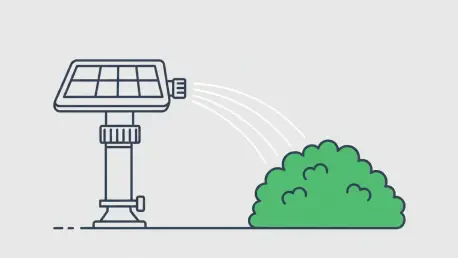

The rhythmic back-and-forth clicking of a traditional impact sprinkler often signals a well-maintained lawn, yet this familiar sound masks a staggering amount of waste that modern landscapes can no longer afford to ignore. For years, homeowners have tolerated the “sidewalk soak,” a phenomenon where poorly aimed hardware drenches pavement and house siding as much as the grass. The Oto Solar-Powered Smart Sprinkler enters the market with a promise to solve this specific frustration by replacing the chaotic spray of traditional hardware with a laser-focused beam of water that goes exactly where it is told.
Beyond the Sidewalk Soak: The End of Wandering Water
Standard sprinklers are notoriously indiscriminate, often drenching the driveway, the side of the house, and the local sidewalk just as thoroughly as the lawn itself. For the modern homeowner, watching gallons of expensive water evaporate off the asphalt is more than just a nuisance—it is a glaring inefficiency. By focusing on precision rather than volume, this new technology attempts to redefine how we view residential irrigation.
The shift toward hyper-targeted delivery ensures that moisture reaches the root zone without the typical overspray. This transition is essential for those who want to maintain lush greenery without the guilt of wasting local resources. By eliminating the wandering water that characterizes older systems, users can finally keep their wooden fences dry while their flower beds thrive.
The Rising Stakes of Domestic Water Management
As water utility costs climb and regional drought restrictions become more common, the “set it and forget it” mentality of old-school irrigation is becoming obsolete. The shift toward precision gardening isn’t just about convenience; it is a response to a global trend of resource conservation and the integration of the Internet of Things (IoT) into the backyard. Homeowners are increasingly looking for cable-free, solar-powered solutions that reduce their carbon footprint while maintaining curb appeal through data-driven maintenance.
Furthermore, the rise of smart home ecosystems has raised expectations for outdoor maintenance. Integrating irrigation into a digital dashboard allows for a more holistic approach to land management. This movement reflects a broader cultural desire to balance aesthetic beauty with environmental responsibility, ensuring that the luxury of a green lawn does not come at an unsustainable cost to the community.
Engineering the Beam: How Digital Boundaries Replace Physical Valves
The Oto system functions as a high-tech sentry for the garden, utilizing a concentrated stream of water that offers significantly more control than a standard oscillating head. Instead of manually adjusting metal tabs or plastic dials, users define their watering zones—classified as specific spots, lines, or complex 2-D shapes—by dropping digital markers within a dedicated mobile app. This interface allows for hyper-targeted irrigation, ensuring that delicate flower beds receive moisture while the adjacent wooden deck stays completely dry.
By utilizing solar energy, the unit eliminates the need for trenching power lines, making it a modular addition to any landscape. This independence from the electrical grid simplifies installation and allows for placement in remote corners of a property. The combination of cloud-based mapping and renewable energy transforms the sprinkler from a simple mechanical tool into a sophisticated piece of digital infrastructure.
Field Results and the Reality of High-Pressure Irrigation
Field testing reveals that the Oto’s systematic approach—moving in expanding circular arcs followed by meticulous “clean-up” runs—successfully eliminates the dry patches that plague traditional systems. However, this precision comes with functional nuances that require a watchful eye. The high pressure needed to project the water beam to the outer edges of a zone can result in a “splashdown” effect, which may lead to soil erosion or damage to fragile seedlings if not positioned correctly.
Furthermore, while the software effectively integrates real-world weather reports to skip watering during high winds or rain, the hardware remains sensitive to fluctuations in household water pressure. If the local supply dips, the reach of the beam may fall short of its programmed boundaries. Despite these technical hurdles, the ability to achieve total coverage without the typical mechanical failures of underground pipes represented a significant step forward in reliability.
A Practical Framework for Implementing Smart Irrigation
Transitioning to a precision watering system required a strategic approach to maximize the technology’s weather intelligence and granular scheduling. Users began by establishing a weekly watering budget measured in inches, allowing the Oto to calculate the exact volume needed based on soil saturation. Setting custom thresholds for wind and rainfall ensured the system didn’t waste water during a storm or see its beam deflected by heavy gusts.
For those seeking more than just utility, the device included a “play mode” for interactive games, but the core value lay in the user’s ability to refine digital boundaries over time. Success with this technology involved a shift in mindset from passive observation to active optimization. By analyzing the landscape and adjusting the digital markers, homeowners turned their irrigation routine into a data-driven investment that prioritized long-term ecological health over short-term convenience.