
The current landscape of robotics is undergoing a seismic shift as capital floods into startups that promise to redefine the utility of autonomous systems within our daily lives. Enigma has entered this competitive arena with a seventy-one million dollar seed funding round led by Index Ventures and Ribbit Capital, signaling a major pivot in how the industry perceives the relationship between humans and machines. Instead of merely focusing on faster processors or more dexterous limbs, this research lab is targeting the “interaction bottleneck,” which refers to the immense cognitive load currently required for a human to instruct a robot. While competitors are racing to develop massive models based on internet videos, Enigma is building a robotic brain designed to interpret subtle human cues. This transition from rigid programming to intuitive guidance represents a fundamental change in robotic philosophy. The goal is to ensure that operating a complex machine becomes as natural as gesturing or speaking to a fellow colleague.
Redefining Control: The Interaction Bottleneck
The central philosophy driving this innovation is the belief that the utility of a robot is inversely proportional to the effort required to control it. To illustrate this, the founders utilize a “volume knob” analogy, suggesting that if a user must spend more time explaining a task than it would take to perform it themselves, the technology has fundamentally failed. To remedy this, the development team is creating a foundational model that prioritizes touch, visual observation, and natural language over traditional coding. By allowing a robot to perceive the physical pressure of a hand or the nuances of a verbal request, the system can adjust its actions in real-time to match the user’s expectations. This approach effectively lowers the barrier to entry for non-technical users, making it possible for individuals without engineering backgrounds to supervise complex operations. Such a leap in usability could potentially unlock thousands of applications in sectors where automation was previously considered too expensive.
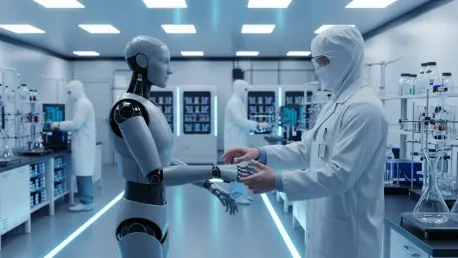
To refine these interaction models, the startup has launched an ambitious global experiment involving more than one hundred proprietary robots stationed in specialized facilities across California and Israel. Unlike traditional laboratory setups that are closed to the public, these machines are actively engaged in tasks that range from delicate artistic painting to high-speed sword-fighting simulations and complex chemistry experiments. By opening these facilities to public interaction, the lab is gathering a unique dataset that captures how ordinary people, rather than expert roboticists, attempt to communicate with and guide machines. Every hesitation and successful correction is fed back into the learning loop to improve the system’s responsiveness. This large-scale deployment serves as a massive stress test for the software, forcing it to adapt to various accents, physical strengths, and conceptual approaches. The result is a more resilient artificial intelligence that can anticipate human needs before they are stated.
Elite Pedigree: Challenging Traditional Industry Dogmas
The leadership team at the helm of this venture brings a distinct “hacker” mentality that contrasts sharply with the traditional academic perspectives often found in the robotics sector. Co-founders Jonathan Jacobi and Gal Niv are veterans of Israel’s elite Unit 8200, a background that has provided them with deep expertise in cybersecurity, high-level system analysis, and unconventional problem-solving. This unique pedigree allows them to view robotics not as a series of mechanical challenges, but as a complex data and interface problem that requires a fresh set of eyes. By intentionally recruiting top-tier talent from outside the traditional robotics sphere—including math Olympiad winners and researchers from prestigious non-robotic programs—the company is prioritizing user experience and system flexibility over established industry standards. This diversity of thought is crucial for breaking away from long-standing technical limitations that have historically hindered the development of truly interactive machines.
Looking at the broader impact, the company established strategic partnerships in high-demand sectors such as healthcare and logistics, where real-time collaboration without complex programming was essential. These industries stood to benefit the most from machines that could assist human staff through simple verbal commands or physical prompts. The successful closure of the seventy-one million dollar funding round and the deployment of the global robot fleet marked a significant milestone in achieving seamless human-machine synergy. By prioritizing the user’s experience over traditional technical metrics, the lab demonstrated that the most effective way to advance robotics was to make machines more receptive to human intent. Stakeholders and industry leaders recognized that the path to widespread adoption required removing the barriers that once separated creators from users. This transition turned what was once a specialized field of engineering into a foundational component of modern society, ensuring that robots remained safe and easy to manage.