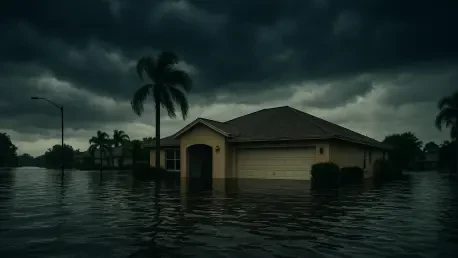

The financial aftermath of Hurricanes Helene and Milton has exposed a staggering disconnect between policy limits and actual payouts for Florida homeowners facing total property loss. This systemic failure has transformed the dream of coastal living into a bureaucratic nightmare for families who find their insurance safety nets effectively shredded. For instance, the case of the Garbowicz family in St. Petersburg serves as a grim illustration of this reality. Despite maintaining a homeowners policy with a $713,000 coverage limit, they received a shockingly low payout of only $2,279.41 after successive storms decimated their residence. Even with supplemental flood insurance providing the maximum $250,000 and federal assistance adding another $33,000, the total recovery funds remain hundreds of thousands of dollars short of the $1.5 million estimated for reconstruction. This massive fiscal vacuum is further exacerbated by mortgage companies that frequently withhold insurance disbursements until active construction begins, even as local permitting delays prevent such work from ever starting.
Navigating Financial and Bureaucratic Obstacles
Beyond the immediate shortfall in insurance payouts, homeowners are increasingly ensnared in a complex web of federal regulations known as the duplication of benefits trap. This administrative hurdle occurs when residents are approved for Small Business Administration disaster loans, which the federal government then uses to offset or repay initial grants provided by emergency management agencies. Consequently, what began as a tax-funded relief grant is effectively converted into a debt-bearing loan, placing an overwhelming financial burden on families already struggling to pay mortgages on homes that are no longer habitable. Navigating this labyrinthine process has become a grueling full-time endeavor for many, requiring constant communication with adjusters and federal representatives who often provide conflicting information. These barriers do not merely delay the recovery process but actively prevent middle-class families from regaining their footing, forcing many to consider abandoning their properties or taking on high-interest debt that may take decades to resolve in the current economic climate.
The broader landscape of the regional property market is characterized by rapidly escalating costs and a diminishing pool of private providers willing to assume coastal risks. Current data indicates that homeowners are now paying annual premiums ranging from $4,200 to $5,700, reflecting a steep trajectory that shows no signs of stabilizing as the state absorbs billions in hurricane-related damages. Since the early part of the decade, numerous insurance carriers have declared insolvency or voluntarily exited the market to avoid catastrophic exposure, leaving the state-backed insurer of last resort dangerously overleveraged. This volatility has created a high-risk environment that discourages new private investment and places the entire financial infrastructure of the region on fragile ground. As private insurers seek legal avenues to narrow their coverage scope or exit flood-vulnerable zones entirely, the burden of protection shifts increasingly onto the public sector and individual homeowners, making the long-term viability of property ownership in storm-prone corridors a significant concern for the state.
Political Divergence and Legislative Barriers
The insurance crisis has precipitated a profound political divide regarding the most effective strategies for long-term infrastructure stability and climate resilience. One faction of leadership emphasizes the urgent need for aggressive mitigation efforts, such as elevating roadways, constructing robust sea walls, and implementing stringent new building codes to withstand more frequent and intense weather events. These advocates argue that focusing on infrastructure and renewable energy initiatives like rooftop solar can significantly lower long-term costs for residents. However, this approach often clashes with legislative priorities that focus on traditional energy expansion and deregulation. For example, recent legislation such as HB 1217 has restricted local municipalities from enforcing net-zero emission policies, effectively halting localized climate initiatives in major urban centers. This friction between state-level mandates and local resilience goals creates a fragmented response to the crisis, where the immediate need for property protection is often sidelined by broader ideological debates over energy production and environmental policy.
In light of these persistent systemic failures, a bipartisan coalition of nearly 100 lawmakers has introduced the FEMA Act to fundamentally overhaul the federal disaster recovery framework. The proposed legislation seeks to streamline the recovery process by establishing an independent status for the federal emergency agency, moving it out of the Department of Homeland Security to reduce administrative friction. A central component of this reform is the creation of a unified application portal designed to eliminate the redundancy and confusion currently faced by storm victims. Furthermore, the act aims to shift the recovery model from a reimbursement-based system to one that provides upfront funding, allowing homeowners to begin rebuilding without waiting months for financial clearance. By prioritizing pre-storm mitigation and property hardening, the initiative intends to transform the current reactionary system into a proactive lifeline. This federal shift represents a critical recognition that the existing insurance and relief models are no longer sufficient to address the scale of modern environmental challenges facing the United States.
The Strategic Evolution of Disaster Management
The resolution of this property crisis required a shift from reactive recovery to proactive resilience, ensuring that financial protections matched the realities of a changing environment. Lawmakers and industry experts recognized that the previous system was fundamentally broken, necessitating a complete re-evaluation of how risk was calculated and how recovery was funded. Successful strategies involved the integration of modern building technologies and decentralized energy grids which mitigated the impact of widespread utility failures. Furthermore, the implementation of more transparent insurance adjustor standards helped bridge the gap between policy expectations and actual payouts, reducing the administrative limbo that once paralyzed entire communities. Communities that adopted these holistic approaches were able to stabilize their local economies and maintain property values despite the increasing frequency of severe weather events. This evolution proved that while the old safety net had collapsed, a more resilient framework could be built through technological innovation, legislative clarity, and a commitment to protecting the financial stability of homeowners through more equitable and streamlined federal support systems.