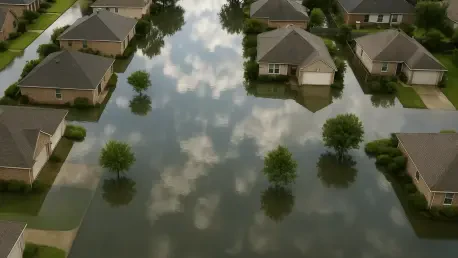

FEMA’s reliance on the one-hundred-year flood threshold fails to account for the increasing frequency of intense rainfall events across the country. As of mid-2026, a comprehensive analysis by the Government Accountability Office (GAO) has revealed a staggering vulnerability in the American infrastructure: 86% of high-risk properties lack any form of flood insurance. This massive deficit persists despite flooding remaining the most destructive natural disaster in the United States, causing billions in damages annually. The GAO found that approximately 13 million high-risk properties currently sit outside the Federal Emergency Management Agency’s (FEMA) designated Special Flood Hazard Areas (SFHAs). This geographical exclusion is particularly dangerous because these designations trigger the mandatory insurance purchase requirement for homeowners with federally backed mortgages. Without this trigger, millions of residents remain unaware of their actual exposure to disaster. The disconnect stems largely from mapping protocols that prioritize coastal surges and river overflows while frequently ignoring “pluvial” flooding, which occurs when heavy rainfall overwhelms local drainage systems regardless of proximity to a body of water.
The scope of this underinsurance crisis suggests that the federal government’s current mapping infrastructure significantly underestimates modern environmental threats. By failing to integrate the risks posed by intense localized downpours, the National Flood Insurance Program (NFIP) has inadvertently fostered a false sense of security among property owners. Private modeling firms have increasingly pointed out that the 1% annual chance flood—the standard for the hundred-year flood—is an inadequate metric for long-term financial planning. Over the life of a standard 30-year mortgage, a property with a 1% annual risk actually faces a 26% cumulative chance of flooding. This statistical reality is rarely communicated to the public, leading to a situation where the vast majority of at-risk Americans are essentially self-insuring against a hazard that is statistically likely to occur during their period of ownership. The GAO’s findings serve as a stark warning that the current regulatory framework is no longer sufficient to protect the financial stability of homeowners or the broader national economy in an era of increasing climate volatility.
The Erosion of Coverage and Rising Financial Stakes
Participation in the National Flood Insurance Program has experienced a notable decline over the last decade and a half, dropping from approximately 5.5 million policies in 2010 to just 4.5 million in 2026. While the private insurance market has seen some expansion, accounting for roughly 14% of all flood policies by 2025, it has not grown at a pace sufficient to offset the loss of federal policyholders. This trend is particularly concerning given that the mandatory purchase requirement remains the primary driver of coverage. Within the Special Flood Hazard Areas where insurance is required by lenders, the coverage rate sits at a modest 43%. However, for properties located outside these official zones, the participation rate plummets to a mere 2%. This massive disparity highlights the limitations of a system that relies on binary geographical boundaries rather than the actual probability of flooding from multiple sources. When coverage is not forced by a mortgage servicer, most property owners choose to forgo it, often due to a lack of awareness or the perceived high cost of premiums.
The financial consequences of this coverage gap are no longer a theoretical concern; they are a direct strain on the federal treasury. Between 1980 and 2004, the NFIP paid out an annual average of $1.2 billion in claims when adjusted for inflation. In the years following, that average quadrupled to approximately $4.8 billion annually. The volatility of these costs is underscored by recent major events, such as Hurricane Helene in 2024, which generated $7 billion in NFIP claims alone. Even localized, non-tropical events have proven catastrophic; in July 2025, flooding in Central Texas resulted in over $31 million in claims and 139 fatalities. The GAO emphasizes that insurance is the most effective mechanism for community resilience, as insured households recover faster and require significantly less direct federal disaster assistance. Without a broad insurance pool, the burden of rebuilding falls back on the taxpayer through emergency appropriations, creating a perpetual cycle of unhedged disaster spending that threatens the long-term viability of federal recovery programs.
Modernized Pricing and the Struggle for Affordability
A significant shift in the NFIP’s operational model occurred with the implementation of Risk Rating 2.0, a modernized pricing methodology that began its full transition for all policies in 2022. Before this change, premiums were largely determined by broad flood zones and often included heavy subsidies for older properties that did not reflect their true risk level. The new system utilizes advanced commercial catastrophe models and incorporates individual property characteristics, such as replacement costs and a wider variety of flood sources. The primary goal of Risk Rating 2.0 was to provide more accurate price signals and stabilize the program’s finances by ensuring that premiums actually reflect the risk being insured. This transition to actuarial transparency was intended to encourage mitigation efforts and discourage development in the highest-risk areas. However, while the methodology is technically superior to the old system, it has introduced a new set of challenges regarding the socioeconomic reality of property owners.
The move toward full-risk pricing has inadvertently sparked an affordability crisis, particularly for low-to-moderate-income homeowners who have seen steady increases in their annual premiums. Although federal law currently caps annual premium increases at 18% for most primary residences, the cumulative effect of these hikes has pushed many participants out of the program. The GAO has kept the NFIP on its “High Risk List” since 2006 because the program cannot generate enough revenue to cover catastrophic losses, yet raising premiums to the necessary levels risks making the product unattainable for those who need it most. For the program to remain viable and expand its reach, analysts suggest that Congress must intervene by authorizing means-based assistance. Such a program would help vulnerable homeowners maintain coverage without further bankrupting the NFIP. Balancing the need for a self-sustaining insurance program with the practical ability of citizens to pay is now the central legislative hurdle facing the future of national disaster management.
Structural Barriers: Beyond the Hundred Year Flood
The National Flood Insurance Program was originally established in 1968 with the intent of reducing federal disaster spending by incentivizing local floodplain management. However, the legal framework governing the program has struggled to adapt to the complexities of modern development and changing weather patterns. Currently, the mandatory purchase requirement applies only to “qualifying properties” in participating communities that have loans from federally regulated lenders or government agencies like the FHA, VA, or USDA. This leaves a significant portion of the housing market—specifically those who own their homes outright without a mortgage—entirely outside the regulatory net. Furthermore, the reliance on the 100-year flood threshold as the sole trigger for insurance creates a psychological barrier. Property owners often interpret being “outside the zone” as having zero risk, failing to realize that the designation is a minimum regulatory standard rather than a comprehensive assessment of safety from all possible water-related hazards.
Modern urban environments face a growing threat from pluvial flooding, which occurs when localized, intense rainfall exceeds the capacity of municipal drainage systems. Because FEMA’s historical mapping focus has been on coastal surges and the overflowing of major rivers, millions of properties in urban and suburban areas remain technically “off the map” for flood risk. The GAO found that the lack of participation in these areas is not necessarily a choice made by informed homeowners, but rather a failure of the system to communicate the actual risk. By tying insurance requirements to specific, often outdated geographical boundaries, the federal government has created a binary system of “insured” and “uninsured” that does not reflect the fluid nature of environmental hazards. This structural rigidity prevents the NFIP from capturing a diverse range of risks, which would otherwise help diversify the insurance pool and lower the overall financial volatility of the program.
Strategic Reforms: A Path toward National Resilience
To address these systemic failures, the GAO proposed four specific actions that require new statutory authority from Congress to modernize the flood insurance landscape. The first and most impactful recommendation involves redefining the criteria for mandatory insurance purchases. Instead of relying purely on geographical designations, the GAO suggested that the criteria should incorporate all sources of risk, including heavy rainfall and drainage failure. This shift would bring millions of high-risk properties into the insured pool, ensuring that coverage reflects the actual environmental reality rather than an arbitrary map line. Legislators recognized that transparency is also a vital component of this reform; therefore, mandating that FEMA make property-level risk data publicly available was a key priority. Such transparency would empower potential buyers to understand the true cost of ownership and the likelihood of disaster before committing to a purchase, effectively moving the market toward more resilient housing choices.
The second half of the GAO’s strategic vision focused on the point of sale and the adequacy of coverage. The agency recommended that lenders be required to provide actual flood insurance quotes to borrowers during the mortgage closing process, even for properties located outside of mandatory zones. This simple administrative change would serve as a formal communication of risk at a moment when buyers are most focused on the long-term costs of their investment. Furthermore, the GAO noted that current federal limits on coverage often fail to reflect modern property values or the actual cost of reconstruction in the current economy. By raising these limits, Congress would allow the NFIP to provide more comprehensive protection, reducing the need for supplemental private policies and minimizing unreimbursed losses. Ultimately, these recommendations were designed to transition the NFIP from a reactive disaster response program into a proactive tool for national resilience, ensuring that more Americans are protected before the next major flood event occurs. Closing the 86% gap required a fundamental shift in how the nation perceives and prices the risk of water.