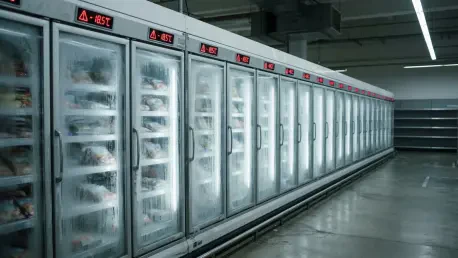

The National Cyber Security Centre warns that many organizations have spent decades doing tech on the cheap, leaving critical infrastructure vulnerable to large-scale disruptions. This sobering reality has recently manifested in a series of coordinated cyberattacks targeting supermarket refrigeration systems across Europe, impacting stores from Sweden to Belgium and France. Hackers successfully manipulated the temperature settings of industrial fridges and freezers, forcing retailers to dispose of massive quantities of perishable food items. This incident marks a significant shift in the cyber threat landscape, where digital breaches move beyond data theft to cause immediate, tangible physical damage. Experts suggest that hospitals, pharmaceutical cold chains, and food manufacturing facilities are equally at risk because they rely on similar legacy operational technology that was never originally intended to be connected to the public internet. The blurring lines between cyber and property risks represent a new challenge for modern businesses seeking to protect assets.
1. Verify Insurance Coverage and Hardware Inventories
Business owners must engage in a thorough evaluation of their current insurance portfolios to identify potential gaps in coverage. While most commercial enterprises maintain standard cyber insurance, these policies frequently limit their scope to digital assets, data restoration, and liability for privacy breaches. They often specifically exclude physical destruction of tangible goods or property damage resulting from a network intrusion. To mitigate the financial impact of incidents like the recent freezer hacks, it is essential to consult with insurance professionals to verify if a plan explicitly includes Cyber Property Damage. Without this specific endorsement, a supermarket or food processor might find themselves unprotected when thousands of dollars’ worth of stock spoils due to a remote temperature adjustment. This lack of coverage can lead to significant unrecoverable losses that threaten the viability of independent retailers operating on thin margins in an increasingly competitive market.
Comprehensive asset management serves as the cornerstone of a resilient cybersecurity strategy, requiring a detailed inventory of every controller and sensor within an organization. Many supermarkets operate with a patchwork of different systems, often managed by various third-party vendors or legacy installers. This lack of standardization creates blind spots where outdated or unpatched hardware can persist for years without the owner’s knowledge. Maintaining a thorough hardware log allows technical teams to track the age, firmware version, and manufacturer of every device connected to the network. By documenting these assets, companies can systematically identify which components are most vulnerable to known exploits. This inventory should be updated every time a new piece of equipment is installed or serviced, ensuring that the security posture of the facility is always based on accurate data. Knowing exactly what hardware is in place is the first step toward effective defense against sophisticated digital threats.
2. Secure Network Connections and Contractor Access
One of the most effective strategies for securing industrial systems is the immediate removal of critical operational technology from the public internet. Many refrigeration controllers and building management systems were installed years ago and were only recently connected to the web to facilitate remote monitoring or centralized control. This connectivity provides a convenient entry point for malicious actors who exploit known vulnerabilities in legacy hardware that lacks modern encryption or multi-factor authentication. By isolating these systems and moving them off the open web, organizations can significantly reduce their attack surface. This process involves identifying all networked devices that do not strictly require external access to function. Isolating sensitive hardware behind robust firewalls or within dedicated internal networks ensures that even if a corporate email system is compromised, the primary operational equipment remains unreachable from the outside, preventing remote tampering with temperatures.
The security of an organization is often only as strong as the least secure third-party contractor with access to its systems. Many refrigeration and HVAC systems are maintained by outside vendors who require remote access to perform diagnostics, adjust settings, and schedule maintenance. However, this convenience can create significant vulnerabilities if contractor access is not strictly managed and audited. Businesses must conduct a thorough review of all third-party entry points to identify who has permission to enter their networks and what level of control they possess. In many cases, a single set of shared login credentials might grant a contractor access to multiple sites or even the entire corporate network. This all-access approach is dangerous, as a breach at the contractor’s office could lead to a cascading failure across all their clients’ systems. Auditing these permissions is a vital step in regaining control over the digital perimeter and reducing exposure to external threats.
3. Implement Physical Overrides and Manual Protocols
To prevent a cyber intrusion from escalating into a catastrophic physical loss, businesses should integrate independent hardware overrides into their mechanical systems. Digital controllers are highly efficient for routine management, but they represent a single point of failure if the software is compromised or the logic is intentionally altered by a hacker. By installing standalone thermostats or hardware cutouts that operate independently of the primary management software, operators can ensure that a secondary layer of protection exists. These mechanical or analog devices should be calibrated to trigger an alarm or shut down a system based on their own direct sensor readings. This ensures that even if a malicious actor hijacks the digital supervisor and forces it to display false normal readings while the actual temperature rises, the independent safety device will detect the anomaly and take corrective action to preserve the contents within, regardless of what the central software indicates.
In an era where automated systems can be manipulated or silenced by hackers, establishing manual monitoring protocols is a necessary redundancy for any business handling sensitive goods. Automated alarms are designed to notify staff of temperature excursions, but if the central server is compromised, these alerts may never be sent, or worse, they could be spoofed to show normal conditions. To counter this, organizations must train their on-site staff to perform regular manual checks of temperature gauges and equipment status. These physical inspections serve as a reality check against what the digital dashboard displays. Creating a structured schedule where employees walk the floor and record readings ensures that anomalies are caught early, even if the digital notification system has been disabled. This human-centric approach to security adds a layer of resilience that purely technical solutions cannot provide, bridging the gap when digital trust is lost during an active cyber incident.
4. Evaluate Long-Term Operational Resilience Strategies
Effective manual monitoring requires more than just occasional checks; it necessitates a well-documented backup plan that staff can execute during a suspected cyber incident. This plan should include clear instructions on how to identify temperature changes without relying on digital sensors, such as using handheld infrared thermometers or checking independent analog displays. Staff should be empowered to escalate concerns immediately if they notice discrepancies between physical readings and software reports. Training should also cover the basic steps for manually overriding or shutting down equipment if the remote interface becomes unresponsive or behaves erratically. By preparing the workforce for these scenarios, a company ensures that its operational resilience is not entirely dependent on the integrity of its network. This strategy focuses on maintaining the safety of the stock and the facility through proactive human intervention, ensuring that the business can continue to function safely under pressure.
The recent wave of cyberattacks on European supermarket infrastructure demonstrated that the risk of physical loss from digital interference was no longer a theoretical concern. Organizations took immediate action by disconnecting vulnerable equipment from the public internet and upgrading to more secure communication networks, such as 5G with modern modems. This shift reflected a growing awareness that legacy operational technology required a different security mindset than standard IT systems. Moving forward, the focus shifted toward building multi-layered defenses that combined digital security with physical overrides and manual oversight. Industry experts highlighted the importance of collaboration between insurers and business owners to ensure that policies evolved to cover these emerging physical risks. By treating cybersecurity as a core component of physical asset protection, companies were able to better safeguard their supply chains and inventory. The transition toward robust and audited systems became the standard for integrity.