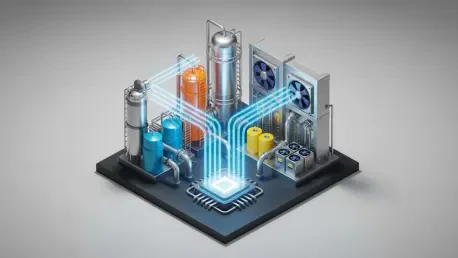

The massive scale of modern industrial infrastructure often conceals a profound operational silence where thousands of expensive sensors generate mountains of data that nobody ever actually reads. Applied Computing, a London-based startup established only three years ago, recently secured twenty million dollars in Series A funding from heavyweights like KBR and Databricks Ventures to bridge this gap. Their flagship product, Orbital, serves as a digital nervous system for refineries and petrochemical plants, aiming to unify fragmented software environments into a single foundation model. By creating a centralized brain for industrial operations, the company provides real-time predictive insights that allow facilities to function as cohesive units rather than collections of isolated machinery. This infusion of capital signals a major shift in how the energy sector views artificial intelligence, moving away from simple automation toward complex, physics-aware systems that understand the fundamental constraints of the physical world.
Bridging the Gap in Industrial Data Utilization
The energy sector currently grapples with a significant paradox where massive volumes of sensor information are harvested every second, yet less than eight percent of this data ever influences a final operating decision. This glaring inefficiency exists primarily because real-time sensor readings, static engineering documentation, and the fundamental laws of physics often exist in entirely different digital dimensions. Plant operators frequently find themselves staring at dashboards that show what is happening without explaining why, or how a change in one sector might disrupt a separate process three miles away. Technical silos have historically prevented the synchronization of these streams, leaving engineers to rely on intuition or legacy software that cannot account for the complexity of a modern chemical facility. By integrating these disparate pillars, the industry moves closer to a state where data is not just an archived byproduct but a primary driver of efficiency and safety across the entire plant.
Within just eighteen months, the firm has transitioned from a stealth startup to a company generating double-digit millions in recurring revenue, proving that there is a massive appetite for integrated intelligence. This rapid growth is fueled by strategic partnerships with major firms like KBR, which has integrated the Orbital model into its ammonia production platform, and global energy giants such as Wipro. These collaborations are crucial because they provide the startup with ground truth operational data from live plants, giving them a distinct advantage over researchers who rely solely on theoretical datasets. By working directly with industry leaders, the company ensures that its models are grounded in the realities of daily plant operations rather than idealized laboratory conditions. This commercial momentum suggests that the era of isolated, specialized software is ending, replaced by foundational models that can scale across different types of industrial assets while maintaining high accuracy.
The Technical Architecture and Expertise Behind Orbital
Unlike the general-purpose large language models that dominate headlines, the architecture behind the Orbital system is purpose-built to handle the unique requirements of the heavy industrial and petrochemical sectors. This specialized framework synthesizes time-series data with physics-based modeling and natural language processing to create a comprehensive understanding of industrial environments. By incorporating the rigid laws of thermodynamics and fluid mechanics into the AI training process, the system avoids the hallucinations common in standard models, providing reliable outputs that engineers trust for mission-critical tasks. This synthesis enables the platform to perform advanced anomaly detection and conduct root cause analysis in mere seconds, whereas traditional methods might take an entire team of specialists several days or even weeks. The result is a tool that does not just process text but understands the behavior of complex physical systems under varying pressure.
The company distinguishes itself from legacy industrial software providers by leveraging a talent moat, attracting world-class AI researchers who might otherwise avoid the oil and gas industry entirely. By positioning itself as a cutting-edge research hub rather than a traditional energy firm, Applied Computing has successfully drawn specialists from the most prestigious academic and tech institutions. This concentration of expertise, combined with a strategic presence in London, Bengaluru, and Houston, allows the firm to refine its physics-aware models and stay ahead of both established vendors and internal IT departments. Having researchers work alongside chemical engineers creates a unique interdisciplinary environment where software innovations are immediately tested against physical realities. This elite talent pool is the primary engine behind the company’s ability to solve problems that have stumped the sector for decades, ensuring that their foundation model remains at the absolute forefront.
Strategic Integration for Operational Resilience
The implementation of physics-aware models provided a clear roadmap for companies that were previously struggling to make sense of their vast, underutilized sensor networks. It was observed that the most successful organizations moved away from isolated software tools and toward cohesive foundation models that treated the entire facility as a living, interconnected organism. Decision-makers prioritized the breaking of data silos and focused on recruiting specialists who understood both artificial intelligence and the specific chemical properties of their production lines. This strategy allowed them to minimize unplanned downtime and significantly improve their environmental compliance by predicting leaks or inefficiencies before they manifested physically. Ultimately, the transition to these integrated systems ensured that industrial operations remained competitive and resilient in an era defined by rapid technological change and high energy demand.
The predictive simulation capabilities of these models allowed technicians to run what-if scenarios that visualized the ripple effects of minor adjustments across an entire refinery before they were implemented. For instance, if an operator wanted to see how a slight increase in pressure within a catalytic cracker might affect secondary cooling systems, the model simulated the outcome with high fidelity. This foresight proved invaluable for identifying potential cascading failures that often went undetected by conventional monitoring systems until it was too late. By preventing these secondary failures, industrial facilities avoided costly unplanned shutdowns and extended the lifespan of their physical assets through more precise operational control. Furthermore, this simulation-driven approach facilitated better training for new staff, who experimented with parameters in a safe digital environment, gaining experience that would otherwise take many years to accumulate on the plant floor.