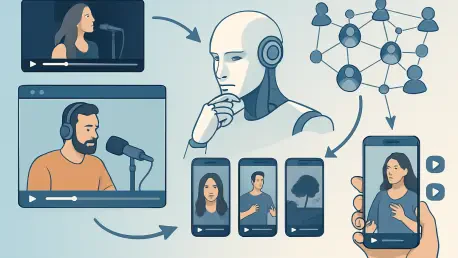

The shift in digital consumption patterns toward thirty-second and ninety-second video clips has fundamentally transformed how modern brands interact with their target audiences on a global scale. In the current media landscape, the traditional marketing strategy of publishing a high-budget commercial and hoping for engagement has been replaced by a rigorous need for high-frequency, short-form content. Brands frequently possess vast libraries of existing material—such as long-form podcasts, music videos, or cinematic films—but they lack the operational infrastructure required to efficiently dismantle this content into viral assets. This transition creates a significant technical bottleneck where the sheer volume of required “clipping” outpaces the capabilities of human editors alone. Consequently, the industry is seeing the rise of sophisticated platforms that treat the pursuit of social media virality not as a creative gamble, but as a repeatable engineering problem requiring a combination of massive human networks and advanced artificial intelligence.
Transforming Creative Chaos into Systematic Production
The Methodology of Algorithmic Penetration
The core innovation driving this new era of content distribution is a technical process described as a continuous testing loop, which draws direct inspiration from cybersecurity penetration testing strategies. Rather than guessing what might resonate with a particular demographic, this methodology treats social media algorithms as systems to be probed for specific engagement vulnerabilities. By deploying thousands of different content formats and distribution strategies simultaneously, the platform can identify exactly which variables—such as specific captions, edit styles, or posting times—trigger the recommendation engines of various apps. This iterative approach allows for the accumulation of massive datasets that reveal the underlying patterns of audience behavior. Over time, the system becomes more intelligent, ensuring that every subsequent campaign is more efficient and targeted than the last, effectively turning the unpredictable nature of social media into a predictable and scalable technical science.
Beyond the algorithmic testing, the logistical backbone of this operation relies on an expansive network consisting of more than one hundred thousand gig creators who operate in tandem with AI. This hybrid model ensures that while artificial intelligence handles the data-driven distribution and pattern recognition, human creators provide the essential nuance and cultural relevance that purely automated systems often lack. The infrastructure manages the complex workflow of assigning tasks, reviewing edits, and coordinating the simultaneous release of content across hundreds of different channels. This level of synchronization was previously impossible for even the largest internal marketing departments to achieve. By treating content creators as a modular workforce within a larger engineering framework, brands can achieve a level of market saturation that feels organic to the viewer while being meticulously orchestrated behind the scenes by a central technical hub.
Shifting from Manual Labor to Enterprise Automation
The traditional model of content creation often involves small teams of editors manually sifting through hours of footage to find a single compelling moment, a process that is both slow and expensive. In contrast, the modern enterprise approach utilizes automated clipping tools to identify high-potential segments before they are even sent to a human creator for final polishing. This drastic reduction in lead time allows brands to react to cultural trends in real-time, capitalizing on fleeting moments of attention that would be lost in a standard production cycle. By removing the friction from the creative process, the system allows for a higher volume of experimentation, which is the primary driver of compounding growth in a digital economy. The focus shifts from the quality of a single video to the integrity of the entire distribution system, where the goal is to build a sustainable pipeline that consistently delivers high-performance media.
The data gathered from these high-volume operations provides a unique competitive advantage that extends far beyond simple vanity metrics like likes or shares. By tracking how different audience segments interact with various content iterations, the system can determine which specific channels offer the highest conversion rates and long-term brand loyalty. This allows for the precise allocation of marketing resources, ensuring that budgets are directed toward the strategies that yield the most significant compounding returns. This move toward a technical discipline reflects a broader trend where marketing is no longer a separate creative silo but an integrated part of a company’s data infrastructure. As organizations continue to integrate these automated networks into their core operations, the distinction between a media company and a technology firm continues to blur, resulting in a more efficient and data-driven approach to global audience engagement.
Establishing a New Standard for Marketing Operations
Real-World Applications and Financial Backing
The practical effectiveness of engineering virality was recently highlighted by the rapid scaling of a major music festival in Manila, which successfully utilized these systematic clipping techniques to reach thousands of attendees. By deploying a massive volume of targeted short-form videos across local social media networks, the event organizers were able to generate organic buzz that translated directly into ticket sales and physical attendance. This case study serves as a proof of concept for how technical infrastructure can be used to dominate a specific geographic or cultural niche in a remarkably short period. The success of such initiatives has not gone unnoticed by the investment community, as evidenced by a substantial seven-million-dollar seed funding round. Led by prominent firms like Slow Ventures and Gold House Ventures, this capital injection signals a high level of confidence in the belief that the future of brand growth is inextricably linked to automated content systems.
With this new influx of capital, the focus is expanding toward building the broader enterprise infrastructure necessary to support the next generation of digital-first brands. The goal is to move beyond being a simple service provider and instead become the foundational layer upon which companies build their entire social media presence. This involves developing even more sophisticated AI models capable of predicting the lifespan of a trend before it peaks, as well as refining the creator network to ensure even higher standards of creative output. Investors are betting on the idea that as more industries—from entertainment to consumer goods—transition to video-first marketing, the demand for a reliable, scalable, and data-driven production engine will become universal. This financial backing provides the resources needed to refine the continuous testing loops and expand the technological moat that separates systematic content engineering from traditional creative agencies.
The Competitive Landscape of Enterprise Growth
As the market for automated content distribution matures, the competition is shifting away from simple video editing applications toward comprehensive enterprise growth platforms. Modern players are increasingly positioning themselves against established marketing technology firms by offering a more integrated and technical solution to the problem of audience acquisition. While many tools focus solely on the “how” of video creation, the most successful platforms are those that address the “why” and “where” through deep data analysis and logistical coordination. This positioning treats social media growth as a scalable engineering problem rather than a series of isolated creative projects. By building a system that manages both the production and the performance of content, these platforms are creating a new category of enterprise software that bridges the gap between creative expression and technical execution in a way that was previously unattainable.
The transition toward a science-based approach to content distribution required organizations to rethink their entire internal structure regarding media production and audience engagement. Decision-makers moved away from subjective creative reviews and instead prioritized the implementation of automated feedback loops that utilized real-time performance data to guide strategy. It was concluded that the most effective way to maintain relevance in an increasingly crowded digital space was to treat the social media algorithm as a technical partner rather than an obstacle. Moving forward, brands sought to integrate their internal data pipelines with external creator networks to ensure a seamless flow of information and content. This shift enabled a more agile response to market changes and allowed for the sustainable scaling of brand awareness across diverse platforms. Future efforts were directed toward refining these engineering processes to ensure that every piece of content contributed to a measurable and predictable growth trajectory.