
The industrial landscape is undergoing a massive shift as labor shortages force manufacturers to rethink how they deploy technology. While humanoid robots often grab the headlines, the real disruption is happening in modular, AI-driven systems that can adapt to the “messier reality” of modern warehouses. Today, we sit down with Simon Glairy to discuss how companies like Theker are rewriting the rules of robotics and why investors just poured $85 million into a vision that prioritizes flexibility over fixed forms. This conversation explores the strategic advantages of modular robotics, the financial impact of Europe’s largest Series A in this sector, and a unique go-to-market strategy that skips traditional pilot programs to focus on immediate operational scaling.
Fixed-form humanoid robots are often viewed as the future of automation, yet modular systems are gaining significant traction in complex environments. How do you evaluate the strategic advantage of choosing a reconfigurable robot over a humanoid one?
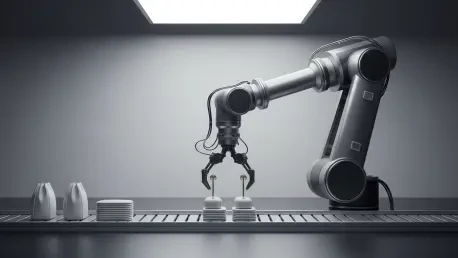
The primary advantage lies in the ability to handle the unpredictability of a warehouse where processes aren’t always about putting the same cookie in the same box. Humanoid robots are impressive, but their fixed forms often limit their efficiency in specialized industrial tasks that require varying reaches or grip strengths. Theker’s approach allows a company to swap out hands, arms, and even resize the overall form depending on whether they are sorting clothing for a major retailer like Inditex or handling bottles and cans. This modularity reduces the risk of hardware obsolescence because the machine can evolve alongside the warehouse’s changing inventory. By focusing on a machine that can be resized and reconfigured, you are essentially future-proofing the investment against the messy, ever-changing reality of logistics.
The recent $85 million Series A represents a massive milestone for European robotics. What does the involvement of high-profile backers like Samsung and Aglaé Ventures tell us about the current market demand for AI-driven robotics?
Raising $85 million in what is being called Europe’s largest-ever robotics Series A is a loud signal that the market is ready for scale rather than just experimentation. When you see strategic investors like Samsung and Aglaé Ventures—the vehicle for LVMH’s chairman—getting involved, it shows that the interest spans from high-tech manufacturing to luxury retail. Samsung is particularly interesting here because even though they aren’t a client yet, the advanced discussions to have them as a customer, supplier, and investor simultaneously would provide a massive boost to manufacturing credibility. This level of funding, which doubled the original target of $30 or $40 million, proves that there is a deep appetite for automation solutions that can solve labor shortages right now. It reflects a shift where the biggest names in global industry are no longer just watching from the sidelines but are actively betting on the infrastructure of the future.
Theker has made a point of skipping innovation departments entirely to deal directly with logistics and operations. In your view, how does this “no-pilot” strategy change the trajectory of a company trying to scale in the industrial sector?
Bypassing the “pilot phase” is a brilliant move to avoid the trap of endless testing that often plagues hardware startups. By going straight to the people in charge of operations, the co-founders ensure that their robots are being judged on real-world productivity and shorter timelines rather than theoretical innovation. This strategy forces the technology to perform immediately in high-stakes environments, which is likely why they’ve already secured backing from Inditex, the parent company of Zara. It creates a sense of urgency and reliability that attracts traditional and strategic investors who want to see actual deployments rather than just laboratory demos. For a startup, this means faster revenue cycles and a much quicker path to proving that their modular AI can handle the complexity and scale of manual tasks.
Managing a workforce expansion while sifting through 15,000 job applications is a massive undertaking. What are the operational risks and rewards of growing a team so rapidly in a competitive hub like Barcelona?
The sheer volume of interest, with 15,000 applications for a team that aims to grow to 120 people by the end of the year, shows that Barcelona has truly become a magnet for robotics talent. The challenge isn’t just about hiring but about “filtering like crazy” to ensure that the culture of rapid deployment stays intact as the headcount triples. Growing that fast requires a very disciplined management structure to prevent the “acceleration barriers” that often slow down European startups. However, the reward is a powerhouse of tech, sales, and deployment experts who can support the opening of new showrooms across Europe, the U.S., and Asia. By maintaining their headquarters in Barcelona, they are proving that you don’t need to be in Silicon Valley to lead a global robotics revolution, provided you have the capital and the talent pool to back it up.
What is your forecast for the adoption of modular AI robotics in the manufacturing sector over the next few years?
I expect we will see a rapid transition where modularity becomes the standard for any warehouse handling high-turnover goods or diverse product lines. As more companies realize that “generalist” robots are more cost-effective than a fleet of specialized machines, the demand for reconfigurable arms and hands will skyrocket. Within the next three to five years, the success of Theker’s $85 million expansion will likely inspire a wave of similar modular designs, potentially making fixed-form humanoids a secondary choice for specific niche applications. We are moving toward a world where the factory floor is no longer static, but a living ecosystem of adaptable machines that can be resized and reprogrammed in a single afternoon to meet the demands of the global market.