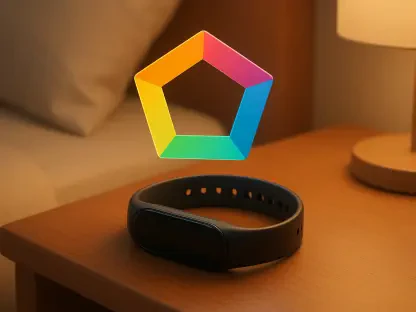

As the digital landscape becomes increasingly saturated with notifications and constant visual demands, many consumers are seeking refuge in devices that provide essential health insights without the intrusive glare of a traditional screen. The current wearable technology market is undergoing a significant transformation where high-end, finger-worn gadgets like the Samsung Galaxy Ring and Oura Ring are being challenged by simpler, screenless alternatives that prioritize discretion. The Fitbit Air sits at the heart of this movement, offering a one-hundred-dollar minimalist solution that focuses on essential biometric data rather than flashy displays. By stripping away the screen, it targets a specific audience that values efficiency and low-profile monitoring over the aesthetic prestige of jewelry-based trackers. This shift suggests that a premium price tag does not necessarily correlate with a more effective daily health tracking experience, especially when compared to the functional versatility of a strap-based device that integrates seamlessly into a variety of lifestyles and physical activities.
Physical Adaptability and Economic Value
Versatile Wearability: Beyond the Single Finger
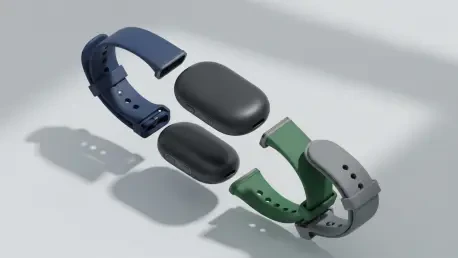
One of the most significant drawbacks of smart rings involves their rigid, size-specific construction which limits the user to a single finger diameter for the life of the device. Once a user purchases a ring, they are committed to that specific fit, making it impossible to switch hands or adjust for fluctuations in finger size due to temperature or health changes. The Fitbit Air effectively avoids this limitation through its modular, strap-based design that accommodates various wearing positions on the body. This flexibility ensures the device remains comfortable regardless of the physical activity being performed or the specific limb chosen for monitoring.
Furthermore, this modularity is supported by an active community of users who utilize 3D-printing technology to create custom mounts and unique watch bands for their trackers. Because the core tracking unit is independent of the strap, it can be worn on the wrist, the bicep, or even the ankle depending on the specific metrics an individual wishes to prioritize during a workout. This level of adaptability ensures that the tracker evolves alongside the user’s body changes and stylistic preferences, rather than forcing the wearer to conform to the static dimensions of a piece of metal jewelry that offers no room for modification or growth.
Financial Accessibility: The Myth of the Luxury Premium
From a financial perspective, the Fitbit Air offers a far more compelling cost-to-benefit ratio than its premium competitors in the smart ring sector. While devices like the Oura Ring 5 and Galaxy Ring often command prices starting at four hundred dollars or higher, the Air provides the same fundamental tracking capabilities for roughly a quarter of that investment. The average consumer looking for a reliable health companion will find that this device delivers heart rate and activity monitoring with high precision. It manages to provide these insights without requiring the steep financial commitment associated with luxury materials or specialized miniature engineering.
While smart rings often boast about high-end materials such as titanium and specialized sensors for skin temperature, these features frequently add more to the price than to the actual utility of the data. The Air focuses on the essentials, providing a reliable experience for users who prefer a device that functions quietly in the background. By avoiding unnecessary luxury markups, the manufacturer has created a product that is accessible to a wider demographic. This democratization of health technology proves that sophisticated data analysis does not need to be locked behind a high paywall or marketed as a fashion-forward status symbol to be effective for the user.
Long-Term Ownership and Safety Considerations
Ownership Lifecycles: The Secondary Market Trap
The lifecycle of a smart ring is inherently limited by its form factor, particularly when evaluating the viability of the secondary market for used electronics. Because these rings are manufactured in specific sizes, reselling them is incredibly difficult because a potential buyer must share the exact finger measurements of the original owner. This size-locking effectively destroys the resale value of the hardware and makes it nearly impossible to pass the device down to family members or friends. It creates a closed loop where the hardware becomes electronic waste once the original user decides to upgrade to a newer model or different brand.
In contrast, the Fitbit Air remains a universal product thanks to its adjustable and replaceable straps that fit any user regardless of their physical dimensions. This universality ensures that the initial purchase retains its utility long after the original owner has finished using the device. It can be easily gifted, sold, or refurbished for a new user without the logistical hurdles of sizing kits or custom fitments. By maintaining a standard form factor that relies on adjustable bands, the device promotes a more sustainable ownership cycle that extends the life of the hardware and reduces the environmental impact of frequent electronic turnover.
Operational Safety: Addressing Potential Hardware Failures
Safety is a critical factor when comparing these two wearable styles, especially concerning the long-term health of the internal lithium-ion batteries that power them. If a battery begins to fail and swell—a phenomenon often referred to in the tech industry as a spicy pillow—on a strap-based tracker, the user can quickly unstrap the device. This allows for immediate removal from the body, preventing potential thermal injuries or skin irritation. The flexible nature of the strap ensures that even if the housing expands slightly, the device does not become physically locked or tightened against the wearer’s limb.
However, if a battery were to fail and expand inside the rigid, circular housing of a smart ring, it could potentially lock the device onto the wearer’s finger. This creates a dangerous scenario where an overheating or failing component is physically trapped against the skin, necessitating emergency intervention to remove the ring. Most wrist-based wearables do not share this specific risk because they do not form a closed, rigid loop around a digit. By choosing a design that prioritizes easy removal, the developers of the Air provided a safety margin that is simply not possible with current finger-worn architectures.
Actionable Strategies: Future-Proofing Wearable Integration
The transition toward more adaptable hardware demonstrated that users valued long-term utility and safety over miniaturized status symbols. Market data indicated that the preference for strap-based systems grew as consumers realized the limitations and risks associated with fixed-size rings. This shift underscored a fundamental change in how health technology was perceived, moving away from high-priced jewelry toward functional tools. Experts suggested that prospective buyers evaluated the total cost of ownership, including resale potential and repairability, before committing to a specific ecosystem. The success of modular designs proved that simplicity often outweighed complex engineering when daily practicality was the primary goal.
Decision-makers in the technology sector observed that the most successful devices were those that offered the least amount of friction in the user’s life. They recommended that consumers prioritized hardware that could be worn in multiple configurations to maximize data accuracy across different types of physical exertion. Observations revealed that users who chose versatile trackers remained engaged with their health metrics longer than those who felt restricted by the sizing of a ring. Ultimately, the industry moved toward a standard where safety and flexibility were the benchmarks for innovation. This evolution ensured that health monitoring became more inclusive and less dependent on the high-cost barriers of the luxury wearable market.