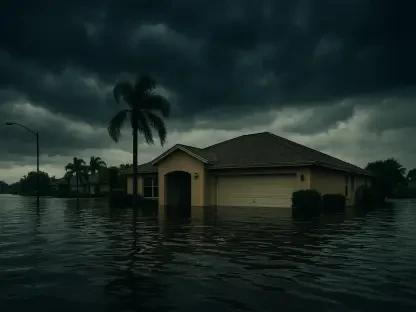

While the thundering of hooves remains a quintessential sound of the British countryside, a much quieter and more menacing force is threatening to silence the gates at dozens of historic racecourses across the United Kingdom. The horse racing industry contributes over four billion pounds annually to the national economy, yet its physical footprint is inherently precarious. Many of the most prestigious venues are situated on low-lying floodplains, a geographical reality that once provided ideal turf but now invites catastrophic financial risk as extreme weather patterns intensify.
The commercial sports industry faces a unique set of vulnerabilities that distinguish it from the residential sector. Unlike housing developments that can sometimes benefit from large-scale municipal defenses, a racecourse is a sprawling, specialized asset where traditional mitigation is often cost-prohibitive. Consequently, market leaders such as Willis Towers Watson (WTW), Descartes Underwriting, and Generali have begun pioneering niche climate solutions to protect these high-risk assets. These firms are integrating Internet of Things (IoT) sensors and real-time data streams into modern underwriting, shifting the focus from post-event recovery to proactive financial resilience.
Evolution of Climate Risk and the Rise of Parametric Solutions
Modern Trends Reshaping Risk Management: Data and Speed
A fundamental shift is occurring in how risk managers view disaster recovery, with 76% of industry professionals now favoring data-driven triggers over traditional loss-adjustment models. The appeal lies in the elimination of subjectivity; if a sensor detects water reaching a specific depth, the payout is triggered automatically. This method utilizes Previsico sensors not only as a coverage mechanism but also as an early warning system. These devices allow groundstaff to move expensive equipment or deploy temporary barriers before the water peaks, effectively merging insurance with active loss prevention.
This transition is essential for addressing the protection gap that has left many venues effectively uninsurable. In the past, a venue might wait months for a loss adjuster to quantify damage before receiving a single pound. Parametric solutions circumvent this bureaucracy, providing the immediate liquidity necessary to manage soft losses like clean-up costs and temporary staff wages. By filling the void left by traditional markets, these specialized products provide a lifeline to venues that would otherwise face insolvency following a major weather event.
Market Projections and Performance Metrics: The Rising Cost of Water
The financial implications of inaction are staggering, with projections indicating that flood-related costs in the UK could rise by 50% to reach GBP 3.6 billion by 2050. For the leisure sector, this represents a systemic threat to operations. Current metrics suggest that 62% of firms now prioritize the speed of payout over comprehensive indemnity, recognizing that immediate cash flow is often more valuable than a larger, delayed settlement. This sentiment is driving a surge in demand for parametric models across other weather-dependent sports, including professional football and cricket.
Navigating the Critical Hurdles of Conventional Flood Insurance
The absence of a commercial safety net has created a significant financial deficit for racecourse operators. While residential properties can lean on government-backed schemes like Flood Re, the Bank of England has maintained a strict exclusion for commercial sites. This leaves racecourses exposed to a volatile private market where premiums have skyrocketed and deductibles have reached levels that make standard policies practically useless. In many cases, insurers have moved toward total flood exclusions, leaving historic venues with no coverage for their primary environmental threat.
Moreover, the burden of proof in traditional insurance remains a major obstacle to business continuity. The process of documenting every damaged fence, track section, and hospitality suite is exhausting and prone to disputes. For seasonal venues that rely on a specific window of racing days, a month-long delay in repairs can result in a lost season. The friction inherent in loss adjustment often creates a secondary financial crisis that is just as damaging as the initial flood.
Regulatory Standards and the Compliance Landscape
Navigating the regulatory environment requires a sophisticated understanding of the distinctions between residential protection and commercial risk exposure. As the Bank of England increases its scrutiny of climate-related financial risks, racecourse operators are under mounting pressure to demonstrate robust protection strategies. Data integrity has become the cornerstone of this compliance; sensors must meet rigorous accuracy standards to be accepted as valid triggers for insurance payouts. This transparency ensures that both the insurer and the policyholder are operating on a foundation of objective, verifiable facts.
Furthermore, the rise of Environmental, Social, and Governance (ESG) reporting is forcing a change in corporate behavior. Investors and stakeholders now demand to see how a venue plans to survive a changing climate. Securing parametric coverage is increasingly seen as a sign of sophisticated management, proving that an organization has moved beyond reactive fixes and toward a sustainable financial blueprint.
Future Frontier: Climate Resilience and Innovative Underwriting
The success of parametric models at racecourses is likely to spark an expansion into the wider leisure and infrastructure sectors. As site-specific hydrological data becomes more accessible, the era of one-size-fits-all regional policies will likely fade. Hyper-localized modeling allows for the creation of insurance contracts that are perfectly calibrated to the unique contours of a single property. This level of precision ensures that policyholders only pay for the specific risks they face, while insurers can manage their capital more efficiently.
Artificial intelligence and satellite imagery are also poised to refine trigger accuracy and payout scaling. By combining ground-level sensor data with orbital observations, underwriters can gain a comprehensive view of flood movements in real time. This technological synergy will allow for more complex triggers that account for duration, flow velocity, and water depth, providing a more nuanced reflection of the actual damage potential on the ground.
New Blueprint for Sustaining the UK’s Historic Sporting Venues
The industry successfully transitioned from a reliance on subjective damage assessments toward a future defined by data-based certainty. Venues like Royal Windsor led the way by adopting technology that favored immediate liquidity over the slow processes of the past. Stakeholders across the racing community prioritized financial agility, recognizing that the ability to fund rapid clean-up efforts was the primary factor in maintaining race schedules. This strategic pivot allowed operators to manage the soft losses that traditional policies typically ignored, ensuring that business interruption remained a manageable hurdle rather than a terminal blow.
The implementation of these innovative tools provided a robust defense against an increasingly volatile climate. Operators who integrated sensor technology into their broader ESG frameworks found themselves better positioned to attract investment and maintain regulatory compliance. Ultimately, the adoption of parametric solutions served as an essential survival tool, securing the future of the UK’s historic sporting landscape through a combination of technological foresight and financial innovation.