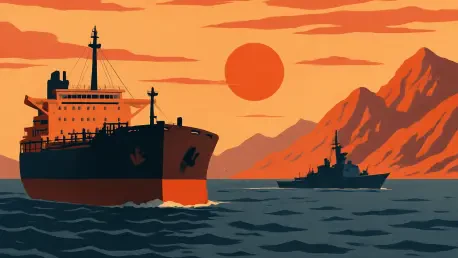

The geopolitical heartbeat of the global energy market often pulses through the narrow waters of the Strait of Hormuz, where the thin line between commercial stability and maritime chaos is drawn by insurance premiums. While recent headlines suggest a cooling of regional tensions, the financial reality for vessel operators tells a far more expensive story of caution. This vital waterway serves as a critical chokepoint for global energy security, handling a significant portion of the world’s seaborne oil. For marine underwriters, these waters represent a unique intersection of financial liability and strategic risk assessment, where every transit is weighed against the potential for sudden seizure or localized conflict.
Within this high-stakes environment, the marine war risk market operates with a level of autonomy that often ignores political posturing. Lloyd’s of London remains the central influence on regional pricing, setting the benchmark for how much a shipowner must pay to move cargo through contested zones. The dominance of foreign jurisdictional control in the area creates an added layer of complexity for standard insurance protocols. When a vessel enters the Strait, it essentially steps into a space where traditional maritime law can be superseded by local military oversight, forcing insurers to act as both financial guarantors and primary risk assessors.
The Fragile State of Global Maritime Risk Management
Underwriters are currently navigating a landscape where the Strait of Hormuz is treated as a permanently volatile variable rather than a temporary problem. The dual role they play involves more than just covering losses; it requires a deep dive into the specific mechanics of regional trade and the behavior of naval actors. Because the Strait is such a concentrated chokepoint, any disruption ripples through the entire global supply chain, causing a spike in demand for specialized coverage that many general insurers are hesitant to provide.
Furthermore, the influence of the Joint War Committee and the heavy reliance on the London market mean that pricing is often reactive to intelligence data that the public rarely sees. This information gap creates a situation where even if a conflict seems to be subsiding, the underlying threat of vessel interference remains high. For many operators, the cost of entering these waters is no longer just a line item but a strategic hurdle that determines the viability of their entire logistics chain.
Divergent Realities: Political Rhetoric vs. Underwriting Logic
The Disconnect: Why Peace Talk Does Not Lower Premiums
A notable gap exists between the optimism of diplomatic ceasefire announcements and the cold calculations made by insurance underwriters. While politicians may signal a return to normalcy, the insurance market operates on a testing phase mentality, usually requiring a window of at least two consecutive weeks of incident-free transit before considering a rate adjustment. This lag is intentional, as underwriters prioritize observed stability over verbal promises. The current environment is heavily influenced by Iranian oversight, which necessitates a level of permission-seeking that insurers view as a fundamental risk to vessel autonomy.
Market Projections: The Persistence of the Risk Premium
Current data indicates that marine war risk rates are holding steady at elevated levels, with short-notice cancellation trends becoming a standard operational feature. Market projections suggest that even with a temporary pause in active hostilities, the growth of insurance costs in high-tension corridors will continue as insurers seek to build reserves against future volatility. Shipowners are adapting to these controlled environment transits by passing costs down the line, but the requirement for sustained operational normalcy remains the only path toward meaningful rate reductions.
Obstacles to Normalization in a Volatile Maritime Corridor
The logistics of modern shipping are inherently poorly suited for the rapid repricing mechanisms used by insurers in the Middle East. When a carrier is hit with a short-notice premium hike, it can throw an entire voyage’s budget into a deficit before the ship even clears the first buoy. Managing this uncertainty is compounded by the ever-present threat of foreign interference, where a vessel might be seized for reasons that are more political than legal, leaving insurers to navigate a nightmare of claims processing.
To mitigate these risks, insurers are increasingly utilizing reactive pricing strategies that allow them to pull coverage or adjust rates within hours of a security breach. This strategy protects the insurance pool but leaves shipping companies in a state of perpetual anxiety. Addressing the information gap between political gestures and actual maritime safety data is essential, yet the lack of transparent communication from regional authorities makes objective risk assessment nearly impossible for the private sector.
Regulatory Standards and Compliance in High-Risk Waterways
The role of the Joint War Committee is paramount in defining the listed areas where special premiums apply. Compliance with international sanctions further complicates the legalities of navigating controlled waters, as insurers must ensure they are not inadvertently facilitating trade with blacklisted entities. This has led to a shift toward mandatory reporting and enhanced satellite tracking, where coverage eligibility is strictly tied to a vessel’s willingness to remain visible to international monitors at all times.
Moreover, the availability of reinsurance for Middle Eastern routes has become more restricted as global providers tighten their exposure to geopolitical flashpoints. Regulatory scrutiny is no longer just about safety at sea; it is about financial transparency and the prevention of illicit trade. For many smaller carriers, the cost of meeting these enhanced security and reporting standards is becoming as burdensome as the insurance premiums themselves, further consolidating the market in favor of larger, more resilient players.
Future Outlook: Innovation and Security in Global Trade Arteries
Looking forward, the integration of artificial intelligence and real-time satellite monitoring offers a potential path toward more objective transit data. These technologies could provide a neutral basis for risk assessment, moving away from the subjective interpretations of political events. However, emerging disruptors like drone technology and asymmetric warfare tactics redefine what safe passage means, as small-scale threats can now cause significant delays and damage without the need for a conventional naval confrontation.
As a result, there is a visible shift in consumer preference toward alternative routes that bypass the Hormuz bottleneck entirely, even if they are longer and more expensive in terms of fuel. This diversification of trade routes will likely drive long-term growth in specialized maritime security insurance and contingency coverage. The industry is moving toward a model where specialized security teams and high-tech surveillance are integrated directly into the insurance package, creating a new standard for high-risk maritime operations.
Persistent Caution as the Industry Benchmark
The transition toward a stable, observation-based pricing model remained elusive as the market prioritized empirical evidence over short-term diplomatic gestures. Stakeholders were encouraged to maintain high liquidity and flexible routing schedules to manage the persistent threat of sudden security deterioration. By shifting from a purely reactive stance to a more technologically integrated monitoring approach, the industry established a new baseline for maritime risk that valued actual safety data over political rhetoric. Future considerations focused on the deployment of autonomous surveillance to bridge the information gap, ensuring that insurance capacity remained available even in the most volatile corridors.