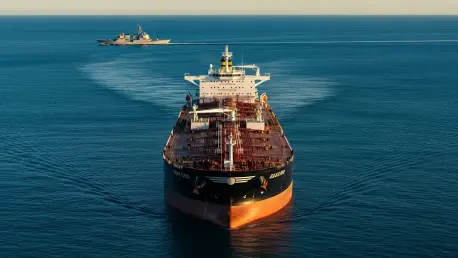

The current geopolitical tension in the Strait of Hormuz has created a paradox where financial tools remain available but the physical assets they protect are staying in port. When the military escalation between the United States, Israel, and Iran intensified, the narrative quickly shifted toward a total collapse of the maritime insurance industry. Observers suggested that insurers had simply walked away, leaving the world’s most vital energy corridor a “no-go” zone by default. However, this interpretation ignores the resilience of the London and American markets. The reality was not a failure of financial appetite but a calculated reaction to an environment where the threat to human life had surpassed any reasonable premium.
This crisis was sparked by a series of coordinated strikes and counter-strikes that paralyzed one of the busiest shipping lanes on the planet. As tankers sat idle and global oil prices fluctuated, a common misconception took hold: that the ships were stopped because they could no longer be insured. In truth, the insurance market remained open, albeit with a radically different price tag. The real barrier was a human one. Captains and crews, faced with the unpredictability of state-actor strikes, began to prioritize their survival over the financial incentives of the voyage. This shift highlights the difference between a systemic financial failure and a rational refusal to enter a combat zone.
The significance of this analysis lies in understanding that the global supply chain is governed by more than just balance sheets. While the media focused on the “insurance blockade,” the industry insiders recognized a deeper crisis of safety. This exploration will delve into the mechanics of the market, the legal ambiguities that leave shipowners vulnerable, and the failure of government interventions that tried to solve a physical problem with a financial tool. It serves as a reminder that safety is the ultimate currency of trade, and without it, the most sophisticated insurance products in the world are essentially meaningless.
The Mechanics of Risk and the Reality of Market Resilience
Beyond the “Notice of Cancellation” Misconception
Industry analysts point out that the widely reported “notice of cancellation” was frequently misinterpreted by the general public as a total withdrawal of coverage. In the world of marine insurance, such a notice rarely signifies a permanent exit from the market. Instead, it serves as a technical “rerating tool.” By issuing these notices, underwriters effectively reset the terms of a policy within a narrow three-to-seven-day window. This allows them to adjust prices and terms to match the hour-by-hour volatility of a high-intensity combat zone. Rather than closing the doors, the market was simply recalibrating its expectations in the face of unprecedented danger.
Data from organizations like the Lloyd’s Market Association reinforces this reality of market resilience. Even during the height of the hostilities, surveys indicated that over 88% of underwriters maintained their appetite for hull war risks. Furthermore, over 90% of the market continued to offer cargo coverage, provided the price was right. This suggests that the financial infrastructure of global trade remained entirely intact. The reduction in traffic, which saw daily transits plummet from over a hundred vessels to fewer than ten, was not caused by a lack of available policies. It was driven by the “crew sentiment” and the rational fear of being targeted by sophisticated weaponry.
The challenge of crew sentiment remains the primary deterrent in the current landscape. Expert commentary from the American P&I Club suggests that while a shipowner might be willing to pay a high premium to protect their asset, they cannot easily replace a crew that refuses to sail into a potential minefield. This creates a disconnect between the availability of coverage and the physical reality of shipping. The maritime industry has learned that while you can insure a hull, you cannot insure away the psychological impact of war on the individuals who operate the vessel. Therefore, the market stayed open, but the ships stayed away because the human element of the equation chose safety over indemnity.
The Economic Weight of Volatile Risk Modeling
The financial burden of transiting the Strait shifted overnight as standard 0.10% premiums skyrocketed to extreme rates of up to 7.5%. For a modern tanker valued at $100 million, a single transit could suddenly require a $7.5 million payment just for war risk coverage. This turned every voyage into a multi-million dollar gamble, even before accounting for fuel, crew wages, and maintenance. Underwriters recognized that the volatility of the situation made traditional modeling almost impossible. Unlike standard maritime risks like groundings or collisions, which follow predictable actuarial patterns, a missile strike is a catastrophic “all-or-nothing” event that defies typical frequency-based calculations.
This extreme volatility explains why specialized underwriters had to step in where mutual Protection and Indemnity (P&I) clubs could not. P&I clubs operate on a principle of mutual risk-sharing, which is ideal for common liabilities but ill-suited for the concentrated, high-value losses associated with state-actor warfare. The result was a shift toward the commercial market, where underwriters charged “hard” premiums to offset the massive potential for individual losses. This pricing served as a transparent market signal of the actual physical risk on the water. When the cost of insurance equals a significant portion of the cargo’s value, the market is essentially saying that the risk is nearly unmanageable.
A specific “US nexus” penalty also emerged, further complicating the economic landscape. Vessels with ties to American interests, whether through ownership, flagging, or management, faced even more prohibitive quotes. In some instances, quotes reached as high as $14 million per voyage for vessels deemed to be high-priority targets. This targeted pricing reflects the reality that in modern maritime conflict, not all ships are equal in the eyes of a belligerent. The insurance market, by pricing these risks so aggressively, was reflecting the strategic realities of the conflict more accurately than the political statements coming from various world capitals.
Why the $40 Billion DFC Reinsurance Initiative Flopped
In an attempt to jumpstart commercial traffic, the United States government introduced a $40 billion reinsurance initiative through the International Development Finance Corporation (DFC). The program was designed to provide a government-backed financial safety net for American interests, theoretically lowering the premiums and encouraging shipowners to resume transits. However, the program saw almost no participation from the industry. Experts suggest that this failure highlights a fundamental disconnect between political strategy and maritime reality. While the administration focused on the financial cost of the crisis, shipowners were focused on the lack of consistent physical protection.
The DFC coverage was often contingent upon the provision of naval convoys, which were supposed to provide a layer of physical security for insured vessels. However, these convoys were never implemented on a scale that could support the volume of trade required to stabilize the market. Without the constant presence of a destroyer or frigate alongside every vessel, the financial guarantee of a government-backed insurance policy was seen as a hollow promise. Shipowners realized that indemnity would help them recover the cost of a lost ship, but it would do nothing to prevent the loss of life or the environmental catastrophe of a major oil spill in the Strait.
This state-backed program failed to gain traction because it attempted to treat a security crisis as a liquidity crisis. Government-subsidized premiums can help a market recover from an economic downturn, but they cannot jumpstart trade in a high-intensity combat zone where missiles are still in the air. The failure of the DFC initiative serves as a case study in the limits of financial intervention. It proved that in the maritime world, the state’s most valuable contribution to trade is not a checkbook, but a credible guarantee of physical safety through naval presence and diplomatic de-escalation.
The Legal Fog Surrounding the “War” Definition
A significant yet often overlooked aspect of the Strait of Hormuz crisis is the legal ambiguity regarding the definition of “war.” While the media and politicians use the term freely to describe the conflict, the lack of a formal, state-to-state declaration of war creates a dangerous “legal fog” for insurers and policyholders alike. This distinction is critical because many standard insurance policies contain “war-exclusion” clauses or require specific “war-risk” riders to be triggered. If a conflict is technically classified as “civil unrest” or “terrorism” rather than an act of war, the coverage may not apply as expected, leaving shipowners in a precarious position.
Comparative analysis with past conflicts, such as the Yugoslav wars of the 1990s, illustrates how these legal semantics can lead to protracted litigation. In those cases, insurers successfully argued that certain hostilities did not meet the legal threshold of a “war,” allowing them to deny claims under war-risk policies. In the current Gulf crisis, a similar risk exists for mid-market policyholders who may only have basic coverage. If a vessel is struck by a missile fired by a state-actor, but the two nations are not “at war” in a legal sense, the shipowner may find themselves caught in a dispute over whether the strike constitutes an act of terrorism, a military accident, or a formal act of aggression.
Expert opinions suggest that this “hidden crisis” of potential litigation is a major reason why many shipowners remain hesitant to transit the Strait even when coverage is available. The fear of having a claim rejected after a catastrophic loss is a powerful deterrent. For cargo owners and traders, this means that even if they see an insurance certificate, they must audit the fine print for state-actor exclusions. The lack of legal clarity essentially shifts the burden of proof onto the policyholder, who must demonstrate that their loss falls precisely within the definitions provided by the underwriter. This legal uncertainty, combined with physical danger, makes the Strait a uniquely difficult environment for global commerce.
Strategic Pathways to Restoring Maritime Normalcy
The primary takeaway from the current crisis is that maritime traffic will only return to historical levels when crews and shipowners feel secure in a physical sense. Financial indemnity, while necessary, is a secondary concern. The industry has demonstrated that it can price any level of risk, but it cannot create safety out of thin air. Therefore, the first step toward normalization is a shift in focus from insurance subsidies to the restoration of naval confidence. This requires not just occasional patrols, but a consistent and visible commitment to protecting the freedom of navigation for all commercial vessels, regardless of their national affiliation.
For shipowners navigating this landscape, the strategy must involve a proactive approach to risk management. This includes demanding “peace-negotiation line-items” in diplomatic discussions, which specifically prohibit naval hostilities within the Strait as a condition for trade. Owners should also work closely with their legal teams to ensure that their policies are airtight against the “legal fog” of modern conflict definitions. By ensuring that “state-actor” strikes are explicitly covered regardless of a formal declaration of war, owners can mitigate the risk of denied claims. Furthermore, maintaining open communication with crews about the specific safety measures in place is essential for overcoming the psychological barriers to sailing.
Cargo owners and traders also have a role to play in this restoration. They should conduct thorough audits of their insurance policies to identify any hidden exclusions before a crisis hits. Relying on standard templates is no longer sufficient in an era where state-actors use asymmetric warfare to disrupt global trade. Additionally, the industry should advocate for a more transparent integration of military and commercial intelligence. When shipowners have access to real-time data on naval movements and threat levels, they can make more informed decisions, which in turn helps underwriters provide more accurate and potentially lower premiums.
Final Reflections on the Strait’s Fragile Equilibrium
The maritime insurance market functioned with remarkable efficiency throughout the crisis, acting as a mirror that reflected the true physical dangers of the Strait. By pricing risk honestly, underwriters provided the only transparent signal of the actual threat level on the water. While government initiatives attempted to mask this risk through subsidies, the market remained grounded in the reality that a ship in a combat zone is an asset under extreme duress. This highlights a fundamental truth: the insurance sector is not broken, but the security environment it covers is. The equilibrium of the Strait remains fragile because it depends on the delicate balance between geopolitical ambition and the safety of the global commons.
Modern warfare and global commerce are now inextricably linked in a way that challenges traditional notions of maritime law and insurance. The Strait of Hormuz is the primary theater for this collision, proving that the world’s energy security is only as strong as the safety guarantees provided to the sailors who man the tankers. The crisis has shown that financial engineering cannot replace physical security or diplomatic resolution. As long as the Strait remains a contested space where state-actors can disrupt trade with impunity, the cost of transit will remain high, and the willingness to sail will remain low.
The industry moved forward with the understanding that insurance was never the problem. Stakeholders across the globe recognized that the financial tools for trade were ready and waiting, but they could not be deployed effectively in a vacuum of physical safety. Shipowners and insurers alike turned their attention toward a more integrated approach to risk, where diplomatic stability was viewed as the most effective form of reinsurance. Ultimately, the lessons learned from this period emphasized that the global supply chain is a human network, and its resilience depends on the collective commitment to protecting the lives of those who keep it moving.