
The traditional method of amassing massive stockpiles of weaponry and hardware at centralized hubs is rapidly becoming a dangerous liability for modern military commanders facing sophisticated long-range threats. A single missile strike on a centralized factory or a lone blockade in a critical shipping lane can paralyze the defense capabilities of a nation for months. In high-stakes modern warfare, the “Iron Mountain” approach to logistics—mass-producing gear in fixed locations and shipping it across vast oceans—is no longer a strategic asset; it is a glaring vulnerability that adversaries are eager to exploit.
As global tensions rise, the United States military faces a grim reality where long-haul supply lines are prime targets for disruption. The reliance on a few concentrated manufacturing centers creates a single point of failure that could decide the outcome of a conflict before it even fully begins. This shift in the security landscape demands a radical departure from established norms, forcing a move toward how hardware is built, maintained, and delivered to the front lines.
The Fragility of the Modern Military Supply Chain
The tyranny of distance in the Indo-Pacific region presents a unique nightmare for military planners, where traditional supply routes must pass through thousands of miles of potentially hostile waters. Fixed manufacturing hubs are high-value targets that cannot be easily moved or hidden, creating a bottleneck that complicates every aspect of readiness. This crisis of contested logistics necessitates a move away from centralized production toward a model that can survive and function even when traditional shipping lanes are severed.
Maintaining technological superiority requires more than just advanced research; it requires the ability to sustain those advantages under fire. When an adversary can monitor and interdict the movement of every spare part and replacement vehicle, the speed of the factory matters less than the proximity of the production line. Transitioning to a distributed model ensures that a strike on one facility does not bring the entire war effort to a standstill, effectively neutralizing the advantage of long-range precision strikes against infrastructure.
Defining the Challenge of Contested Logistics in the Indo-Pacific
The geography of modern conflict is increasingly defined by vast maritime expanses where land-based support is scarce and replenishment is risky. In the Indo-Pacific, the ability to project power depends entirely on the resilience of a logistics tail that stretches across the globe. Adversaries have spent decades developing “anti-access/area denial” strategies specifically designed to snap these tails, making the delivery of heavy equipment nearly impossible during active hostilities.
Because of these risks, the defense establishment is re-evaluating the concept of the “factory.” Instead of massive, stationary plants, the goal is to create a network of nimble manufacturing nodes that can be deployed at a moment’s notice. By moving the point of production closer to the point of need, the military reduces its dependence on vulnerable maritime corridors and ensures that critical assets remain operational regardless of the status of international shipping lanes.
Decentralizing Defense Through the xCell Manufacturing Platform
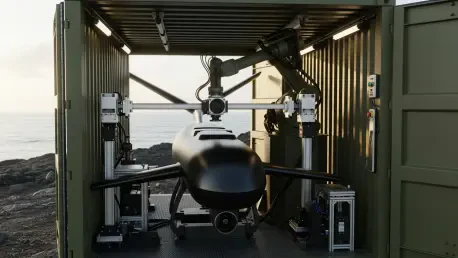
Firestorm Labs is addressing this critical gap with the xCell platform, a containerized, mobile manufacturing unit designed to function as a “factory in a box.” By leveraging a five-year exclusivity deal with HP for industrial-grade 3D printing in mobile environments, these units can produce fully functional drone systems in under 24 hours directly at the front lines. This capability allows the military to bypass the risks of transporting sensitive technology across contested zones, printing what they need exactly when they need it.
These mobile units are not limited to a single type of hardware. The xCell system can produce drones in highly versatile configurations for surveillance, electronic warfare, or lethal strikes, adapting to the specific needs of a local commander. This flexibility transforms the logistical burden from a physical inventory of finished goods into a digital library of blueprints. By shipping raw materials and data instead of finished machines, the military maintains a smaller, more elusive footprint that is far harder for an enemy to target.
From Ukraine to the Bradley: Validating the On-Demand Production Model
The necessity for rapid manufacturing is backed by recent observations in Ukraine, where battlefield conditions evolve so quickly that drone designs must be updated in days rather than years. Beyond aerial systems, the tactical utility of on-site 3D printing has been proven by slashing procurement times for critical components, such as replacement parts for the Bradley Fighting Vehicle. What previously took months of bureaucratic red tape and transoceanic shipping can now be completed in a matter of hours, keeping essential armor in the fight.
This shift is supported by significant financial and institutional backing, including a $100 million U.S. Air Force contract ceiling and investment from defense giants like Lockheed Martin. Firestorm Labs, having raised $153 million to date, demonstrates that the private sector and the Department of Defense are aligned on the urgency of this transition. The success of these pilot programs suggests that the age of waiting months for a spare part to cross the ocean is rapidly coming to an end.
Framework for Transitioning to a Locally Distributed Inventory System
To successfully implement this technology, the Department of Defense adopted a strategy of localized production nodes that prioritized tactical mobility. This involved deploying containerized 3D printing units to forward operating bases, ensuring that digital blueprints were ready for immediate iteration based on real-time combat feedback. By treating hardware as a digital file that was “teleported” to a printer on the front lines, the military maintained supply resilience and technological superiority even when under fire.
The integration of these systems required a fundamental shift in how inventory was managed and protected. Leaders moved away from physical stockpiles and toward a distributed manufacturing network that functioned as a singular, cohesive organism. This transition effectively solved the logistics crisis by making the supply chain as dynamic as the battlefield itself. Ultimately, the move to on-site production ensured that the forces remained equipped, adaptable, and ready for any challenge that emerged in contested environments.