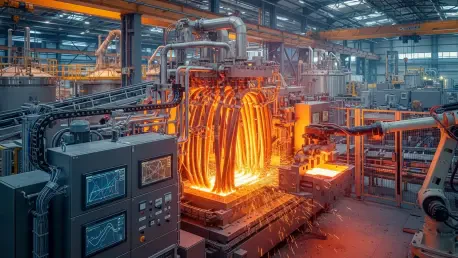

The blindingly bright interior of a modern glass furnace has historically demanded a constant torrent of fossil fuels to maintain the thousand-degree temperatures necessary for production, but a burgeoning technological shift is finally making clean electricity a viable heavyweight contender. While electric vehicles have successfully revolutionized the way people move, the towering kilns of cement and glass factories have remained stubbornly tethered to the carbon economy. These hard-to-abate sectors represent the final frontier of the energy transition, where the sheer intensity of required thermal energy—often exceeding 1,000°C—has long outpaced the modest capabilities of conventional electrical resistive systems. NOC Energy is now challenging this long-standing status quo with a hybrid heating model that mimics the functional logic of a gasoline-electric car.
This innovative approach offers a pragmatic solution to one of the most difficult puzzles in industrial decarbonization by allowing factories to transition without discarding their existing infrastructure. By treating electricity as a primary fuel source rather than an experimental secondary one, the company has created a bridge for manufacturers who cannot afford even a single hour of downtime. This Nut Graph captures the essence of a shift that is less about a radical overhaul and more about an intelligent, phased integration of renewable power into the world’s most energy-intensive processes. As the industrial sector faces mounting pressure from global carbon taxes, this hybrid induction technology provides a survival kit for the modern manufacturer.
Bridging the Thermal Gap in Heavy Manufacturing
The fundamental barrier to industrial electrification has always been the requirement for extreme, sustained heat that can withstand the rigors of 24-hour production cycles. In industries like glass and cement, the chemical transformations required to turn raw materials into finished products occur only at temperatures that would melt or vaporize most standard heating elements. Consequently, fossil fuels have remained the default choice, not due to a lack of environmental will, but due to the physical limitations of current electrical grids and hardware durability.
NOC Energy identifies these sectors as the ultimate challenge, focusing on the specific “thermal gap” that exists between what current green tech provides and what heavy industry demands. By introducing a hybrid system, the company allows these factories to maintain their traditional burners as a fail-safe while increasingly relying on induction-based thermal energy. This strategy acknowledges that the energy transition is a spectrum rather than a binary switch, providing a mechanism for industries to lower their emissions immediately while the broader electrical infrastructure catches up.
The Pragmatic Shift Toward Industrial Hybridization
The move toward net-zero emissions is frequently stalled by the immense financial and operational risks associated with abandoning proven, multi-million-dollar infrastructure. For industrial giants, a total transition to electric heat often feels like a gamble because of the inherent volatility of electricity markets and the unproven longevity of large-scale heating elements. A dual-fuel system mitigates these risks, acting as a “bolt-on” solution that integrates with existing fossil-fuel-fired plants rather than replacing them entirely, which preserves the value of existing assets.
Economic flexibility is the secondary pillar of this hybridization strategy, allowing plant operators to utilize electricity when renewable energy is abundant and prices are low. This creates a powerful hedge against energy uncertainty; if the grid faces a price spike or a supply shortage, the operator maintains the ability to switch back to traditional fuels instantly. This capability de-risks the transition, allowing companies to lower their carbon footprint without jeopardizing their bottom line or operational reliability in an increasingly unpredictable global energy market.
Reimagining Industrial Heat Through Induction and Storage
At the heart of the innovation is a shift from traditional resistive heating to advanced electromagnetic induction, a method that bypasses the durability issues of the past. By utilizing the same principles found in modern kitchen cooktops—but at a massive industrial scale—NOC Energy has developed a system where the heating source never touches the material it warms. Copper coils generate magnetic fields that vibrate steel spheres inside ceramic containers, creating heat internally while the coils themselves remain at room temperature, protected by advanced insulation.
This design enables the system to deliver reliable heat at 1,200°C, with a development roadmap already pushing toward the 1,500°C threshold required for the most intense chemical transformations in glass and cement production. Furthermore, each unit acts as a massive thermal battery, wrapped in 20 inches of insulation to store heat for hours. This enables “energy arbitrage,” where plants charge the system when power is cheap and discharge the stored heat during peak price windows, effectively turning a factory into a flexible participant in the modern energy grid.
Expert Validation and Industry Momentum
The credibility of this approach is backed by rigorous pilot testing and significant support from the venture capital community, moving the conversation from theoretical ideals to measurable performance. The company has already logged over 15,000 hours of operation on a pilot system, demonstrating the long-term durability of its induction components under extreme conditions. A recent $2.7 million seed funding round led by 360 Capital, SOSV, and Desai VC highlights investor confidence in the ability to tackle the most difficult industrial sectors.
CEO Carlos Ceballos emphasizes that the goal is not just to provide heat, but to provide economic certainty in an era of fluctuating energy costs and increasing carbon taxes. By focusing on real-world applications, such as current installations in French glass and cement plants, the company is proving that its modular, stackable units can meet the specific thermal capacity and duration needs of any facility. This momentum suggests that the industry is ready to move beyond fossil fuels, provided the alternative is as reliable as the technology it intends to replace.
A Framework for Implementing Hybrid Thermal Solutions
For manufacturers looking to integrate this technology, the path to decarbonization involves a strategic transition that balances current output requirements with long-term sustainability goals. The first step involves careful integration planning to identify specific thermal bottlenecks where modular induction units can be added to existing infrastructure. Following this, operators must optimize their energy mix by utilizing real-time grid data to determine the most cost-effective moments to switch between electric induction and traditional combustion.
The final stages of implementation focus on leveraging thermal storage and phased scaling to ensure the system remains efficient and reliable. By programming the system to store heat during periods of high renewable energy production—such as solar and wind peaks—factories can maintain a consistent thermal baseline without stressing the grid. Starting with small-scale demonstration projects allowed early adopters to establish a proof-of-concept before expanding the technology across an entire facility, ensuring that the transition remained manageable and economically sound.
The successful deployment of these induction units demonstrated that heavy industry could maintain its rigorous production standards while significantly reducing its reliance on traditional combustion. Manufacturers realized that the hybrid model offered the most stable path forward, as it protected them from the volatility of single-source energy markets. These early adopters integrated thermal storage to manage their energy budgets more effectively, eventually proving that green technology could be a source of competitive advantage. As the industrial sector moved forward, the focus shifted toward optimizing these electromagnetic systems to achieve even higher temperatures for specialized chemical processes. In the end, the transition was achieved not through a sudden abandonment of the past, but through the deliberate adoption of flexible, high-capacity heating solutions.