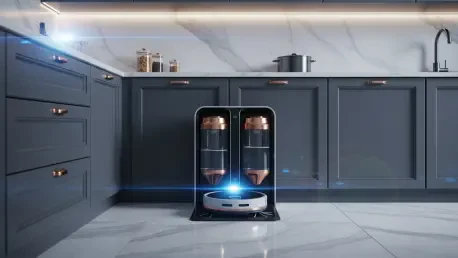

The home automation landscape shifted significantly when Dyson finally decided to integrate its legendary suction power with a dedicated mopping system, promising to eliminate the human element from floor maintenance. The Dyson Spot+Scrub represents more than just a brand expansion; it is an ambitious attempt to solve the “last mile” of robotic cleaning—the stubborn, dried-in stains that typical robomops merely dampen and smear. This review examines whether this high-tech entry truly revolutionizes domestic chores or if it remains a beautiful piece of engineering hindered by practical limitations.
Evolution of Autonomous Floor Care and the Dyson Entry
For years, the robotic cleaning market was split between vacuums that could barely wet a cloth and dedicated mops that lacked suction. Dyson’s entry into this space marks a transition toward unified intelligence, where a single machine manages both dry and wet debris without user intervention. By merging its Hyperdymium motor technology with a pressurized scrubbing module, Dyson aims to move beyond the simple “set and forget” mentality toward a more proactive, reactive cleaning experience.
This shift is crucial because modern households demand more than basic pathing; they require robots that understand the difference between a dust bunny and a spilled coffee stain. The Spot+Scrub reflects a broader industry trend where the focus has moved from “how much can it pick up” to “how well does it see.” This context is essential for understanding why Dyson prioritized onboard vision and machine learning over traditional mechanical simplicity.
Sophisticated Cleaning Technology and Performance
The AI Spot+Scrub System and Stain Detection
The heart of the device lies in its proprietary AI-driven vision system, which utilizes a high-definition camera to monitor floor conditions in real-time. Unlike competitors that rely on pre-programmed moisture levels, the Dyson identifies specific visual anomalies on the floor and classifies them as stains. Once a mess is detected, the robot does not just pass over it; it pauses, increases downward pressure, and initiates a localized scrubbing cycle until the visual feedback confirms the floor is clean.
This implementation is unique because it removes the guesswork from the cleaning process. The machine learning algorithms are trained to recognize various textures, from dried mud to sticky syrup, adjusting the water flow and agitation speed accordingly. This level of autonomy ensures that water is used efficiently and only where needed, preventing the over-saturation of delicate wood floors while providing intensive care for tiled surfaces.
Suction Capabilities and Carpet Maintenance
While the scrubbing feature is the headline, the vacuuming performance remains consistent with the brand’s reputation for high-velocity airflow. The robot utilizes a multi-stage filtration system that captures microscopic particles, making it particularly effective for homes with pets or allergy sufferers. On carpets, the unit automatically boosts its suction, pulling deep-seated grit from the base of the fibers, a task where most robotic mops usually compromise.
The dry debris removal is handled by a wide brush bar that covers a significant portion of the machine’s footprint. This design choice minimizes the number of passes required to clear a room. However, the reliance on high-performance suction does mean the battery life can fluctuate significantly depending on the floor type, as the motor works harder to maintain the necessary static pressure on high-pile rugs.
Current Trends in the Robotic Maintenance Industry
The industry is currently moving toward “hands-off” ecosystems where the human operator is only required for monthly maintenance rather than daily upkeep. Multi-functional docking stations have become the gold standard, providing automated water refilling and dustbin emptying. Dyson has followed this trend but emphasized the hygienic aspect of the process, ensuring that the damp mop pads are dried with heated air to prevent bacterial growth and unpleasant odors.
Furthermore, there is a visible move toward high-definition spatial awareness. Consumers no longer tolerate robots that bump into furniture or get tangled in charging cables. The current standard involves sophisticated LiDAR and vision-based mapping that allows the device to navigate complex environments with surgical precision. Dyson’s integration of these technologies reflects a market that prizes structural awareness as much as cleaning power.
Real-World Applications and Deployment Scenarios
In a typical modern home, the Spot+Scrub shines in high-traffic areas like kitchens and mudrooms where stains are frequent. For instance, the robot can detect a dried juice spill under a dining table and prioritize that area during its routine. Its ability to transition between hardwood scrubbing and carpet vacuuming without cross-contaminating the rug with moisture is a significant advantage for open-plan living spaces.
Beyond general cleaning, the AI-driven targeting allows for unique implementations in homes with varied flooring. The robot can be programmed to perform a “deep scrub” in the kitchen while maintaining a “light suction” mode in the bedroom. This flexibility is essential for users who want to customize the care of different materials without having to swap out attachments or manually adjust settings via an app every time the robot moves.
Navigational Constraints and Logistical Challenges
Physical Design and Clearance Limitations
Despite the advanced sensors, the physical architecture of the Spot+Scrub presents some hurdles. The unit lacks an extendable side arm for its scrubbing module, which means it cannot reach deep into corners or under the shallow overhangs of kitchen cabinets. This creates a “dead zone” of about an inch along the perimeter of the room that still requires manual attention, a frustrating trade-off given the device’s premium positioning.
The height of the unit also poses a challenge for those with low-profile furniture. While the top-mounted sensors provide excellent room mapping, they add physical bulk that prevents the robot from sliding under certain bed frames or bathroom vanities. In many cases, the device might wedge itself in tight spots, requiring the user to physically intervene and reset the cleaning cycle, which defeats the purpose of an autonomous system.
Software Discrepancies and Multi-Floor Management
The software side of the experience reveals further logistical bottlenecks, particularly for multi-story homes. While the app can store multiple maps, the robot’s self-cleaning logic is tied strictly to its base station. If the unit finishes a cleaning task on a floor without a dock, it returns to its starting point but does not prompt the user to bring it back to the station for essential maintenance like pad washing or tank drying.
This disconnect can lead to stagnant water sitting in the machine if the user forgets to manually initiate a dock return. Furthermore, the mapping interface occasionally struggles with “no-go” zones around complex furniture. Without a clear way to label specific items in the app, users often find themselves guessing where to place digital barriers, leading to missed patches or the robot attempting to clean areas it cannot actually navigate.
Future Outlook and Technological Refinement
Looking ahead, the evolution of this technology will likely focus on mechanical flexibility. The next iteration of hardware could benefit from articulating scrubbing heads or extendable brushes to resolve the edge-cleaning deficit. As manufacturers refine these designs, the goal will be to ensure that no corner is left untouched, finally achieving the promise of a truly zero-manual-effort cleaning solution.
On the digital front, more intuitive mapping software that uses object recognition to label furniture automatically would solve many current frustrations. Imagine an interface where the robot identifies a “sofa” and asks if it should venture underneath, rather than requiring the user to draw arbitrary boxes. As docking requirements become more flexible, perhaps through smaller satellite charging pads, the logistical issues of multi-floor maintenance will likely dissipate.
Final Assessment of the Dyson Spot+Scrub
The Dyson Spot+Scrub proved to be a sophisticated, if occasionally temperamental, addition to the smart home. It successfully demonstrated that AI vision can effectively replace the “spray and pray” method of traditional mopping, offering a level of targeted cleaning that was previously unavailable. However, the physical constraints regarding edge cleaning and the rigid docking logic highlighted that even the most advanced software cannot always overcome hardware limitations.
Moving forward, the industry should prioritize universal docking compatibility and more aggressive mechanical reach to ensure these machines can handle the diverse architecture of global homes. While the device set a high bar for stain detection, the true victory for future models will lie in refining the software-to-hardware communication to handle multi-floor logistics seamlessly. Ultimately, this technology served as a vital stepping stone toward a future where floor care is entirely invisible to the homeowner.