
Grilling is fundamentally a primal act of fire, smoke, and perception, yet the modern backyard cook often struggles to balance that “Zen” of manual airflow with the desire for a perfect result. Recent innovations in aftermarket technology have changed the landscape, allowing enthusiasts to “soup up” traditional charcoal and ceramic cookers with sensors and fans that mimic the precision of an indoor oven. By integrating PID controllers and modular hubs, these tools bridge the gap between ancient techniques and digital convenience, turning a standard kettle into a high-performing smart machine.
Traditional charcoal grills are prized for their longevity, yet adding sensors and fans introduces digital failure points. How can a griller balance the simplicity of a classic kettle with these high-tech components, and what specific maintenance ensures these aftermarket attachments outlast the grill itself?
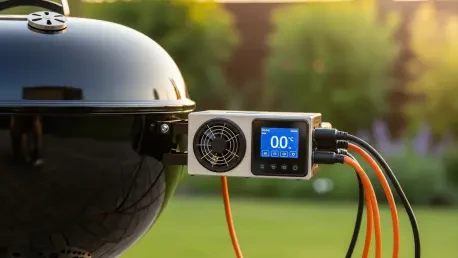
The most resilient path for any pitmaster is to keep the grill “dumb” while making the technology modular and upgradable. A Weber Kettle is essentially forever because it is simple and durable, but all-in-one smart cookers can become expensive “black boxes” if a manufacturer discontinues an app or a sensor fails. By using an aftermarket controller like the Spider Grills Venom, you retain the ability to swap out the tech without having to replace the entire $1,000-plus machine. To ensure longevity, treat these components like specialized kitchen electronics rather than hardware store tools; keep them shielded from the elements when not in use and use stable power sources. I often use a heavy-duty extension cord for the Venom, though a dedicated $50 mountable battery pack is a great way to keep the setup portable and free from the wear and tear of dragging cables across a patio.
PID controllers are designed to predict temperature swings rather than just reacting to them. How does this technology change the way air is managed in a standard kettle grill, and what manual adjustments should a cook still make to the top vent to achieve a perfect sear?
The introduction of a Proportional-Integral-Derivative (PID) controller, like the one found in the Venom or high-end espresso machines, shifts the grill from a reactive tool to a predictive one. Instead of waiting for the temperature to drop and then blasting the coals with air, the system measures temperature differentials moment by moment to keep things stable. Even with this automation, the cook still plays a vital role in managing the “exhaust” side of the equation by manually adjusting the top vent according to the app’s guidance. For a perfect sear at higher temperatures—around 450 to 475 degrees Fahrenheit—you want that top vent open enough to allow the fan to feed the fire without choking it, though you should expect a slight overshoot of about 25 degrees before the PID logic levels the heat out for that admirable charcoal-flavored crust.
Ceramic grills hold heat exceptionally well but are notoriously difficult to cool down once they overshoot a target temperature. How do modular fan systems mitigate this “thermal mass” problem, and what steps should be taken to sync wireless probes and hubs reliably across a weak outdoor signal?
Ceramic cookers like the Kamado Joe or Big Green Egg are famous for holding heat like a mother’s embrace, but that thermal mass is a double-edged sword if you let the temperature get away from you. Modular fan systems like the ChefsTemp Breezo mitigate this by strictly regulating oxygen intake from the start, preventing the “runaway train” effect of over-stoked lump charcoal. To ensure these modular parts—the fan, the hub, and the probes—actually talk to each other in a backyard with a weak signal, you must ensure you are using a 2.4-GHz Wi-Fi band, which offers the better range needed for outdoor cooking. If your house signal is truly cruddy, I recommend using a mobile hotspot or installing a mesh router system to bridge the 30-to-50-foot gap between your kitchen and the grill.
Smart grilling often relies on 2.4-GHz Wi-Fi signals which can be spotty in backyards. Beyond using mobile hotspots, what infrastructure or setup changes are necessary to ensure a stable connection between the meat probes, the fan, and the phone app during a twelve-hour brisket cook?
For a long-haul cook like a twelve-hour brisket, signal stability is as important as your fuel source. Beyond the hotspot trick, the best infrastructure change is to move toward a dedicated mesh Wi-Fi system that specifically pushes a 2.4-GHz signal into the backyard. Some devices are persnickety about switching between Bluetooth and Wi-Fi, often requiring you to fully unpair the setup to change modes, which is the last thing you want to do while your meat is in a critical stall. You should also take the time to separate your 2.4 and 5-GHz bands on your router settings to ensure your phone doesn’t accidentally hop onto a faster, shorter-range signal and lose contact with the fan controller while you are inside the house.
Some purists prefer monitoring over automation by using hub devices without integrated fans. In what scenarios is it better to manually adjust charcoal than to rely on an automated airflow system, and how do app-based recipe timers specifically improve the results for a beginner?
Manual adjustment is often the preferred route for the “grilling Luddite” or the purist who views cooking as more artistry than science, as it minimizes the mechanical failure points of a fan. Using a device like the Weber Connect Smart Grilling Hub allows you to wander off and do yard work while still receiving an alert if the temperature dips, signaling that it’s time to manually add more charcoal. For a beginner, the app-based recipe timers act as a digital mentor, providing specific guidance on flip times and internal temperature targets for various cuts. This takes the guesswork out of the process, ensuring that even if you aren’t a “Zen master” of the vents yet, you won’t end up with a half rack of ribs that has turned to jerky.
Modifying a ceramic cooker with an automated controller involves attaching hardware to the front vent and replacing the stock thermometer. What are the common pitfalls during this physical installation, and how does a variable-speed fan specifically replicate the environment of a kitchen oven for low-and-slow barbecue?
The most common pitfall during installation is the physical fit of the fan adapter and the syncing of multiple wireless components; for instance, the ChefsTemp system requires four different devices to be charged and paired simultaneously. Replacing the stock thermometer with a digital hub like the ProTemp S1 is usually a simple “unscrew and replace” job, but the real magic happens with the variable-speed fan. By modulating exactly how much oxygen reaches the embers, the fan creates a steady, radiant heat environment that mimics a kitchen oven, allowing for that low-and-slow “sugar-bark” on a pork loin. This automation is particularly helpful on ceramic grills where there is no electric ignition, as it handles the difficult task of maintaining a specific 225-degree environment after you’ve manually lit your Tumbleweeds.
What is your forecast for the future of smart grill technology?
I predict that the industry will move away from “all-in-one” black-box machines and toward highly interoperable, modular ecosystems where the consumer owns the “brain” of the grill. We are seeing the beginning of this with brands like Weber and Big Green Egg releasing their own official digital controllers, but the real growth will be in third-party tech that can be moved from a kettle to a smoker to a ceramic egg seamlessly. As 2.4-GHz connectivity becomes more stable and PID algorithms become more refined, the “barrier to entry” for perfect barbecue will vanish, making professional-grade brisket and ribs a standard weekend achievement for the average backyard cook. In the end, the technology will become so transparent that we can stop worrying about the vents and get back to the primal enjoyment of the fire and the meat.